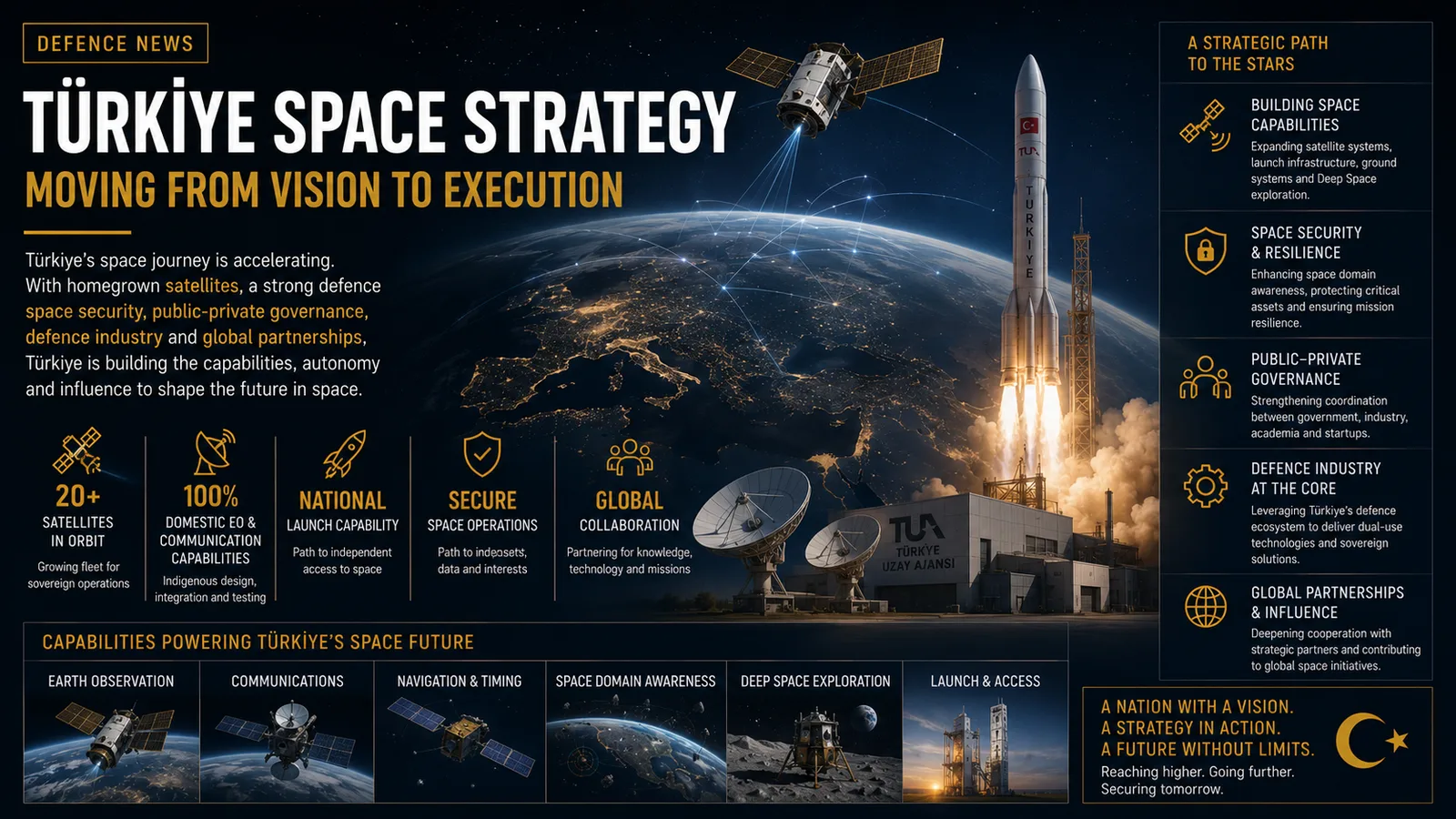
Türkiye space strategy is moving from vision to execution as satellites, national-security needs, public-private governance and defence-industrial capacity reshape the country’s path to the stars.
A SAHA Blog analysis argues that space ambition is not only about prestige. It is an industrialisation project, a scientific-development agenda and a national-security requirement. The article’s central message is clear: reaching space requires governance as much as technology.
The phrase per aspera ad astra, from hardship to the stars, fits Türkiye’s space challenge. The country has already built a strong defence and aerospace ecosystem. The next task is to convert that industrial base into a mature space economy.
Türkiye Space Strategy Starts With Industrial Policy
The original Cold War space race was not only a race for astronauts and flags. Behind every mission stood a deep industrial base: propulsion, materials, electronics, computing, communications, systems engineering and advanced manufacturing.
That lesson remains relevant. Space capability is built through long-term industrial policy. Satellites, launch systems, ground infrastructure and space-domain awareness require companies, universities, laboratories and government users to work under a shared roadmap.
For Türkiye, this makes space a natural extension of the National Technology Initiative. The objective is not simply to send objects into orbit. The objective is to create a national ecosystem that can design, produce, operate and protect space systems.
Public-Private Governance Is the Core Requirement
Modern space programmes increasingly depend on public-private governance. Governments define missions, security requirements and national priorities. Private companies deliver speed, engineering capacity, manufacturing scale and operational innovation.
NASA’s Commercial Crew Program shows how this model works in practice. NASA says the programme provides safe, reliable and cost-effective transportation to the International Space Station through partnership with American private industry. It also allows NASA to focus more resources on deep-space missions while companies provide low-Earth-orbit transportation services.
The lesson for Türkiye is not to copy the American model directly. The lesson is to create clear mission ownership, predictable demand and industry-facing procurement models. Space companies need customers, testing opportunities, data access, certification pathways and long-term mission portfolios.
The Turkish Space Agency Gives the Strategy an Anchor
The Turkish Space Agency gives Türkiye space strategy an institutional anchor. The National Space Program identifies goals such as developing required technologies, infrastructure and skills in the space domain; reducing foreign dependence; using space technologies as a driver for national development; and advancing sustainable indigenous technological development.
These goals are strategically important because they connect space to national capacity. A space programme should not sit apart from industry, education, security, telecommunications, disaster management or digital transformation. It should multiply them.
The governance challenge is coordination. Türkiye needs a system that can identify national needs, translate them into space missions, assign industrial responsibilities, manage funding and track delivery. Without that discipline, space ambition can remain fragmented.
Space Is Now a National-Security Domain
Space is no longer a distant scientific environment. It is part of daily military and economic infrastructure. Communications, navigation, intelligence, weather data, missile warning, financial timing, maritime tracking and disaster response all depend on space-enabled services.
NATO declared space an operational domain in 2019. NATO also states that space data, products and services directly support air, land, maritime and cyber operations. This shows why space has become a defence-planning issue for every serious military power.
Türkiye’s space policy therefore cannot be only civilian. It must include defence users, intelligence requirements, resilient communications, space-domain awareness, secure ground infrastructure and protection against cyber and electronic threats.
Türksat 6A Shows Strategy Can Become Industrial Product
Türksat 6A is a practical milestone for Türkiye space strategy. Türkiye’s first domestically produced communications satellite was launched in July 2024 and commissioned in April 2025. Türksat says the satellite expands the company’s service area to include India, Thailand, Malaysia and Indonesia, increasing the population reached by Türkiye’s satellites from 3.5 billion to 5 billion.
The significance is industrial as much as operational. A communications satellite requires systems engineering, payload design, software, ground segment integration, testing, qualification and mission operations. These capabilities are transferable across the wider space economy.
Türksat 6A should therefore be treated as a platform for learning. The next step is to deepen the supplier base, expand national subsystems, strengthen space-grade manufacturing and connect satellite capability to exportable services.
IAC 2026 Antalya Can Become an Ecosystem Platform
The 77th International Astronautical Congress will take place in Antalya, Türkiye, on 5–9 October 2026. The official IAC 2026 website states that this will be the first time the congress is hosted in Türkiye.
This creates an opportunity beyond event visibility. IAC 2026 Antalya can help Türkiye position its space ecosystem in front of agencies, primes, universities, start-ups, investors, astronauts, policymakers and international organisations.
The strategic question is how to convert the congress into long-term value. Türkiye should use the platform to build partnerships, attract investment, showcase national capabilities, connect young talent to global networks and launch concrete cooperation tracks.
Space Governance Needs High-Level Coordination
The SAHA Blog article argues that space governance requires national-level direction, policy production, guidance, needs analysis, R&D planning, procurement and education. This is the right framing.
Space missions cross institutional boundaries. A single satellite programme can involve defence, communications, transport, agriculture, disaster management, finance, industry, science and foreign policy. Without a coordination mechanism, each user may pursue separate systems and duplicate spending.
A stronger Türkiye space strategy should therefore include a high-level coordination board, a national mission portfolio, shared testing infrastructure, clear procurement rules and measurable milestones for industry participation.
Defence Industry Is the Bridge to Space Capability
Türkiye’s defence industry is one of the country’s strongest bridges into space. Defence companies already work with avionics, sensors, secure communications, electronic warfare, propulsion, mission software, command-and-control, radar, composite materials and systems integration.
Many of these skills are dual-use. The same ecosystem that supports aircraft, UAVs, missiles, naval systems and C4ISR can also support satellite subsystems, ground stations, space-domain awareness tools and secure space communications.
The challenge is qualification. Space systems require reliability, radiation tolerance, thermal control, launch survivability, long-duration operations and strict quality assurance. Defence firms can enter this market, but they need space-specific standards, testing infrastructure and mission heritage.
The Space Economy Requires Market Formation
The OECD describes the space economy as all activities and resources that contribute to human progress through space exploration, research, management and utilisation. It also notes that space systems now support critical infrastructures and services across sectors such as transportation, energy, food supply and law enforcement.
This matters for Türkiye because space companies cannot grow only through symbolic projects. They need real markets: Earth observation data, secure satellite communications, IoT connectivity, precision agriculture, maritime tracking, disaster response, climate monitoring and defence services.
Government demand can create the first market. Commercial demand can then scale it. The strongest model is not state versus private sector. It is state-led market formation with private-sector execution.
Space Sustainability Must Be Part of the Strategy
More satellites create more capability, but they also create more risk. The OECD warns that growing space activity increases the threat from space debris and requires public-private action, international cooperation, new technologies and policy innovation.
Türkiye’s space strategy should include space sustainability from the beginning. This means debris mitigation, responsible operations, collision-avoidance capability, end-of-life planning, space-domain awareness and participation in international norms.
Responsible behaviour in orbit is not only an ethical issue. It is also a strategic advantage. Countries that operate safely and transparently will be more attractive partners in global space cooperation.
A Practical Roadmap for Türkiye Space Strategy
A practical roadmap should begin with mission discipline. Türkiye should define which space missions are most important for national security, economic value and technological learning.
The first priority should be satellite capability: communications, Earth observation, navigation augmentation, meteorology, disaster response and space-domain awareness. These missions have direct public value and clear defence relevance.
The second priority should be industrial depth. Türkiye needs more space-qualified suppliers, national payload technologies, testing centres, ground-segment capabilities, secure software and mission-operations capacity.
The third priority should be talent. Space programmes need systems engineers, orbital analysts, software developers, propulsion engineers, materials experts, mission operators, cyber-security specialists and space-law professionals.
The fourth priority should be international partnership. Türkiye should use its NATO role, IAC 2026 visibility, commercial partnerships and regional diplomacy to build cooperation in missions where shared infrastructure and data can create mutual value.
The Main Risk Is Fragmentation
The biggest risk for Türkiye space strategy is fragmentation. Space activity can spread across too many institutions, companies and symbolic projects without enough mission focus.
Fragmentation weakens scale. It produces duplicated spending, slow learning and limited export potential. It also prevents companies from building mission heritage, which is one of the most important currencies in the global space market.
The solution is not excessive centralisation. The solution is coordinated decentralisation: a clear national strategy, strong agency leadership, competitive industry participation and measurable mission outcomes.
From Hardship to the Stars
Türkiye space strategy is now entering a decisive phase. The country has national institutions, an expanding defence and aerospace ecosystem, satellite milestones, international visibility and growing public interest in space.
The next challenge is execution. Space power is built through patient governance, industrial depth, reliable funding, talent pipelines, test infrastructure and mission continuity.
If Türkiye can connect its public institutions, private companies, universities and defence ecosystem under a disciplined space roadmap, the country can move from symbolic milestones to sustainable space capability. That is the real meaning of per aspera ad astra: from hardship to the stars, through organisation, engineering and national will.
For further Defence Agenda coverage, read our space, defence technology and aerospace sections. Related analysis includes 5G military communications and next-generation weapon systems, digital troops and battlefield command and AUKUS defence technology partnership.