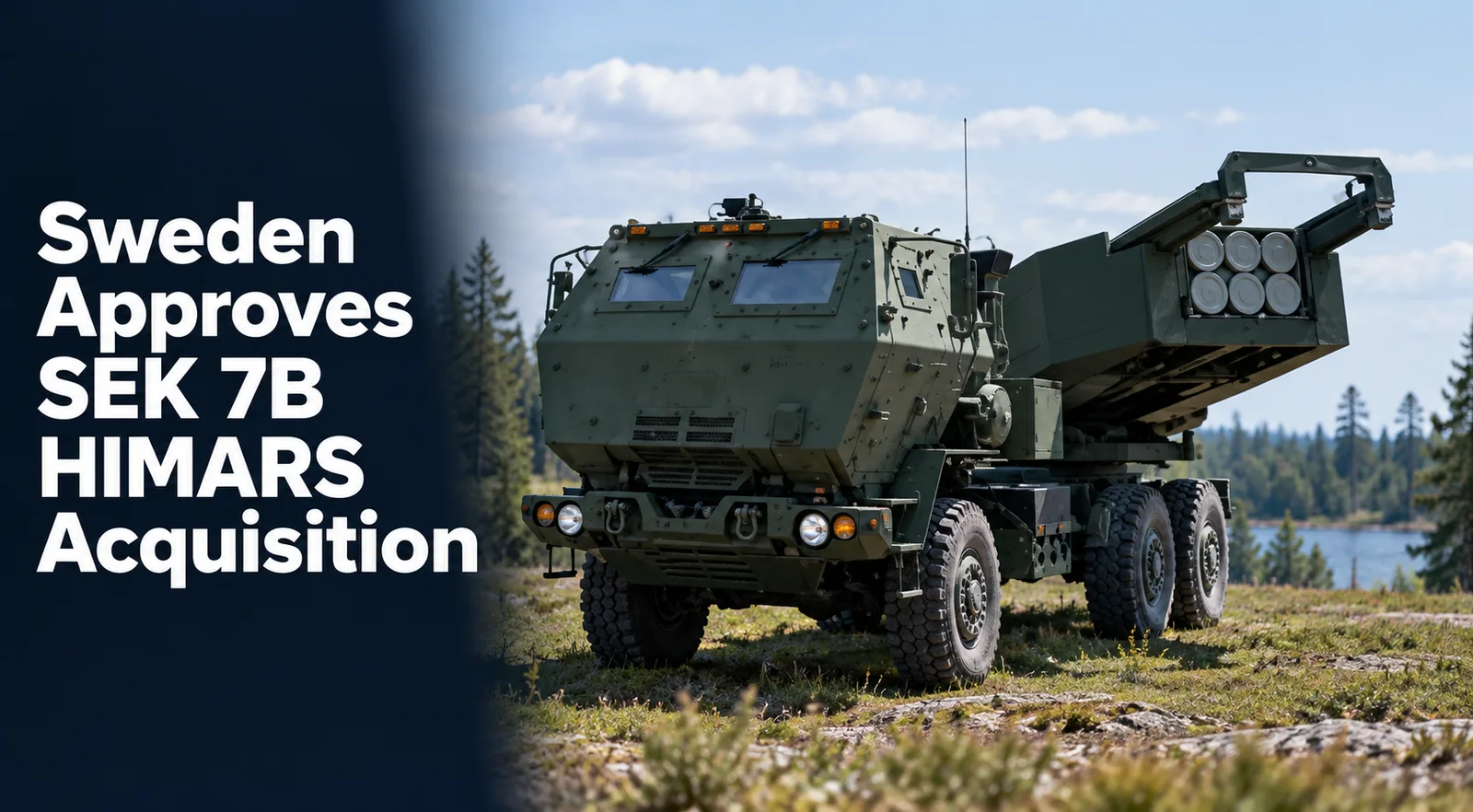
The Swedish Government has authorised the Armed Forces to procure Lockheed Martin’s High Mobility Artillery Rocket System in a programme valued at around SEK 7 billion, roughly $730 million. The decision was announced on 7 September 2026, with first deliveries planned for 2027. Stockholm says the system will provide reach beyond Sweden’s existing conventional artillery and complement platforms such as Archer.
HIMARS Gives Sweden a New Long-Range Fires Layer
The acquisition is being treated as an ‘opportune purchase’ because Sweden wants capability quickly. HIMARS is already fielded by several NATO allies and shares ammunition families and support relationships with Finland’s MLRS fleet. That interoperability reduces some of the risks associated with introducing a new long-range fires architecture, particularly for training, sustainment and coalition operations.
The Finnish Cooperation Track Extends Beyond a Hardware Purchase
Sweden and Finland signed a Joint Declaration covering rocket-artillery training, education, capability development, maintenance, security of supply and production cooperation. The arrangement is important because northern European operations would likely require the two countries to coordinate fires and logistics in the same theatre. Common or compatible ammunition and procedures can reduce friction during combined operations.
The agreement also links acquisition policy to industrial resilience. A launcher is only useful if rockets, spare parts, trained crews and maintenance capacity remain available during sustained operations. By building cooperation around sustainment and production at the same time as the purchase, Sweden is trying to avoid treating HIMARS as a stand-alone vehicle acquisition.
GLSDB and Munitions Cooperation Could Expand the Industrial Dimension
The Swedish government says Saab and Lockheed Martin are signing a separate Joint Declaration covering potential integration of Saab’s Ground-Launched Small Diameter Bomb and cooperation on ammunition production for HIMARS and other systems, including Patriot. That does not yet constitute a funded integration or production contract, but it creates a pathway for Swedish industry to participate in the wider fires ecosystem.
Potential GLSDB integration would be strategically relevant because Sweden already has industrial and technical knowledge associated with the weapon. Local or regional ammunition production could also improve security of supply as NATO members expand long-range fires inventories. The economic and operational impact will depend on whether the declarations become specific contracts with defined quantities and production locations.
Delivery Quantity and Ammunition Mix Remain Key Details
The government has disclosed the approximate programme cost and first-delivery year but has not publicly provided the full launcher quantity and ammunition mix in the announcement reviewed here. Those details will determine the actual scale of the Swedish capability and how quickly units can train at meaningful tempo. Launcher numbers alone are not sufficient because precision-fires readiness depends heavily on stocked munitions and reload capacity.
The next milestones are contract execution, first deliveries in 2027, establishment of Swedish training and support infrastructure, and any follow-on agreement on GLSDB or ammunition production. Until then, the decision should be described as an authorised HIMARS procurement with Nordic cooperation and industrial discussions attached, not as proof that every planned integration has already been completed.
A further programme-management issue is the relationship between the announced milestone and the supporting infrastructure needed to turn it into repeatable capability. Training, maintenance, software configuration, supply-chain availability and acceptance standards can all become schedule drivers after the public announcement. For that reason, Defence Agenda will track follow-on evidence from the customer, supplier and relevant government authority rather than treating the initial milestone as the end of the acquisition cycle.
Implications / Next
The next Defence Agenda update should be tied to a dated, independently verifiable event that changes programme maturity: a delivery, exercised option, completed test, production milestone, operational acceptance or new contract action. Until that occurs, the current announcement should remain the baseline and should not be extrapolated into undisclosed quantities, performance or fielding status.