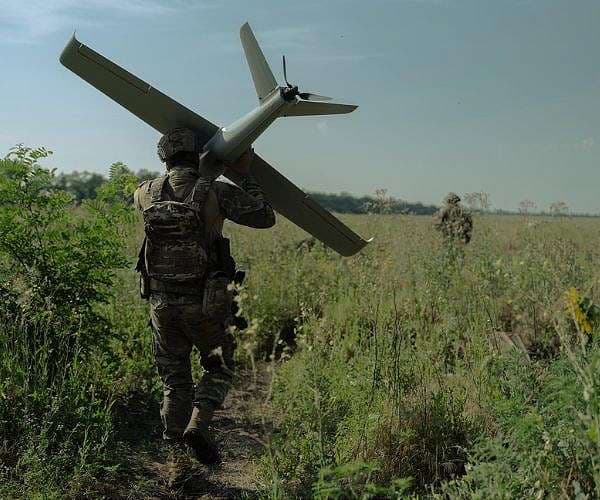
Drone wars are changing the economics of military power. A relatively inexpensive uncrewed aircraft can force an opponent to divert air-defence crews, sensors and interceptors, even when the drone never reaches its target. On 16 October 2026, NATO described expanded trials linking different counter-drone systems into a shared defensive network. Three days later, Ukraine’s Ministry of Defence published fresh mission-reporting data showing the industrial and operational scale of drone use. The central lesson is not that cheap aircraft always win. It is that militaries must now compete over production volume, adaptation speed and the cost of each successful defence.
The 16 October NATO Allied Command Transformation announcement described Crucible 4-26, an experiment designed to connect multiple counter-uncrewed aircraft system (C-UAS) cells across national and technical boundaries. In a separate 19 October Ukrainian defence ministry update, the government reported more than three million strike-mission records in its DELTA Mission Control system as of 1 October. These are operational reporting records, not three million independently verified successful strikes.
The contrast explains why drone warfare has become an industrial question as well as a battlefield question. Attackers seek inexpensive ways to generate persistent pressure; defenders must respond at sustainable cost and without exhausting limited stocks intended for more demanding missile and aircraft threats. Governments are consequently investing in low-cost interceptors, shorter procurement cycles and interoperable networks rather than treating drones as isolated pieces of equipment.
Why Do Cheap Drones Change the Cost of War?
The conventional acquisition model frequently rewards individual platform performance: range, payload, survivability, sensor quality and reliability. Drone wars add a different question: how much capability can a force generate, replace and update over thousands of missions? An attritable aircraft does not have to match a high-end missile or fighter in every technical category to impose meaningful costs on an adversary.
The best-known example is the mismatch between one-way attack drones and certain missile interceptors. CSIS has described Shahed-type attack drones as a lower-cost way for Russia to create repeated long-range strike pressure. A separate CSIS assessment of drone defence cites typical Ukrainian interceptor-drone costs of roughly USD 2,000–4,000 and a roughly USD 4 million example for a Patriot interceptor. Those figures illustrate why an appropriate low-cost defensive layer matters; they are not interchangeable quotations for every drone or missile variant.
The relevant measure is not simply price of attacker versus price of interceptor. A complete cost-exchange calculation includes detection, command-and-control, maintenance, operator training, ammunition stocks, the probability of success, possible damage to the defended asset and the opportunity cost of consuming scarce interceptors. Firing an expensive missile can be rational if the defended infrastructure or human lives at risk justify it. Conversely, choosing a cheap defence that repeatedly fails may cost more overall.
A 19 February 2025 CSIS study reached an important qualification: many Russian drones were intercepted or failed, but lower unit prices still made the long-range campaign economically relevant. Its estimates depend on reporting periods and uncertain munition prices, and cannot serve as a definitive unit-cost schedule for 2026. In this context, cheap means affordable enough to field and replenish at scale, not guaranteed to achieve a favourable military outcome.
Illustrative Cost Comparison, Not a Procurement Price List
| Capability | Indicative figure in cited analysis | Interpretation and limitation |
|---|---|---|
| Small FPV attack drone | USD 600–1,000 in a CSIS 2025 case study | Case-specific estimate; payload, navigation and support costs vary substantially. |
| Shahed-type one-way attack drone | About USD 35,000 in a CSIS 2025 estimate | Historic approximate figure, not a universal 2026 Russian contract price. |
| Ukrainian drone interceptor | About USD 2,000–4,000 in a 2026 CSIS analysis | Indicative system range; engagement outcome and supporting network also matter. |
| Patriot missile engagement | Roughly USD 4 million per interceptor in the same analysis | An illustrative expensive missile layer; variant and contract prices differ. |
These values are drawn from different systems, estimates and dates, and should not be multiplied into precise battlefield savings without comparable engagement data. The correct procurement question is the expected total cost per successfully neutralised threat, assessed alongside coverage, response time, capacity and the consequences of failure.
Drone Wars in Ukraine: From Individual Systems to Mass Procurement
Ukraine provides unusually detailed public evidence that drone operations are moving from improvisation towards an institutional supply chain. On 17 July 2026, the defence ministry disclosed UAH 333.6 billion in drone contracts signed during the first six months of the year, describing that as double the equivalent 2025 contract value. The amount refers to contracted procurement, not necessarily equipment delivered, accepted or paid for by July.
The ministry also reported that first-person-view (FPV) drones comprised the largest share of contracted drone categories. Its digital DOT-Chain Defence marketplace allows eligible combat units to select approved equipment using allocated resources while the Defence Procurement Agency handles contracting and logistics. Ukraine said in July that in-stock marketplace orders had an average delivery time of nine days. That is a reported average for a specific transaction class, not a promise applying to every procurement.
The breadth of the supply ecosystem is striking. A 22 September ministry release recorded 650 UAS models codified and approved since January, including 238 strike-copter types, 231 fibre-optic-controlled types and 42 interceptor-drone types. Authorisation does not establish mass production, fielded inventory or combat effectiveness for each model. It does, however, show the speed at which equipment choices and technical requirements can change.
A fresh 19 October update on DOT-Chain Defence said one in five drones purchased by the agency had been delivered through that marketplace since its July 2025 launch, and that more than 500 combat units used the service. These are ministry-reported programme figures. They underline that digital procurement, selection and replenishment are themselves becoming operational capabilities.
Why Air Defence Cannot Rely on Expensive Missiles Alone
Large one-way attack drone waves force defenders to protect numerous possible targets while reserving sophisticated surface-to-air missiles for high-end threats. A system optimised to intercept ballistic missiles should not be the default response to every slow propeller-driven aircraft. Yet neither guns, electronic warfare nor inexpensive interceptor drones can counter every threat in every environment.
In a 28 July 2026 assessment, RUSI airpower analyst Justin Bronk described Ukraine’s use of layered short-range air defence, including anti-aircraft guns, mobile teams and interceptor drones, against large Russian strike waves. He also identified missile resupply and the pressure placed on fighter flying hours as major constraints. The lesson is defensive differentiation: lower-cost tools should carry a suitable share of the workload so more capable systems remain available when their specific performance is needed.
Ukraine’s 30 April procurement announcement for 8,000 Octopus interceptor drones illustrates an industrial response. Officials said the system was designed for Shahed-type targets and was being scaled through licensed manufacturers, including international industrial participation. A procurement announcement does not prove that all units were delivered or that every engagement succeeds.
There is a further limitation to the price argument. Weather, target speed, electronic interference, sensor coverage, operator availability and the protection of civilian infrastructure influence the choice of defensive method. Affordability matters only when the defensive system can be deployed and operated effectively across the required area.
NATO’s 2026 Response: A Network, Not a Single Anti-Drone Weapon
NATO's latest experiments reflect this broader systems view. The 16 October Allied Command Transformation statement described C-UAS cells that connect sensors, command-and-control functions and effectors. Crucible 4-26 seeks to examine whether multiple such cells can exchange information and operate across nations and suppliers. The announcement did not claim that a universal cross-Alliance counter-drone architecture was already operational.
This distinction is central for procurement authorities. Buying a detection radar, a jammer or an interceptor does not automatically create a coherent air-defence system. Interfaces, track quality, data latency, identification standards, training, cyber resilience and rules of engagement all influence whether separately purchased components work together. Suppliers able to demonstrate interoperability may gain a greater advantage than suppliers offering impressive isolated demonstrations.
At the NATO Summit Defence Industry Forum on 7 July 2026, Allies announced plans to invest more than USD 40 billion in counter-drone capabilities over five years and to train five times as many drone operators by the end of 2027. NATO also described a marketplace for NATO-tested, NATO-compatible systems. Announced investment intentions and operator targets should be assessed separately from national budget appropriations, signed supplier contracts and operational deployments.
The defence-industrial significance is that demand is expanding from drone airframes into a broad ecosystem: detection, identification, communications, engagement management, affordable effectors, simulation, testing and maintenance. For smaller manufacturers, certification and interoperability may prove as important as rapid prototyping.
The Industrial Race: Can Production Keep Up With Battlefield Losses?
Drone warfare combines relatively short product cycles with an intense demand for repeat purchases and software upgrades. Governments want large quantities of systems, but they also need consistent reliability, traceable components, secure communications and assured access to batteries, motors, sensors and semiconductors. Cheap assembly is not the same as a resilient national supply chain.
An Associated Press investigation published in October 2026 highlighted Ukraine’s reliance on Chinese-made drone components despite efforts to diversify. Dependency on outside suppliers can put a cost advantage at risk when export restrictions, component shortages or industrial competition disrupt procurement. The issue is not limited to Ukraine: any state pursuing mass-produced uncrewed systems must examine the origins and replaceability of critical parts.
The UK government’s 18 June 2026 announcement offers another scale indicator: a £752 million package supporting 150,000 Ukrainian-produced drones as well as more than 350 air-defence missiles and radar systems by year-end. It would be inaccurate to divide the entire funding package by the number of drones and describe the result as a unit price, because the package finances multiple equipment categories.
For Türkiye, European defence industries and other NATO suppliers, the competitive opportunity lies in proven and supportable product families rather than the promise of one exceptionally inexpensive prototype. Modular designs, repeatable manufacturing, software support, certification evidence and reliable integration into partner networks will all affect commercial adoption. This is an industrial assessment, not evidence of any specific contract award to a Turkish supplier.
Are Cheap Drones Better Than Missiles, Aircraft or Artillery?
Not categorically. Small drones generally offer limited payload, variable weather tolerance and important constraints on speed, endurance and survivability. Larger one-way attack drones can cover greater distances, but are still vulnerable to layered defences and may carry substantially less destructive effect than heavy missiles. Persistent observation is valuable, but holding territory, protecting cities and disrupting protected targets still require combined-arms capabilities.
Another misunderstanding concerns the word swarm. A large group of aircraft launched at similar times does not necessarily constitute an autonomous swarm capable of distributed decision-making. Many current mass attacks rely on predetermined navigation, remote control or independently tasked aircraft. Claims of machine-led cooperative behaviour require specific technical evidence rather than the number of drones launched.
Recent combat also shows that the cost of failure must be considered alongside the cost of a platform. A cheap drone that misses, is jammed, or lacks the intelligence required to reach a militarily relevant target is not automatically economical. Equally, a defensive interceptor that costs more than the attacking aircraft can still protect assets and civilians of far greater value. Defence Agenda’s broader review of drone warfare and AI examines the complementary roles of uncrewed systems, conventional firepower and ground forces.
Implications / Next: What to Watch in 2027
First, NATO will need to show whether connected counter-UAS cells can transition from experimentation to repeatable operational interoperability across deployed formations. Useful evidence would include accepted technical standards, funded procurement, fielding decisions and performance measured under realistic limitations, rather than a single trial demonstration.
Second, Ukraine’s programme should be monitored through delivered systems, procurement fulfilment, sustainment and independent outcome assessment. The 19 October DELTA Mission Control figures indicate the volume of reported activities; they should not be confused with confirmed destruction of targets or uniformly successful missions.
Third, the critical industrial variables will be unit production capacity, time-to-replace, component availability and the affordability of an entire defensive engagement. Policymakers should ask not simply which drone costs least, but whether it fits a force-wide architecture that can continue working after weeks or months of attrition. Defence Agenda’s coverage of NATO’s counter-drone spending plans provides the wider procurement context, while its report on the Millerovo drone facility illustrates why launch infrastructure, production and operational employment need to be evaluated separately.
Conclusion
Cheap drones are changing warfare because they compress the cost of generating military pressure and accelerate the contest between attack, defence and industrial replenishment. Yet their value is conditional: successful strikes, sustainable interception, logistics, integration and human decision-making remain decisive. The 2026 evidence points not to the end of traditional military systems, but to a new requirement to combine affordable mass with competent, layered defence and adaptable production.
Further Reading
- NATO Allied Command Transformation: NATO Scales Counter-UAS Experimentation — 16 October 2026
- Ukraine Ministry of Defence: DELTA Mission Control Records — 19 October 2026
- Ukraine Ministry of Defence: First-Half Drone Contracts — 17 July 2026
- NATO: Counter-Drone Investments and Training — 7 July 2026
- RUSI: Four Years On, the Air War Over Ukraine — 28 July 2026
- CSIS: Counter-Drone Strategy and Interceptor Costs
- Defence Agenda: Drone Warfare 2026 — AI, Robots and Swarms
- Defence Agenda: NATO Counter-Drone Capabilities Get $40bn Investment