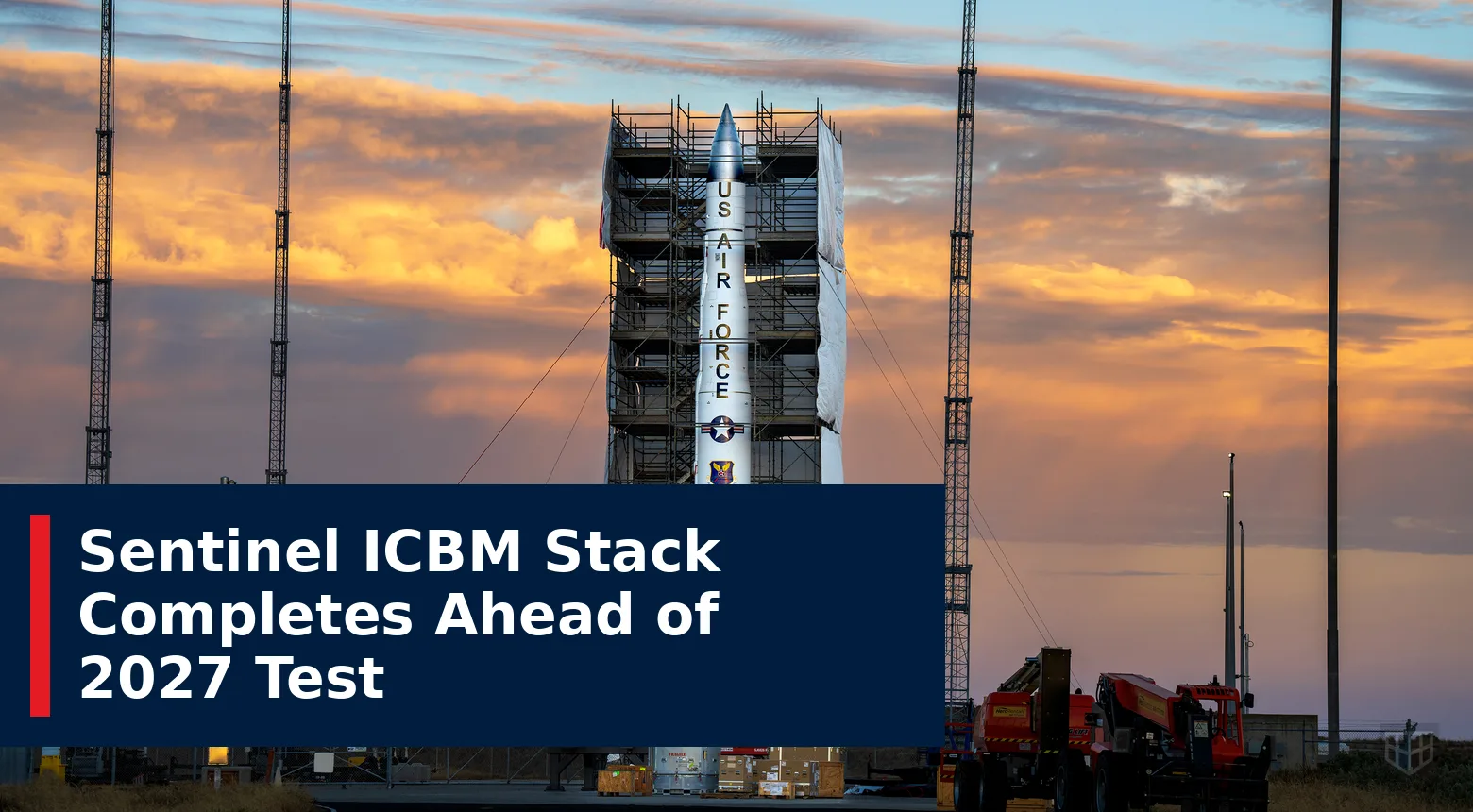
The US Air Force and Northrop Grumman have completed vertical assembly of an inert LGM-35A Sentinel stack ahead of a planned 2027 flight test.
An inert Pathfinder, not a flight test
The US Air Force and Northrop Grumman have vertically assembled a full inert LGM-35A Sentinel configuration at Vandenberg Space Force Base. The activity is part of a four-month Pathfinder campaign designed to rehearse the logistics, handling and assembly steps that will be required for later flight-test vehicles. No propulsion system was fired and no operational missile capability was demonstrated.
The completed stack brings together representative stages, propulsion sections, the shroud and associated subcomponents in the physical arrangement planned for the test programme. It allows teams to verify that tooling, cranes, transport equipment, procedures and connection points work as intended before a powered article reaches the same site. Finding an interface or access problem during Pathfinder is substantially less disruptive than discovering it during final preparation for launch.
What the campaign is intended to prove
Large strategic missiles are systems of systems whose risks include ground operations as well as flight performance. Components must arrive in the right configuration, remain within handling limits and be assembled under tightly controlled safety and security procedures. The Pathfinder gives the Air Force, test squadron and contractor a realistic way to time each operation, refine work instructions and confirm that responsibilities are understood across organisations.
The campaign also provides evidence about test-site readiness. Electrical and mechanical interfaces, lifting fixtures, access platforms, transport routes and communications between control teams can all affect schedule. Successful stacking therefore removes one category of uncertainty, but it does not validate guidance, propulsion, stage separation, re-entry performance or command-and-control functions in flight.
Preparing for the first 2027 flight
The 719th Test Squadron has completed the critical design review for the first Sentinel flight test, according to the Air Force. The programme plans that event for 2027. A flight-test campaign will need to build evidence progressively, and the first launch should not be confused with completion of development or readiness for deployment.
Sentinel is intended to replace the Minuteman III intercontinental ballistic missile and is planned to reach an initial operational capability in the early 2030s. That long transition involves missile development, command-and-control systems, launch facilities, support equipment, workforce training and conversion of operational sites. The scale means that schedule performance in one element can affect several others.
Programme risk remains broader than the stack
The Pathfinder result is useful because it converts drawings and simulations into a repeatable physical sequence. It can support more credible planning for later test articles and expose opportunities to reduce handling time. However, the programme’s central risks remain cost, schedule, infrastructure conversion and the maturity of the complete weapon system.
The next observable milestones will be closure of Pathfinder findings, arrival of powered flight-test hardware and completion of pre-launch reviews for the 2027 test. Analysts should continue to separate those development steps from operational deployment. The stacked inert vehicle demonstrates preparation and integration discipline; it does not yet demonstrate the performance of the missile the Air Force intends to field.
The ground campaign is also relevant to the pace of later testing. A procedure that requires scarce equipment, unusually long safety holds or repeated component movement can limit launch cadence even if the flight hardware is available. Capturing lessons now allows the programme to redesign tooling or work instructions before several test articles compete for the same facilities. It also supports training for teams that will eventually handle operational hardware at multiple locations. Evidence that the Pathfinder sequence is repeatable, not merely completed once, will be important. Repetition under controlled conditions is what turns a successful assembly event into a dependable process for the flight-test programme and, later, for deployment and sustainment.