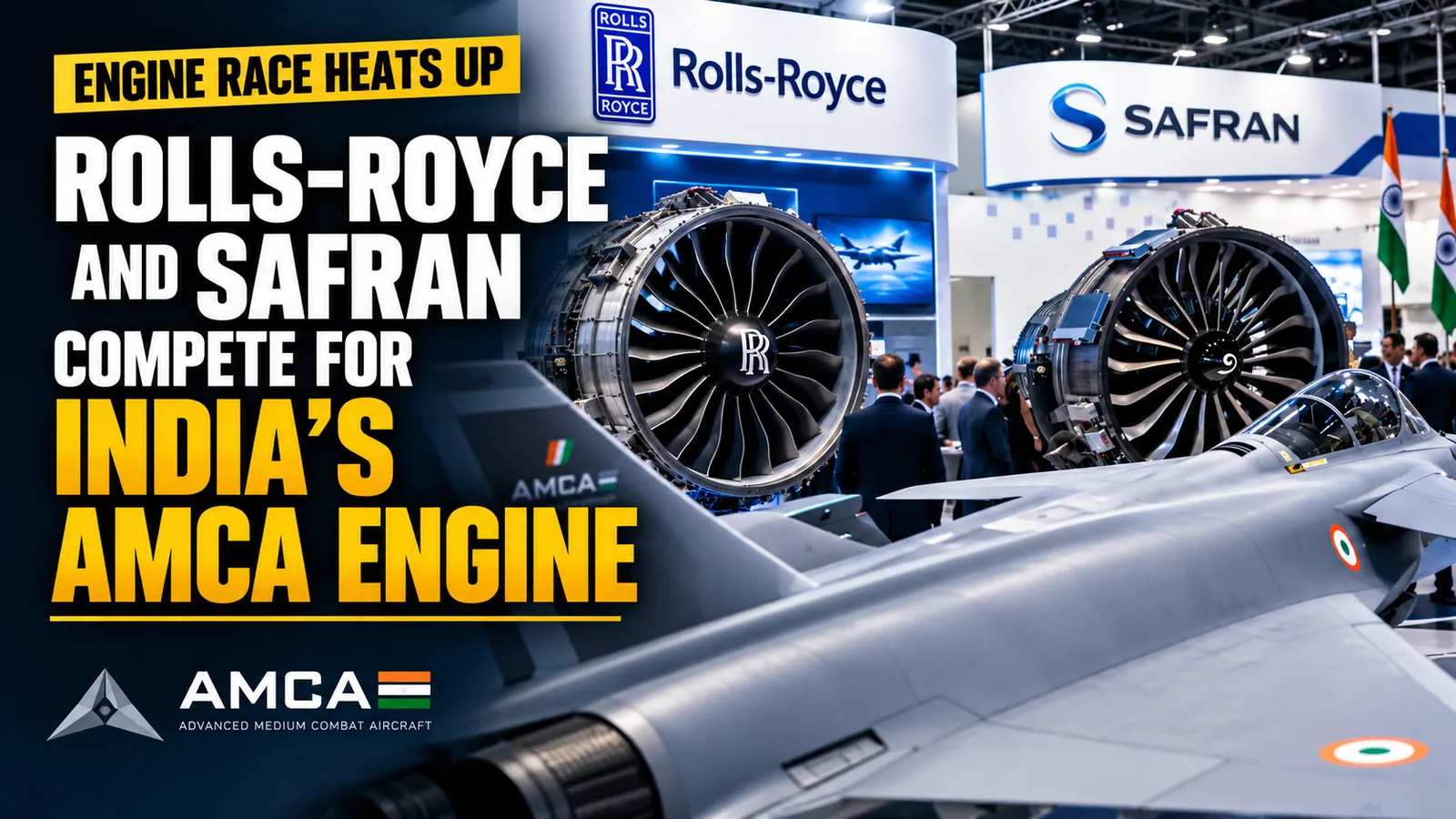
India’s effort to secure sovereign fighter-engine capability for later variants of the Advanced Medium Combat Aircraft (AMCA) is developing into a competition between Rolls-Royce and Safran, with the two European engine houses offering different industrial structures for a high-thrust powerplant intended to reduce New Delhi’s long-term dependence on imported combat-aircraft propulsion.
Rolls-Royce and Reliance Industries announced their strategic intent on 14 August 2026 to jointly offer design, development, manufacturing and delivery capability for an indigenous AMCA combat engine and to explore a dedicated Aerospace Gas Turbine Complex in India. Safran, meanwhile, has a more mature proposal with DRDO’s Gas Turbine Research Establishment for a new high-thrust engine involving extensive technology transfer. Defense News reports that the Safran proposal is being evaluated by India’s Cabinet Committee on Security, although no Indian government source reviewed for this article has publicly confirmed a final partner selection.
Key Facts
- Aircraft programme: Advanced Medium Combat Aircraft (AMCA)
- Later-engine requirement: Approximately 120 kN class according to current reporting
- Initial AMCA propulsion: GE Aerospace F414-GE-INS6
- Rolls-Royce Indian partner: Reliance Industries
- Rolls-Royce status: Strategic intent announced on 14 August 2026
- Safran Indian partner: DRDO Gas Turbine Research Establishment (GTRE)
- Safran status: Advanced co-development proposal; reported under government evaluation
- Final engine-development award: Not publicly confirmed
India Is Choosing More Than an Engine Supplier
The propulsion decision is strategically larger than selecting a powerplant for one aircraft configuration. India has manufactured and integrated increasingly sophisticated combat aircraft, but it still relies on foreign-origin engines for frontline fighter programmes.
The Ministry of Defence acknowledged that gap in 2021 when it said India intended to develop indigenous engines for future LCA variants and AMCA in association with an international engine house, using technology accumulated through the Kaveri programme.
Kaveri generated nine full prototype engines, four core engines and more than 3,200 hours of testing, including altitude and flying-test-bed trials. It did not, however, meet the thrust requirements required to power the Tejas in its intended configuration.
The AMCA engine programme is therefore aimed at a deeper form of sovereignty: gaining the engineering knowledge, intellectual-property position, materials capability, testing infrastructure and production base required to design and evolve future combat engines rather than merely assemble a licensed foreign product.
Rolls-Royce and Reliance Propose an Indian Gas-Turbine Ecosystem
Rolls-Royce and Reliance Industries announced on 14 August that they intend to partner on an indigenous combat engine for AMCA. Their joint statement covers design, development, manufacturing and delivery and says the companies will explore formation of a dedicated Aerospace Gas Turbine Complex in India.
The proposed complex is intended to create end-to-end Indian capability across design, development, manufacturing, testing, production and through-life support. That scope is notable because it places test and lifecycle infrastructure alongside manufacturing, two areas that are essential if India wants to retain meaningful design authority over future engine upgrades.
The announcement does not constitute an AMCA engine award. Rolls-Royce and Reliance describe it as strategic intent, and the proposed gas-turbine complex has not yet been announced as a funded or commissioned facility.
The 14 August official release also does not publish the engine’s thrust, development cost, timeline, equity structure, intellectual-property allocation or precise technology-transfer package. Defense News reports that Rolls-Royce has separately proposed a 120 kN-class engine with full technology transfer and Indian ownership of newly generated intellectual property, but those details are not repeated in the August joint statement and should therefore be treated as reported proposal terms rather than contractual commitments.
Safran’s GTRE Route Is Further Advanced
Safran’s proposal has been under discussion for longer and is structured around direct cooperation with GTRE, India’s state gas-turbine research organisation. Safran Chief Executive Olivier Andriès said in a November 2025 interview that the company was proposing complete technology transfer, including critical hot-section technologies, and joint development of a new engine in India with DRDO.
The Economic Times reported the proposed engine in the 120–140 kN class and said the arrangement would include technology needed for the high-temperature core of the engine. Defense News now describes the later AMCA requirement more narrowly as a 120 kN-class powerplant and reports that the Safran proposal is being evaluated by the Cabinet Committee on Security.
No official CCS decision or final Safran-GTRE engine-development contract was identified in the authoritative Indian government sources reviewed for this package. The strongest defensible formulation is therefore that Safran’s proposal is more advanced in the government evaluation process, not that Safran has definitively won the programme.
Rolls-Royce vs Safran: Publicly Visible Offer Structure
| Area | Rolls-Royce / Reliance | Safran / GTRE |
|---|---|---|
| Public status | Strategic intent announced 14 August 2026 | Advanced co-development proposal; reported under government evaluation |
| Indian partner | Reliance Industries | DRDO Gas Turbine Research Establishment |
| Industrial concept | Dedicated Aerospace Gas Turbine Complex | Joint development with GTRE and Indian engineering participation |
| Published thrust framing | Official August statement does not disclose thrust; current reporting describes 120 kN class | 120–140 kN reported in 2025; current AMCA reporting describes approximately 120 kN class |
| Technology-transfer claim | Official release promises sovereign end-to-end Indian capability; detailed full-ToT/IP claims reported separately | Safran CEO publicly described complete technology transfer including hot-section technology |
| Final award | Not confirmed | Not confirmed |
The F414 Remains the Bridge to AMCA
The competition does not mean AMCA is waiting for a new indigenous engine before prototype development can proceed. GE Aerospace says the F414-GE-INS6 has already been selected for AMCA prototype development, testing and certification, and that the first AMCA aircraft will initially use two F414 engines.
The F414 is also tied to India’s Tejas Mk2 programme. GE and Hindustan Aeronautics signed a 2023 memorandum covering potential Indian production of F414 engines for the Indian Air Force, subject to the required approvals.
This creates a two-stage propulsion roadmap. F414 provides a mature engine for near-term AMCA development, reducing propulsion risk during prototype and flight-test phases. The later Indian-controlled high-thrust engine is intended to remove that dependency from future AMCA configurations and establish domestic engineering capability for subsequent combat-aircraft programmes.
Why High-Thrust Fighter Propulsion Is Difficult
Moving from an established imported engine to an indigenous 120 kN-class afterburning turbofan is not simply a matter of increasing thrust. A modern fighter engine must balance compressor pressure ratio, turbine-inlet temperature, mass flow, fuel efficiency, afterburner performance, durability, cooling and weight while surviving extreme thermal and mechanical loads.
The most strategically sensitive technologies are concentrated in the hot section: high-pressure turbine blades, single-crystal superalloys, thermal-barrier coatings, cooling passages, combustor design and high-temperature manufacturing processes.
Modern low-observable fighters add further requirements. Propulsion interacts with infrared signature, inlet design, exhaust geometry, electrical-generation demand and thermal management for radar, electronic warfare, mission computing and future high-power systems.
For India, the partner-selection question is therefore not only who can deliver an engine meeting the thrust target. The more important question is which arrangement leaves Indian engineers able to understand, modify, certify and eventually redesign the underlying engine architecture.
AMCA’s Industrial Model Is Already Changing
India approved a new AMCA Programme Execution Model in May 2025. The Ministry of Defence said the Aeronautical Development Agency would execute the aircraft programme through industry partnership and that eligible Indian public- and private-sector companies could participate independently, in joint ventures or through consortia.
That framework is relevant to propulsion because it signals a wider effort to expand India’s combat-aircraft industrial base beyond the traditional public-sector model. Reliance’s participation with Rolls-Royce reflects that shift, while Safran’s GTRE proposal represents a more research-establishment-led route.
Safran Already Has a Deep Indian Propulsion Footprint
Safran enters the competition with an established industrial position in India. Its M88 powers the Rafale fleet, while Safran and HAL already cooperate on helicopter engines and aircraft-engine components. On 26 August 2026, HAL and Safran Helicopter Engines also signed the final contract launching development and production of the 3,500–4,000 shp Aravalli engine for India’s future IMRH and DBMRH helicopters.
That industrial base does not automatically determine the AMCA decision, but it gives Safran existing relationships and infrastructure that could support a long-term fighter-engine programme.
Technology Transfer Is Not the Same as Sovereignty
Both offers are being discussed in terms of technology transfer, but percentage claims alone can obscure the real issue. A country may receive manufacturing drawings and process instructions while remaining dependent on the original engine house for redesign, uprating, life extension or changes to the hot section.
True propulsion sovereignty requires access to the engineering rationale behind the design, ownership or legally durable control of relevant intellectual property, mastery of materials and manufacturing processes, independent test and certification capability and an indigenous supplier base able to reproduce critical components.
India’s decision will therefore have to examine what is transferred, who owns newly generated design data, whether Indian engineers participate in core architecture decisions and whether India can develop later derivatives without foreign approval.
Kaveri Shapes the Risk Assessment
The Kaveri experience explains why India is seeking an international engine house rather than attempting another isolated clean-sheet effort. The programme generated useful technology and substantial test experience, but it did not produce the operational fighter engine originally intended for Tejas.
The Ministry of Defence has explicitly stated that the technological capability created through Kaveri will be used in future engine programmes. A foreign co-development partner can therefore be viewed as a mechanism for combining that accumulated domestic knowledge with technologies India has not yet mastered at operational fighter-engine level.
Strategic Parallels with KAAN and European Programmes
India’s propulsion challenge is not unique. Türkiye is following a comparable staged strategy with KAAN, using GE F110 engines for current development while pursuing the indigenous TF35000 for later configurations.
European sixth-generation programmes likewise treat propulsion as a sovereignty pillar rather than a commodity subsystem. GCAP and FCAS both integrate engine development with wider power, thermal-management and industrial-autonomy requirements.
The recurring lesson is that airframe sovereignty can precede propulsion sovereignty by many years. An indigenous fighter can still retain a strategic external dependency if its engine design, production or upgrade path remains controlled abroad.
Limitations and Counterpoint
The competition remains less formal than the word “race” may imply. India has not publicly announced a final competitive tender result between Rolls-Royce and Safran, and the two proposals are not at identical stages.
The Rolls-Royce–Reliance announcement is formally a statement of strategic intent. The Safran proposal is reported to be further along, but the public sources reviewed here do not include a final Cabinet Committee on Security approval or signed development contract.
Exact thrust requirements also vary in reporting. Defense News describes the later AMCA requirement as approximately 120 kN class, while Safran’s 2025 proposal was reported at 120–140 kN. Until India publishes a definitive engine requirement or contract specification, those values should be treated as programme-level reporting rather than a final certified thrust target.
Development cost, workshare, intellectual-property allocation, prototype schedule and production quantities remain unconfirmed for both routes.
Implications / Next
The next decisive milestone is an Indian government partner decision or formal engine-development approval. That will establish whether Safran’s more mature GTRE route proceeds, whether Rolls-Royce–Reliance advances into formal negotiations, or whether India keeps multiple options open longer.
The second indicator is intellectual-property structure. A credible sovereignty model should identify ownership of foreground IP, Indian rights to modify the engine and access to critical hot-section design and manufacturing knowledge.
The third is industrial infrastructure. If the Rolls-Royce–Reliance Aerospace Gas Turbine Complex proceeds, its location, investment level, test capability and ownership will be significant. If Safran is selected, the scale of Indian design, materials, manufacturing and test infrastructure under the GTRE arrangement will be equally important.
Finally, programme schedule will determine whether the indigenous engine can mature in time for later AMCA configurations without forcing India to extend F414 use beyond its preferred roadmap.
Conclusion
Rolls-Royce and Safran are positioning two different routes to the same Indian objective: a sovereign high-thrust fighter-engine capability that extends beyond licensed manufacturing.
Rolls-Royce is proposing a new private-sector industrial structure with Reliance and a dedicated national gas-turbine complex. Safran is offering a more mature GTRE-centred co-development model and has publicly committed to extensive technology transfer, including hot-section know-how.
No final winner has been publicly confirmed. The decisive metric will not be the headline thrust figure or the nominal technology-transfer percentage, but whether India emerges with the design authority, intellectual property, materials capability, test infrastructure and supplier base required to independently develop the next engine after AMCA.