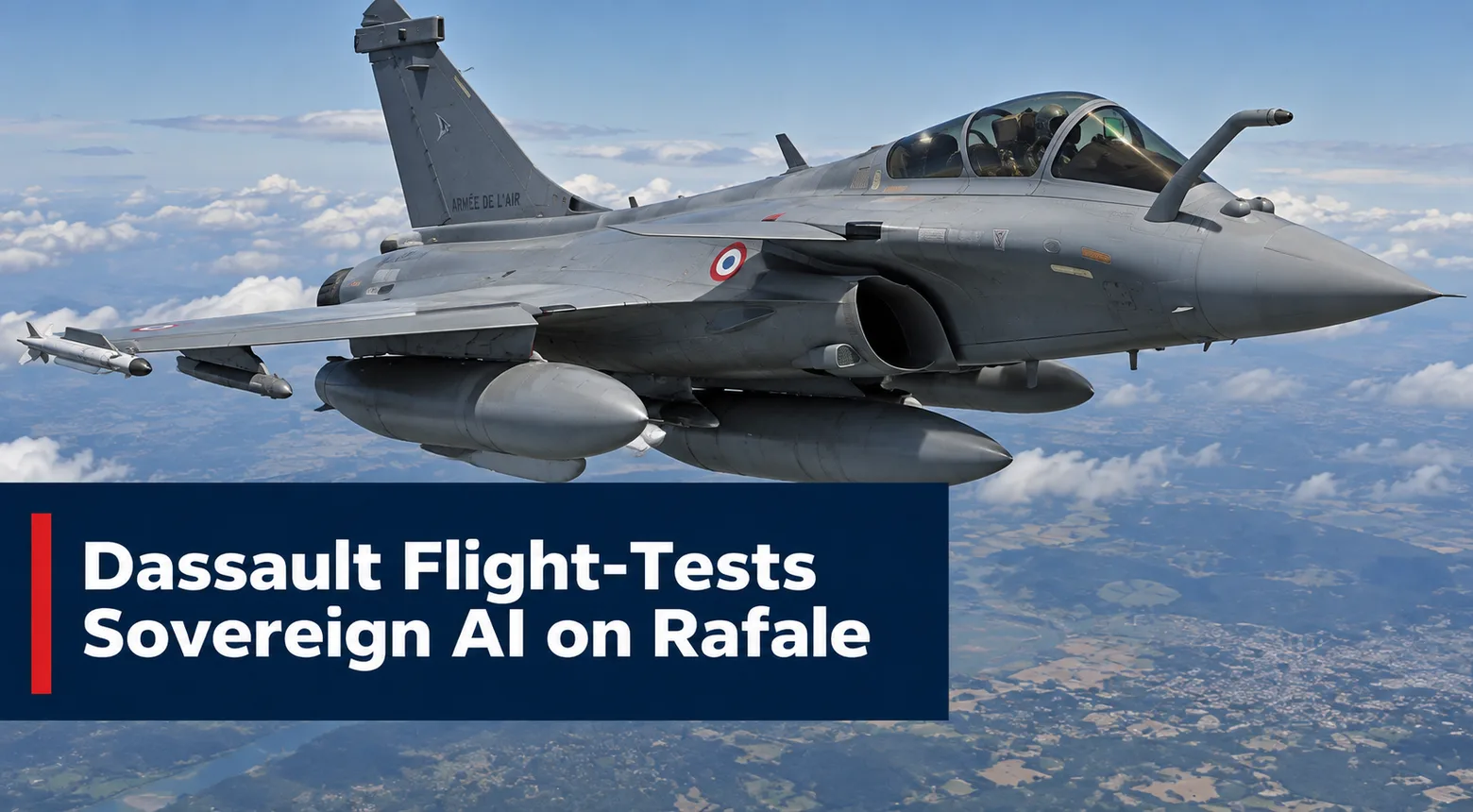
Dassault Aviation has flight-tested two sovereign artificial-intelligence algorithms on the Rafale fighter, one developed internally and one with Thales/cortAIx. Dassault says the functions are mature enough to be considered for future Rafale upgrades, but it has not disclosed their exact operational roles or announced fielding.
Dassault has moved two AI functions onto a flying Rafale
Dassault Aviation has flight-tested two new sovereign artificial-intelligence algorithms aboard the Rafale, shifting the work from software development into airborne integration. The company announced the milestone on 22 September 2026. One algorithm was developed by Dassault engineers, while the second was developed with Thales through its cortAIx artificial-intelligence activity.
Dassault described the functions as part of a wider effort to integrate controlled and supervised AI into the cockpit in support of the human crew. The company did not identify the algorithms’ exact mission roles. That omission is important: the test confirms airborne integration and a stated maturity level, but not whether the functions support sensor management, mission planning, electronic warfare, threat prioritisation or another task.
The programme emphasis is supervised AI, not autonomous command
The company’s wording places the human crew at the centre of the architecture. In combat aviation, that distinction affects certification, trust, data quality and the authority assigned to software. AI can assist by filtering large data volumes, highlighting anomalies or recommending actions without taking independent control of weapons employment. Public reporting on the Rafale test does not support a claim that the aircraft has been given autonomous lethal decision authority.
Dassault also highlighted the engineering problems specific to embedded military AI: operational data quality, combining software with deep domain expertise and running algorithms within strict onboard computing, power and thermal constraints. Those are practical integration issues that separate a laboratory model from software suitable for a combat aircraft.
Future Rafale upgrades are the immediate route to relevance
Dassault says the tested functions have reached a maturity level that makes them eligible for future Rafale upgrades. “Eligible” is a carefully bounded term. It means the technology can enter upgrade consideration; it does not establish that a specific Rafale standard has selected the algorithms or that an operational fleet has received them.
The company is simultaneously developing the Rafale family toward more networked operations, new weapons and collaboration with uncrewed systems. AI decision support can become more valuable as the cockpit receives data from distributed sensors and autonomous teammates, because the crew’s information-management burden rises with the number of connected nodes.
Sovereignty is part of the technical requirement
France’s emphasis on sovereign AI reflects more than industrial branding. Combat-air software may process classified mission data, threat libraries and sensor outputs, making control of source code, training data and update pipelines strategically important. A nationally controlled algorithm can also reduce dependence on external software providers when mission requirements change.
The trade-off is that sovereign development still has to meet the same standards for verification, validation, cybersecurity and safety as any other embedded combat function. The more an algorithm influences time-critical decisions, the more rigorous its testing and configuration control must become. Flight testing is therefore a necessary step, but not the end of the qualification process.
Programme maturity and verification
For acquisition and programme-management teams, the milestone is most useful when separated from the claims that usually surround it. The confirmed event establishes technical or contractual progress, while production scale, operational availability, unit adoption and future performance still require their own evidence. That distinction keeps the programme baseline stable as new announcements arrive.
Implications / Next
Watch for disclosure of the algorithms’ mission roles, assignment to a defined Rafale upgrade standard, qualification activity with operational units and any integration with collaborative uncrewed aircraft. Until those milestones appear, the 2026 event should be treated as a successful flight-test and technology-maturation step.