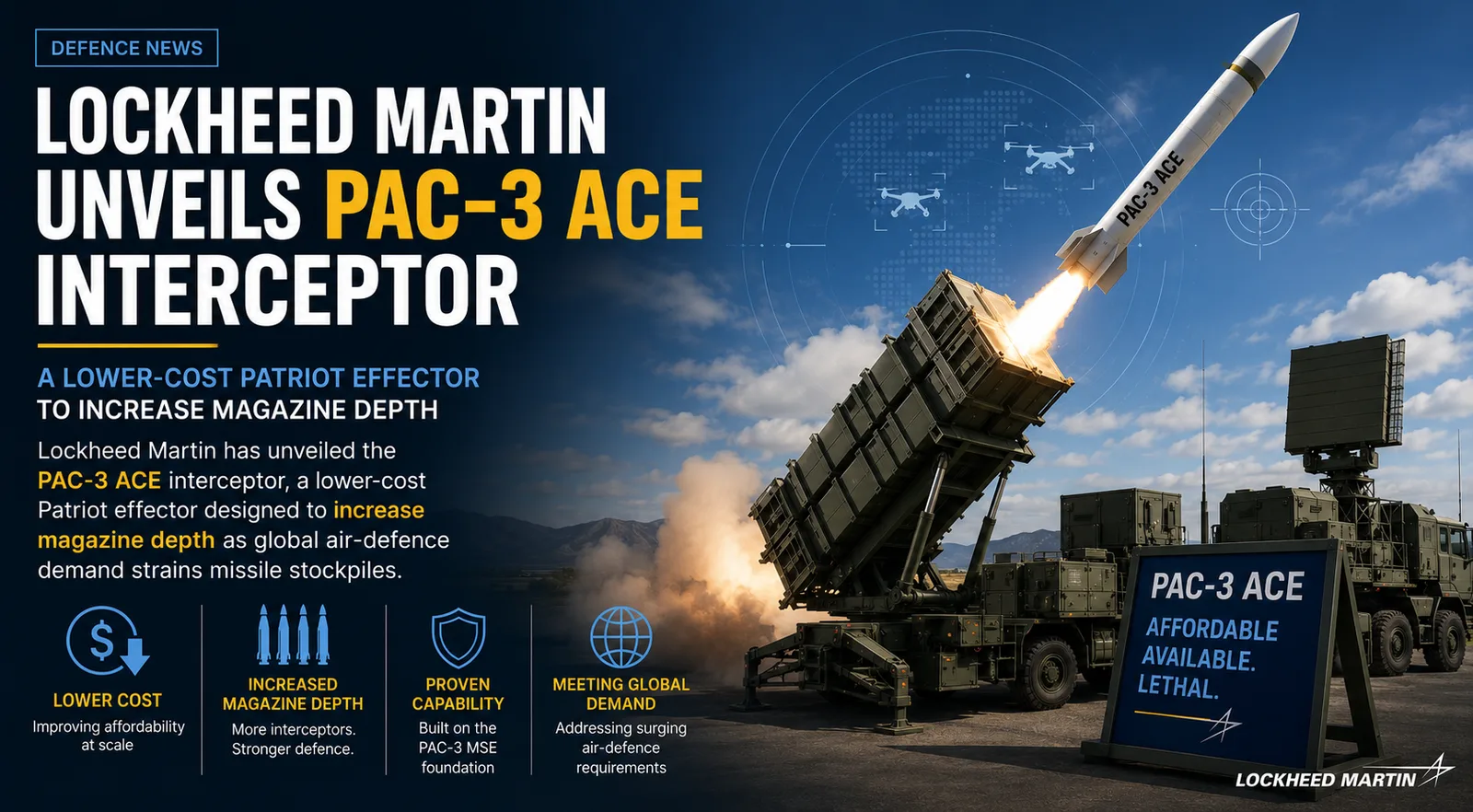
PAC-3 ACE interceptor plans have been unveiled by Lockheed Martin as demand for Patriot air-defence missiles rises across Ukraine, Europe and the Gulf.
Lockheed Martin announced the PAC-3 Adapted Capability Effector, or PAC-3 ACE, at Farnborough Airshow 2026. According to Reuters, the missile is intended to cost less than half as much as the PAC-3 MSE interceptor, which costs roughly $4 million per missile according to U.S. Army budget documents.
Lockheed said initial production could begin within 36 months. The company also plans to develop and manufacture the weapon with U.S. and European industry partners, linking the new interceptor to wider efforts to expand allied air-defence production capacity.
The announcement reflects a central problem in modern air defence. Militaries need more interceptors, but they also need cheaper ways to defeat drones, cruise missiles and short-range ballistic threats without exhausting high-end missile stocks.
PAC-3 ACE Interceptor Targets the Cost-Per-Kill Problem
The PAC-3 ACE interceptor is aimed at the cost-per-kill challenge. Modern air-defence forces often face lower-cost threats, including drones and simpler missiles. Using expensive interceptors against every target can drain stockpiles and strain budgets.
This is especially important for Patriot operators. PAC-3 MSE is a high-end interceptor designed for demanding air and missile defence missions. However, not every target requires the most expensive missile in the magazine.
PAC-3 ACE is therefore positioned as a complementary effector. It is not meant to replace PAC-3 MSE. Instead, it could give Patriot units a lower-cost option for selected air and missile threats while preserving higher-end interceptors for more complex targets.
Lockheed Builds on Patriot and IBCS Integration
Lockheed Martin says PAC-3 ACE will build on the existing PAC-3 fire-control system. The company also says the interceptor will be fully linked to the Patriot weapon system and the Integrated Battle Command System, or IBCS.
This matters because integration is often the hardest part of air defence. A new missile must work with launchers, sensors, command systems, fire-control logic and engagement doctrine. By using existing Patriot and IBCS pathways, Lockheed is trying to reduce development time and fielding risk.
The company says the missile is designed to counter air-breathing threats, cruise missiles, close-range ballistic missiles and short-range ballistic missiles. That gives PAC-3 ACE a broad role inside lower-tier air and missile defence.
Ukraine and the Gulf Drive Patriot Demand
The Patriot system has become one of the most sought-after air-defence systems since Russia’s full-scale invasion of Ukraine in 2022. Ukrainian forces have used Patriot batteries to defend cities against ballistic missile attacks, while Kyiv continues to request more launchers and interceptors.
Demand has also increased because of instability in the Gulf and missile exchanges involving Iran, Israel and the United States. These events have highlighted the shortage of advanced air-defence interceptors and the difficulty of replenishing them quickly.
For NATO and partner countries, the lesson is clear. Air-defence readiness now depends not only on launchers and radars, but also on deep interceptor stockpiles and production lines that can surge during crisis.
A Lower-Cost Patriot Effector Could Add Magazine Depth
Magazine depth is becoming one of the most important measures of air-defence strength. A battery with excellent sensors and launchers still becomes vulnerable if it runs out of interceptors.
PAC-3 ACE could help address this problem by giving operators more interceptors for the same budget. If production scales, the system could make Patriot units more sustainable during long campaigns or high-volume missile and drone attacks.
This is part of a wider trend. NATO countries are investing in counter-drone systems, low-cost air-defence effectors and missile-production capacity because adversaries can generate mass with cheaper weapons.
European Industry Role Signals Transatlantic Production Strategy
Lockheed’s plan to work with U.S. and European industry partners is strategically important. European governments are increasing defence spending, but they also want more local production, sustainment and supply-chain resilience.
That pressure is already visible in Patriot sustainment. Lockheed recently welcomed a commitment by the United States, Germany, the Netherlands, Poland and Sweden to explore a dedicated PAC-3 missile maintenance facility in Europe.
A European industrial role for PAC-3 ACE could help address two problems at once. It could support production scale for allied users while also giving European governments a stronger stake in the Patriot supply chain.
Startups Push Prime Contractors Toward Lower-Cost Weapons
The PAC-3 ACE interceptor also shows how established defence primes are responding to competition from newer defence-technology companies. Startups are promising cheaper weapons, faster development cycles and larger production volumes.
That competition is changing expectations. Governments still need high-end interceptors for ballistic missile defence, but they also want affordable systems that can be produced in quantity.
For Lockheed Martin, PAC-3 ACE is a way to defend the Patriot ecosystem while adapting it to a market where cost, speed and scalability have become decisive factors.
PAC-3 ACE Fits a Layered Air-Defence Future
The future of air defence will be layered. High-end interceptors will remain essential against ballistic missiles and complex threats. At the same time, lower-cost effectors, electronic warfare, guns, directed energy and counter-drone systems will be needed against cheaper and more numerous targets.
PAC-3 ACE would sit inside that layered model. It could give Patriot operators a more affordable missile option while maintaining integration with existing fire-control and command systems.
The key question is production. A cheaper interceptor matters only if it can be manufactured quickly, qualified reliably and delivered in the quantities needed by U.S., European and allied forces.
Conclusion
Lockheed Martin’s PAC-3 ACE interceptor reflects a major shift in the air-defence market. Demand for Patriot-class systems is rising, but customers also need more affordable interceptors that can build magazine depth and reduce cost per engagement.
If the missile reaches initial production within 36 months, PAC-3 ACE could become an important complement to PAC-3 MSE. It would also show how the Patriot ecosystem is adapting to a battlefield shaped by drones, cruise missiles, ballistic missiles and sustained interceptor demand.
For further Defence Agenda coverage, read our air defence, missiles and defence industry sections. Related analysis includes NATO’s $40 billion counter-drone investment, low-cost air-defence interceptors under LCADE and Bliksem EXO and Europe’s missile shield gap.