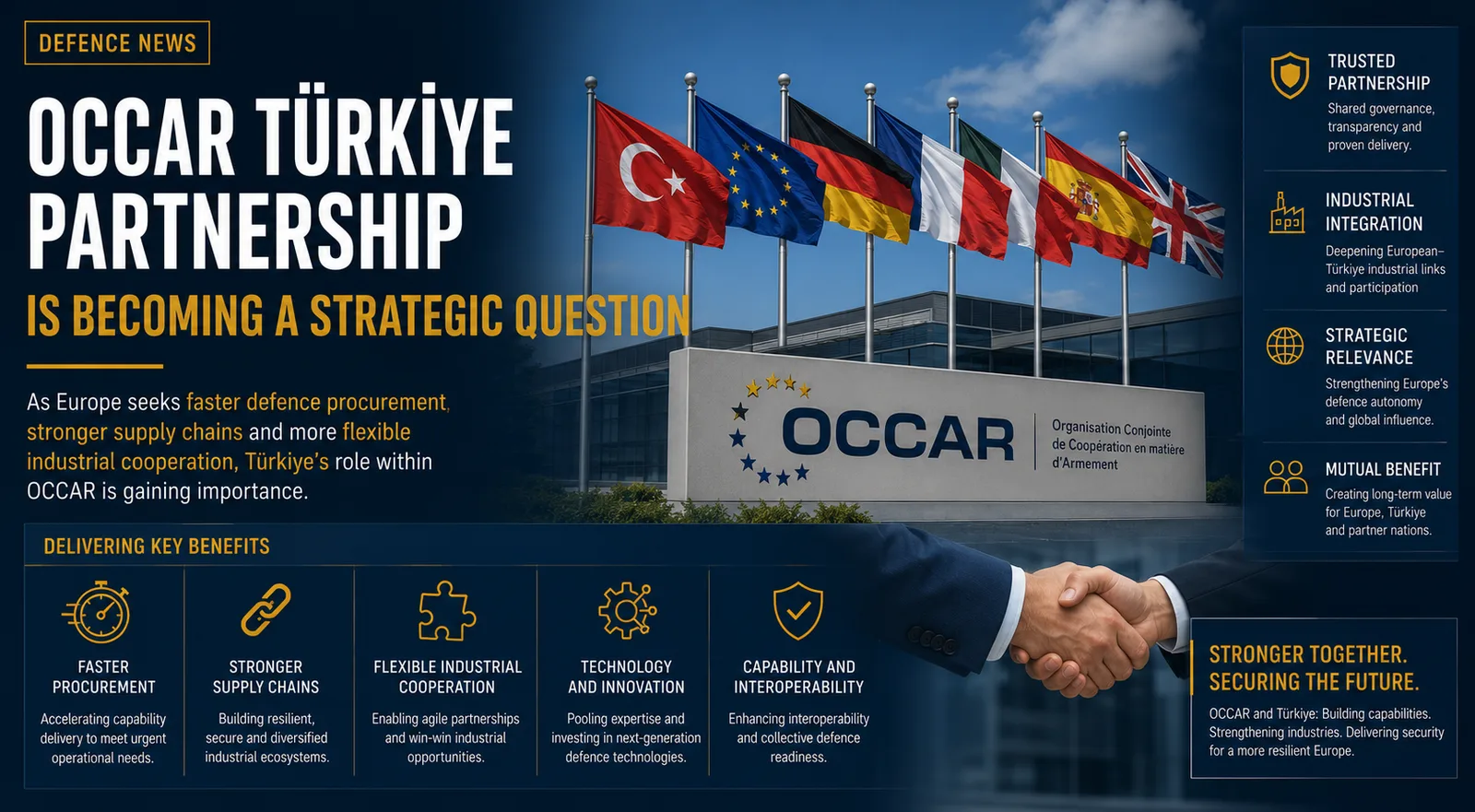
OCCAR Türkiye partnership is becoming a strategic question as Europe tries to turn higher defence spending into faster procurement, stronger supply chains and deployable military capability.
A SAHA Blog analysis argues that OCCAR’s way out of Europe’s bureaucratic and industrial bottlenecks is renewed partnership with Türkiye. The article frames Türkiye not only as an A400M partner, but as a defence-industrial actor with growing relevance for European security.
The argument is timely. Europe is spending more on defence, but the central problem is execution. Governments need to convert political intent into production, delivery, sustainment and interoperable capability.
That is exactly where OCCAR matters. The Organisation for Joint Armament Cooperation manages complex multinational defence programmes through their life cycle. Its role is not only procurement. It is programme governance, cost control, industrial coordination and delivery management.
OCCAR Türkiye Partnership Starts With Programme Reality
The OCCAR Türkiye partnership already has a practical foundation: A400M. OCCAR lists Türkiye among the A400M participating states, alongside Germany, France, Spain, the United Kingdom, Belgium and Luxembourg.
The A400M programme is strategically important because it is not a simple aircraft purchase. It is a multinational airlift programme involving industrial participation, aircraft delivery, sustainment, upgrades and long-term operational use.
For Türkiye, A400M participation showed that the country can work inside a complex European defence programme. For Europe, it demonstrated that Türkiye can be part of a major multinational capability architecture when the governance model is clear.
OCCAR Was Built to Reduce Fragmentation
OCCAR was created to improve armament cooperation, increase efficiency and reduce costs among participating states. Its model is based on multinational programme management rather than fragmented national procurement.
This matters because European defence has long struggled with duplication. Different national requirements, industrial workshare politics and slow procurement cycles can weaken scale and delay delivery.
OCCAR’s logic is different. It gives countries a programme structure where management, governance, reporting and delivery can be handled through a dedicated international organisation.
Europe’s Defence Problem Is No Longer Only Budget
Europe’s defence problem is no longer only insufficient spending. Budgets are rising, and EU instruments such as SAFE are designed to support large-scale joint procurement. The harder problem is converting money into equipment at speed.
The European Commission’s Readiness Roadmap 2030 points to joint procurement targets, stronger European defence industrial capacity and the need to integrate Ukraine’s defence industry into Europe’s production scale.
This creates a governance challenge. Europe needs more common buying, but common buying requires programme authorities that can manage complexity. OCCAR could therefore become more important, not less.
Türkiye Adds Industrial Capacity and Operational Lessons
The case for a deeper OCCAR Türkiye partnership rests on two factors: industrial capacity and operational learning.
Türkiye’s defence industry has expanded across drones, armoured vehicles, missiles, naval systems, communications, sensors, electronic warfare and aerospace structures. This gives European partners access to a wider supplier base at a time when capacity is becoming a strategic constraint.
Türkiye also brings operational lessons from conflicts where drones, electronic warfare, precision fires and agile supply chains have been decisive. These lessons are relevant for European armies that are adapting to high-intensity warfare.
Supply Chains Make the Partnership More Urgent
The COVID-19 period and the war in Ukraine exposed the fragility of defence supply chains. Raw materials, electronic components, engines, munitions and spare parts became strategic issues rather than routine procurement details.
The SAHA Blog article argues that Türkiye’s geography and industrial base give it a stronger role in alternative logistics routes and defence supply chains. This point is important for Europe because resilience now depends on supplier depth and geographic flexibility.
A deeper OCCAR Türkiye partnership could help Europe diversify sources, reduce bottlenecks and create more resilient production networks for selected programmes.
OCCAR Needs Flexible Partner-State Models
The key question is not whether every partner must become a full OCCAR member immediately. The more practical question is how OCCAR can use flexible partner-state models for specific programmes.
Türkiye’s A400M role shows that non-member participation can work when programme governance is clear. This model could be expanded for selected capability areas where Türkiye has relevant industrial or operational strength.
Potential areas include unmanned systems, secure communications, tactical data links, armoured vehicles, naval systems, missile subsystems, electronic warfare and aerospace structures.
The Challenge Is Political Trust
The main barrier is not only industrial. It is political trust. Defence cooperation requires alignment on security policy, export controls, technology protection, programme priorities and end-user rules.
Türkiye is a NATO ally, but its relationship with parts of Europe has faced political friction. Any deeper OCCAR Türkiye partnership would therefore need clear governance, transparent programme rules and predictable export-control arrangements.
That does not make cooperation impossible. It means cooperation should begin where interests are concrete and measurable. Programmes should be built around capability gaps, industrial complementarity and delivery timelines.
Ukraine Changed the Defence Procurement Debate
Ukraine changed Europe’s defence procurement debate. The war showed that readiness depends on stocks, production tempo, rapid adaptation and battlefield-proven systems.
It also showed that traditional long-cycle procurement can fail when threats evolve faster than programme schedules. Drones, loitering munitions, electronic warfare and precision fires have moved quickly from niche capabilities to operational necessities.
This strengthens the argument for flexible OCCAR cooperation. Europe needs structures that can manage large programmes, but it also needs partner networks that can absorb innovation faster.
A Win-Win Model Would Need Industrial Discipline
A successful OCCAR Türkiye partnership would need industrial discipline. It cannot be built only on political declarations. It must be built on programme rules, quality systems, qualification standards, delivery metrics and cost transparency.
This is where OCCAR’s quality and programme-management culture matters. The organisation’s purpose is to reduce cost, improve efficiency and manage complex multinational programmes in a structured way.
Türkiye’s defence industry would benefit from deeper access to European programme structures. Europe would benefit from additional capacity, competitive suppliers and operationally relevant technologies.
What a Practical Roadmap Could Look Like
A practical roadmap should begin with limited but high-value cooperation. OCCAR and Türkiye could identify capability areas where Türkiye already has proven capacity and where European demand is rising.
The first step could be programme-level industrial participation rather than immediate institutional enlargement. The second step could involve joint testing, certification, logistics and sustainment arrangements. The third step could be deeper participation in selected future capability programmes.
This staged approach would reduce political risk while allowing both sides to measure results. It would also keep cooperation focused on delivery rather than symbolism.
OCCAR Türkiye Partnership Could Support European Readiness
The strategic case is clear. Europe needs more defence capacity, faster joint procurement and stronger supply-chain resilience. Türkiye needs deeper access to high-value European cooperative programmes and wider industrial integration with allied markets.
An OCCAR Türkiye partnership could serve both objectives. It would not replace EU defence instruments, NATO planning or bilateral defence agreements. Instead, it could add a practical programme-management route for selected capabilities.
The strongest argument is operational. Europe does not have the luxury of slow procurement. Any partner that can add capacity, reduce cost, increase speed and strengthen resilience deserves serious consideration.
Conclusion
OCCAR was created to make European armament cooperation more efficient. Today, that mission is more urgent than ever. Europe has more money for defence, but it still needs faster delivery, deeper stocks and stronger industrial coordination.
The OCCAR Türkiye partnership is therefore not only a political idea. It is a practical question of capacity, resilience and programme execution. Türkiye’s A400M experience provides a working foundation, while its expanding defence industry offers new options for future cooperation.
The challenge will be trust, governance and disciplined implementation. If OCCAR and Türkiye can build cooperation around clear programmes, transparent rules and shared capability gaps, the partnership could become one route out of Europe’s defence procurement bottleneck.
For further Defence Agenda coverage, read our defence industry, Europe and defence procurement sections. Related analysis includes Farnborough Airshow 2026 and defence demand, ITAR-free defence products in Europe and Saab operating profit and European defence orders.