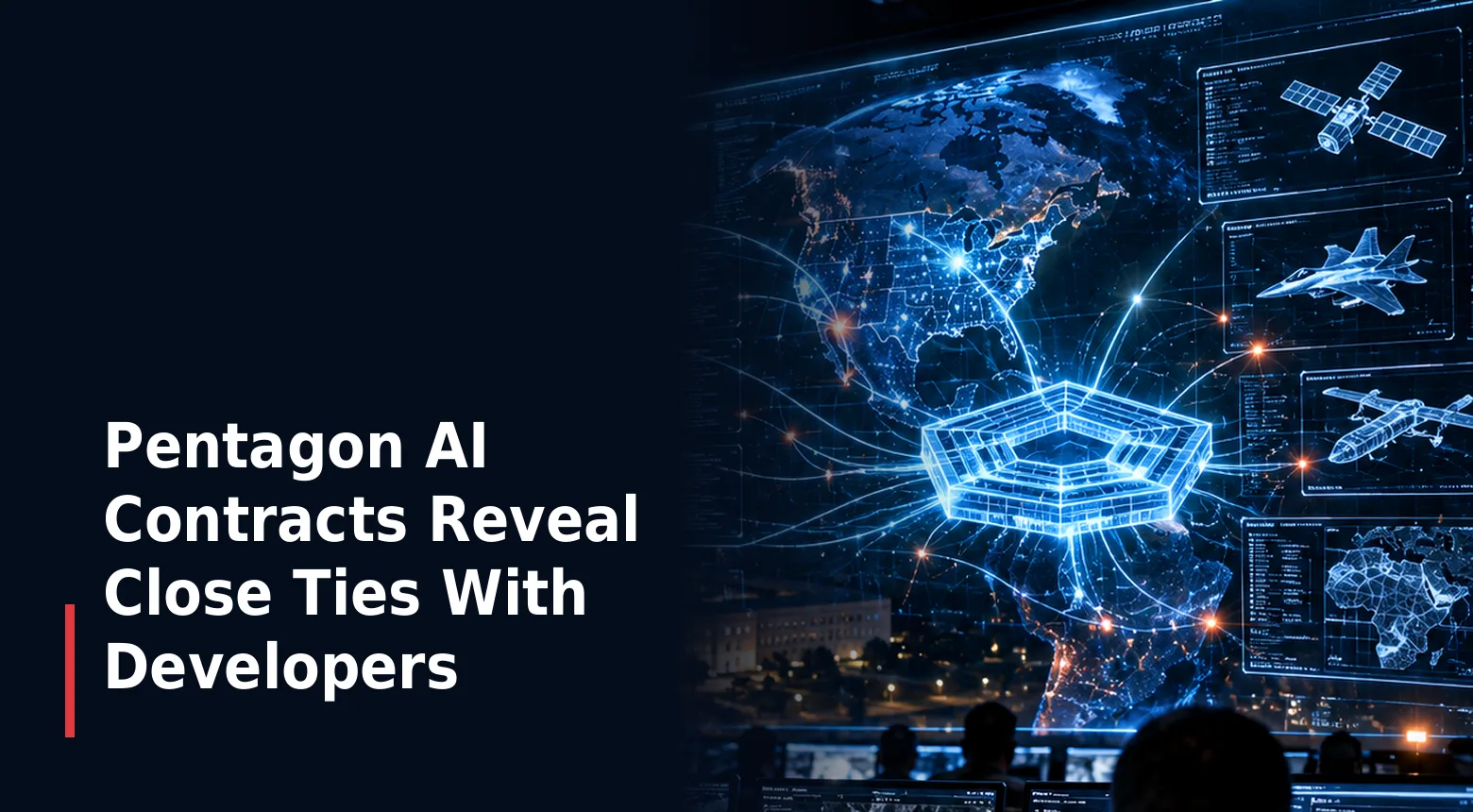
Documents obtained by The Intercept and reported on 8 September 2026 provide a closer view of how the Pentagon works with frontier artificial-intelligence suppliers, including OpenAI, Anthropic, Google and xAI. The records add context to contract relationships announced in July 2025, but their disclosure does not mean that every possible contract ceiling was spent or that all proposed military applications were fielded.
The records expand visibility into existing relationships
The Intercept said it obtained more than 400 pages of documents through a Freedom of Information Act legal process. The material concerns contractual relationships between the U.S. military and leading frontier AI firms, notably OpenAI, Anthropic, Google and xAI. It examines the practical depth of cooperation rather than merely noting that suppliers provide a generic software product. The disclosure is reporting about contract terms and negotiations; it is not a newly announced award to each company on 8 September 2026.
The Pentagon's Chief Digital and Artificial Intelligence Office had announced awards to the same four developers on 14 July 2025, each with a ceiling of $200 million. A ceiling specifies the maximum potential value under an agreement, not the amount already ordered or paid. An account of the September documents must therefore keep announced contract authority separate from subsequent task orders, deployments and financial obligations, which require contract-level evidence.
Model integration introduces security and mission-specific requirements
Frontier language models can support research, analytical work, software development and administrative workflows, but defence use entails additional challenges. Military data may be classified or operationally sensitive, requiring protected infrastructure and strict access controls. Operators need testing against error, manipulation and unanticipated behaviour rather than assuming that success on commercial benchmarks establishes reliability in national-security applications.
The Intercept reporting also highlights potential tension between supplier safety rules and government expectations for military utility. These issues are not limited to abstract principles: contract language can shape access, support, permissible use, evaluation conditions and remedies if the parties disagree. Organisations procuring AI should distinguish exploratory prototypes from tools that have passed mission-specific security and operational approval.
A supplier relationship is broader than a software licence
Military customers often need continuing access to models, technical expertise, application interfaces and changes to the underlying system over time. Unlike static hardware, frontier models can change rapidly, making version control, cybersecurity assessment and evaluation processes central to the acquisition. An update that improves one benchmark may alter behaviour in a mission workflow; procurement teams must decide which changes require new assurance and what records must be retained.
Close collaboration may accelerate adaptation to defence requirements, but it can also create dependency on proprietary systems or individual providers. Competition, exit provisions, model portability and data ownership are relevant considerations for an organisation seeking durable operational capability. The source documents should therefore be read as evidence of complicated contractual and technical relationships, not as proof of unqualified military endorsement of any supplier's entire product range.
Governance and oversight become acquisition questions
When an AI system supports operational planning or decision-making, accountability remains with human organisations and authorised officials. Procurement officials need to define acceptable uses, monitor outcomes and verify that cybersecurity and legal conditions are met. These requirements can become more demanding when a model interacts with tools, real-time data or mission systems rather than simply generating internal text.
Future reporting should focus on which contracts were actually funded, what deliverables were accepted and how deployed systems were evaluated. Public documents may not disclose sensitive deployments, but that limitation does not justify guessing at operational functions. The September investigation offers material for scrutiny of procurement design and oversight, while the July 2025 Pentagon announcement remains the public baseline for the original contract ceilings.
Implications / Next
Watch formally disclosed task orders, independent audit findings, CDAO implementation guidance and revised contracting terms. Do not aggregate four $200 million ceilings into confirmed expenditures or claim that any specific AI-enabled weapon was fielded on this evidence.