MKE MMT-76 Completes Helicopter Qualification for Door-Gun Missions
MKE’s MMT-76 Modern Machine Gun has completed its helicopter air-qualification campaign, clearing the 7.62×51 mm NATO weapon for use as a door-mounted gun on general-purpose helicopters after vibration, reliability, temperature and air-to-ground firing tests.
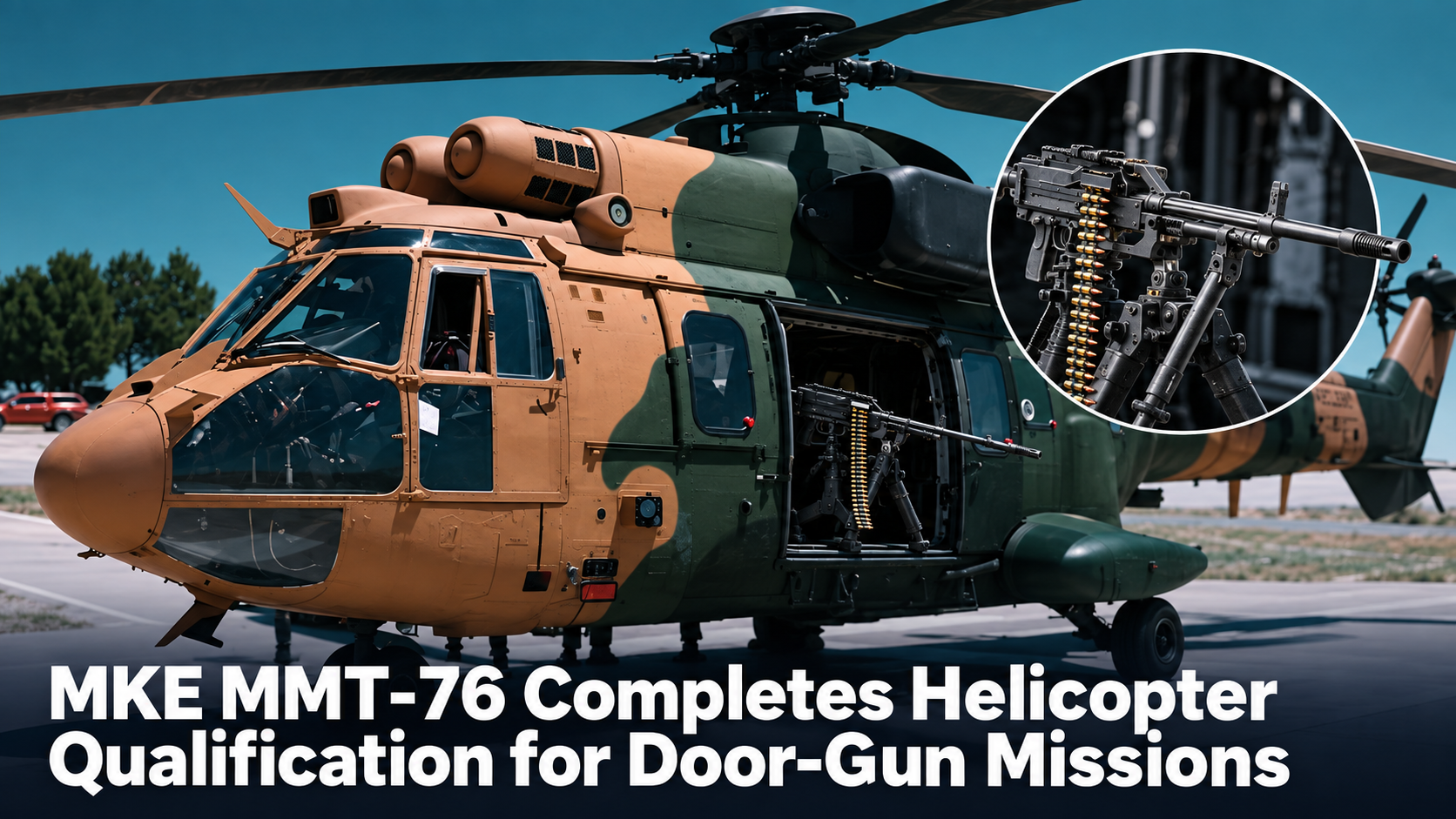
The qualification extends a weapon that completed ground trials in 2025 into the rotary-wing domain and gives MKE a domestically developed machine-gun solution for both infantry and platform use. MKE and Türkiye’s Secretariat of Defence Industries say the MMT-76 successfully completed the full helicopter qualification sequence, while test footage shows the weapon firing from an AS532 Cougar operated by the Turkish Land Forces.
Key Facts
- Weapon: MMT-76 Modern Machine Gun
- Developer: MKE
- Calibre: 7.62×51 mm NATO
- New role: Helicopter door gun
- Ground qualification: Completed in 2025
- Air qualification: Completed in August 2026
- Tests: Helicopter vibration simulation, reliability and durability, low-temperature, high-temperature and air-to-ground firing
- Previously completed: 40 NATO-standard qualification tests
- Published weight: Approximately 8 kg
- Published effective range: 1,000 metres
- Published rate of fire: 750 rounds per minute
The New Milestone Is Rotary-Wing Qualification
MMT-76 was already a qualified ground weapon before the August 2026 announcement. MKE’s earlier product announcement says the weapon completed approximately 250,000 rounds of firing and 40 demanding NATO-standard tests in less than one year, reaching serial-production readiness for its ground role.
The latest campaign addresses a different requirement: operation from helicopters. The weapon had to demonstrate that it could tolerate vibration, environmental extremes and repeated firing from an airborne platform while remaining suitable for use as a door-mounted weapon.
The Test Campaign Covered Five Main Areas
MKE and SSB identify five principal qualification activities: helicopter vibration simulation, reliability and durability testing, low-temperature testing, high-temperature testing and helicopter air-to-ground firing.
The companies describe the qualification as successfully completed and the weapon as ready for helicopter operations. Public reporting does not disclose the detailed acceptance thresholds, round counts for each test, vibration profiles, environmental temperature limits or malfunction rates achieved during the campaign.
Test Footage Shows an AS532 Cougar
TURDEF reports that MKE footage from the qualification campaign shows the MMT-76 being fired from an AS532 Cougar operated by the Turkish Land Forces.
This provides a concrete integration reference for the weapon. However, the public MKE and SSB statements frame the qualification more broadly around use on general-purpose helicopters rather than announcing a fleet-wide installation contract for a specific helicopter type.
MMT-76 Uses 7.62×51 mm NATO Ammunition
MKE’s official product information describes MMT as a 7.62×51 mm NATO-calibre general-purpose machine gun. The company lists an approximate weight of 8 kg, an effective range of 1,000 metres and a firing rate of 750 rounds per minute.
The calibre positions MMT-76 in the general-purpose machine-gun class rather than the heavier 12.7 mm door-gun category. These are MKE product specifications and should not be treated as measured performance values from the helicopter qualification campaign.
Door-Gun Qualification Adds a New Mission Layer
Helicopter door guns can provide suppressive fire, landing-zone protection, escort support and close-range defensive fire while allowing engagement outside the helicopter’s forward axis.
For a general-purpose machine gun, qualification for this role expands platform utility without requiring the weapon to become a dedicated aircraft cannon. The public material does not disclose the exact helicopter mount, traverse limits, ammunition-box configuration, sighting system or crew interface used during qualification.
MMT-76 Is Part of MKE’s Wider 7.62 mm Portfolio
MKE’s current production documents list both MMT-76 and PMT-76/57A among the company’s 7.62 mm general-purpose and platform machine guns.
The helicopter qualification gives MMT-76 a clearer role alongside MKE’s existing platform-weapon portfolio, which also includes heavier 12.7 mm rotary-barrel systems, 20 mm guns and a three-barrel helicopter nose cannon.
Ground Qualification Was Completed in 2025
MKE says the weapon completed ground qualification in 2025. The company’s earlier announcement states that MMT passed 40 different NATO-standard tests and accumulated up to 250,000 rounds during development and qualification before being declared ready for serial production.
The helicopter campaign therefore represents an extension of a qualified baseline rather than a new weapon starting from the beginning of development.
Air Qualification Can Reduce Integration Risk
Aircraft integration imposes additional stresses that can affect both the weapon and its mounting system. Rotor vibration, airframe vibration, temperature changes, airflow, ammunition feed behaviour and repeated firing loads can all influence reliability.
By completing helicopter-specific qualification before broad deployment, MKE and SSB reduce technical risk for rotary-wing introduction. Public sources do not identify whether the current qualification also covered electromagnetic compatibility, corrosion or salt-fog exposure.
The Weapon Could Support Indigenous Helicopter Armament Packages
Türkiye operates multiple utility-helicopter fleets and continues to expand domestic helicopter production through programmes such as T625 GÖKBEY.
A qualified national door-gun solution can reduce dependence on imported general-purpose machine guns in helicopter mission kits. However, the August announcement does not confirm a GÖKBEY integration contract or identify future helicopter programmes that will adopt MMT-76.
Standard NATO Ammunition Improves Export Compatibility
The use of 7.62×51 mm NATO ammunition gives MMT-76 a natural level of interoperability for users already operating the calibre.
Helicopter qualification may also broaden the commercial market by allowing MKE to offer the same core weapon for ground infantry, vehicle-mounted and rotary-wing roles. No export order for the helicopter-qualified MMT-76 was announced with the qualification milestone.
Industrial Significance: One Weapon, Multiple Roles
The MMT-76 programme illustrates a common industrial strategy in small arms: increase the number of platform roles served by one qualified weapon architecture.
MKE can potentially use the same production base, spare parts and ammunition family while adapting mounts and interfaces for infantry, vehicle and helicopter applications. The actual commonality level between infantry and helicopter configurations has not been publicly quantified.
The Qualification Strengthens MKE’s Platform-Weapons Portfolio
MKE has been expanding from conventional ammunition and small arms into more integrated weapon-system roles. Recent examples include the TOLGA counter-UAS system, naval 20 mm weapon-station integration aboard TCG Beykoz and the DENİZHAN-76 naval gun.
MMT-76’s helicopter qualification fits that wider direction by moving a small-arms product into a platform-integrated mission.
Limitations and Counterpoint
The August announcement confirms qualification, not a fleet-wide procurement quantity. No contract value, production quantity, helicopter fleet allocation or operational squadron assignment has been disclosed.
The detailed helicopter mount and ammunition-feed configuration are not public.
The claim of “100% success” comes from MKE and associated Turkish reporting and refers to successful completion of the qualification process; no independent military test report with the underlying data has been released publicly.
The AS532 Cougar appearance in test footage confirms a demonstrated platform but should not be interpreted as exclusive qualification to that helicopter type.
Implications / Next
The next indicators are a formal Turkish Armed Forces production or integration order, disclosure of the standardised door mount and ammunition configuration, integration on additional helicopter types and any export customer for the airborne configuration.
Conclusion
MMT-76 has moved from ground qualification into a verified helicopter role. After completing vibration, reliability, temperature and air-to-ground firing tests, the 7.62×51 mm weapon is now qualified for use as a door gun on general-purpose helicopters.
The milestone does not yet reveal how many systems will be procured or which helicopter fleets will receive them, but it gives MKE a nationally developed, NATO-calibre machine-gun option spanning both ground and rotary-wing applications.