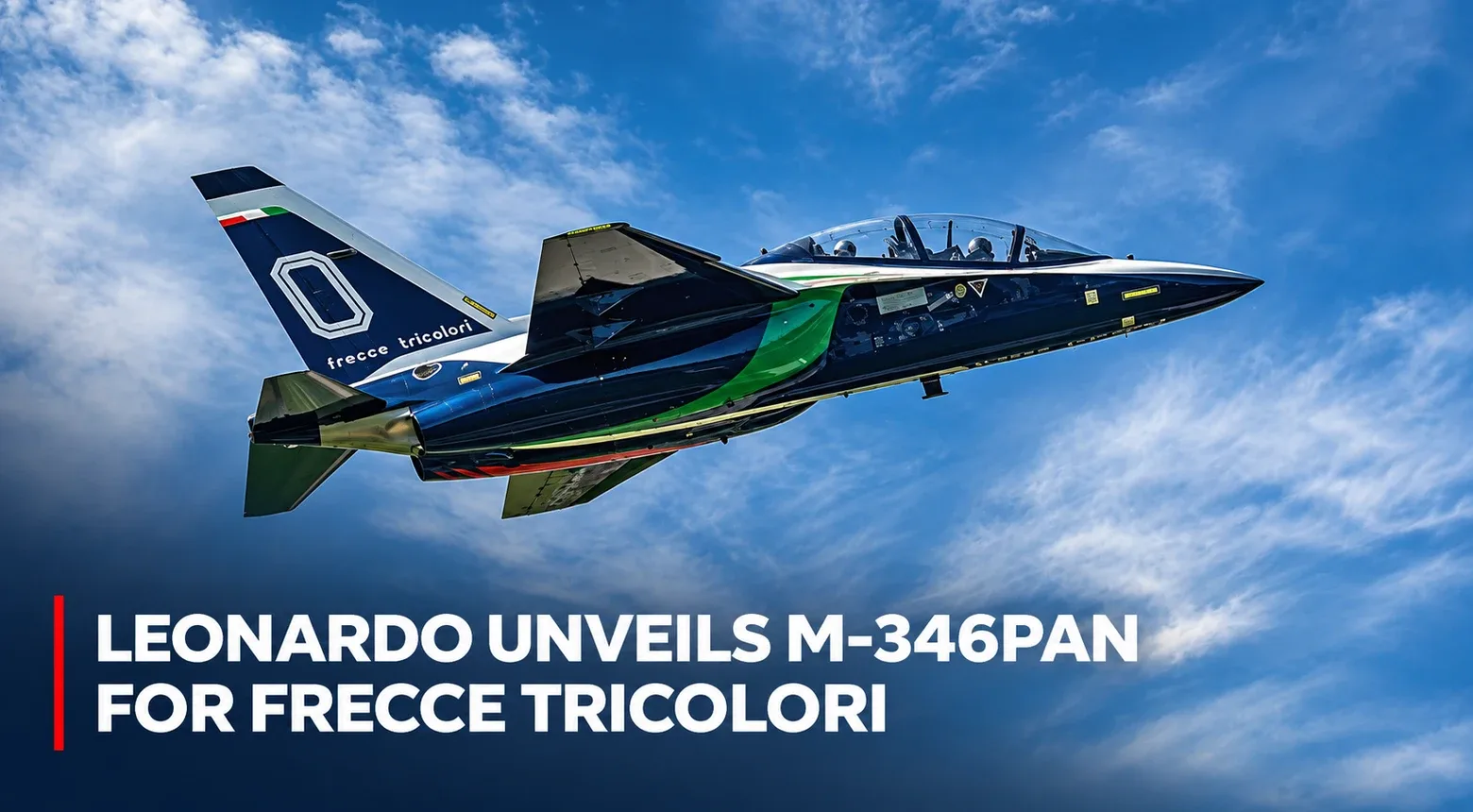
Leonardo and the Italian Air Force formally unveiled the first M-346PAN at Venegono Superiore on 26 November 2026, advancing the replacement of the Frecce Tricolori aerobatic fleet. The dedicated configuration of the M-346 advanced jet trainer is the centrepiece of a 15-aircraft renewal programme that includes ground infrastructure, training and support, rather than a simple exchange of aircraft.
M-346PAN roll-out advances Italy’s aerobatic fleet renewal
According to The Aviationist, the aircraft had already been flying before the ceremony and performed a demonstration on the day of the presentation. Six further airframes were reportedly undergoing manufacturing at the facility. The unveiling therefore represents progress in the industrial and testing programme, not the maiden flight of the M-346 family or the completion of fleet conversion.
The replacement decision dates to 12 September 2024, when the Italian Air Force announced the M-346 selection at Istrana. That event also introduced the livery developed by Pininfarina. The November 2026 presentation turns the earlier selection and design announcement into a visible milestone for an aircraft dedicated to the national aerobatic team. Its predecessor, the MB-339PAN, has served the team for more than four decades.
The new aircraft draws on an existing Italian training platform. The official T-346A aircraft profile describes a twin-engine advanced trainer with digital flight controls and avionics, supported by ground-based simulation. Those characteristics provide an established starting point for the fleet renewal. However, the standard trainer and the dedicated aerobatic configuration should not be treated as identical for the purposes of acceptance or support planning.
The selection also preserves the team's longstanding association with Italian aerospace manufacturing. From an industrial perspective, adapting a product already used by the national air force can offer advantages in institutional knowledge, supplier continuity and training infrastructure. These are potential benefits rather than verified savings: the public announcements reviewed do not quantify the life-cycle cost difference between operating the legacy fleet and converting to the new aircraft.
Deliveries, infrastructure and programme risks through 2028
The Leonardo announcement reproduced by EDR Magazine describes a programme extending beyond the 15 aircraft. It covers technical and logistical assistance, personnel preparation, simulation facilities and work at Rivolto, the team's home base. Radiocor reporting via Borsa Italiana places aircraft production and delivery in 2027 and 2028. The first aircraft's presentation is thus an intermediate milestone within a wider transition.
ANSA reports an approximate value of EUR 1 billion for the complete lot. That figure should not be interpreted as the purchase price of the unveiled jet or divided by the aircraft quantity to derive a flyaway unit cost. The inclusion of support, training and infrastructure makes the programme a bundled acquisition, and no detailed price breakdown was established in the material reviewed.
A separate RID report identifies a wider acquisition of 20 M-346 aircraft, including five intended for training alongside the 15 for Frecce Tricolori. This distinction matters for readers tracking procurement volumes: the aerobatic fleet is a subset, not an additional order of 15 aircraft on top of the reported 20. The official contract documentation and allocation of expenditure between these requirements warrant separate verification before a consolidated financial comparison is made.
For programme managers, the central challenge will be coordinating deliveries with aircraft acceptance, availability of support resources and personnel conversion. A public demonstration by an individual aircraft does not establish the readiness of the entire display team. Maintaining continuity while the MB-339PAN fleet is phased out adds a further scheduling consideration, particularly if infrastructure or acceptance milestones diverge from the production timetable.
The transition is also relevant to Leonardo's broader aircraft industrial portfolio. Defence Agenda has previously covered the Leonardo–Baykar LBA Systems joint venture and KIZILELMA developments involving M-346 aircraft. Those activities illustrate separate applications of the wider Leonardo aerospace ecosystem; they should not be confused with the PAN contract or treated as evidence of capabilities in the aerobatic variant.
Implications / Next: The principal indicators to monitor are the start of customer deliveries in 2027, progress at Rivolto, completion of the planned aircraft batch in 2028 and formal confirmation of the new team's display readiness. Until those milestones are documented, the programme is best described as a fleet renewal in production and testing rather than an operationally completed transition.
Further Reading
- The Aviationist — M-346PAN unveiling
- Leonardo announcement reproduced by EDR Magazine
- Italian Air Force — 2024 fleet selection and livery
- Italian Air Force — T-346A aircraft profile
- Radiocor via Borsa Italiana — delivery schedule
- ANSA — programme value and scope
- LBA Systems Joint Venture Reaches Operational Readiness
- Baykar Delivers First Three KIZILELMA Fighters