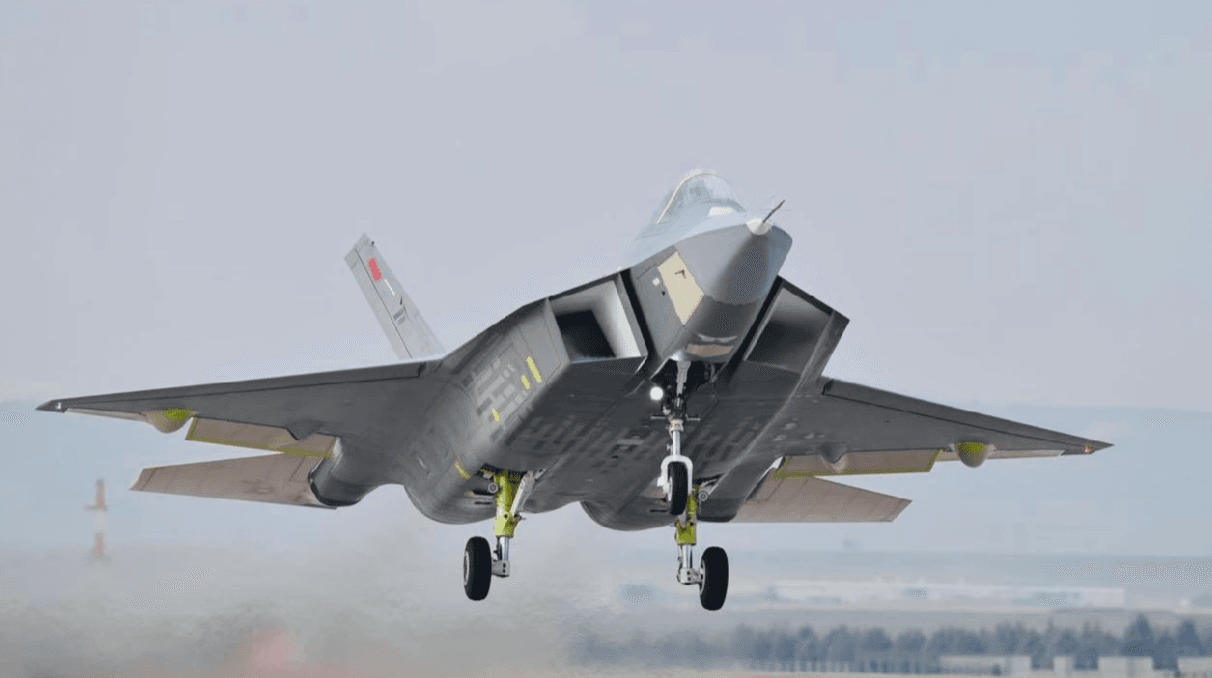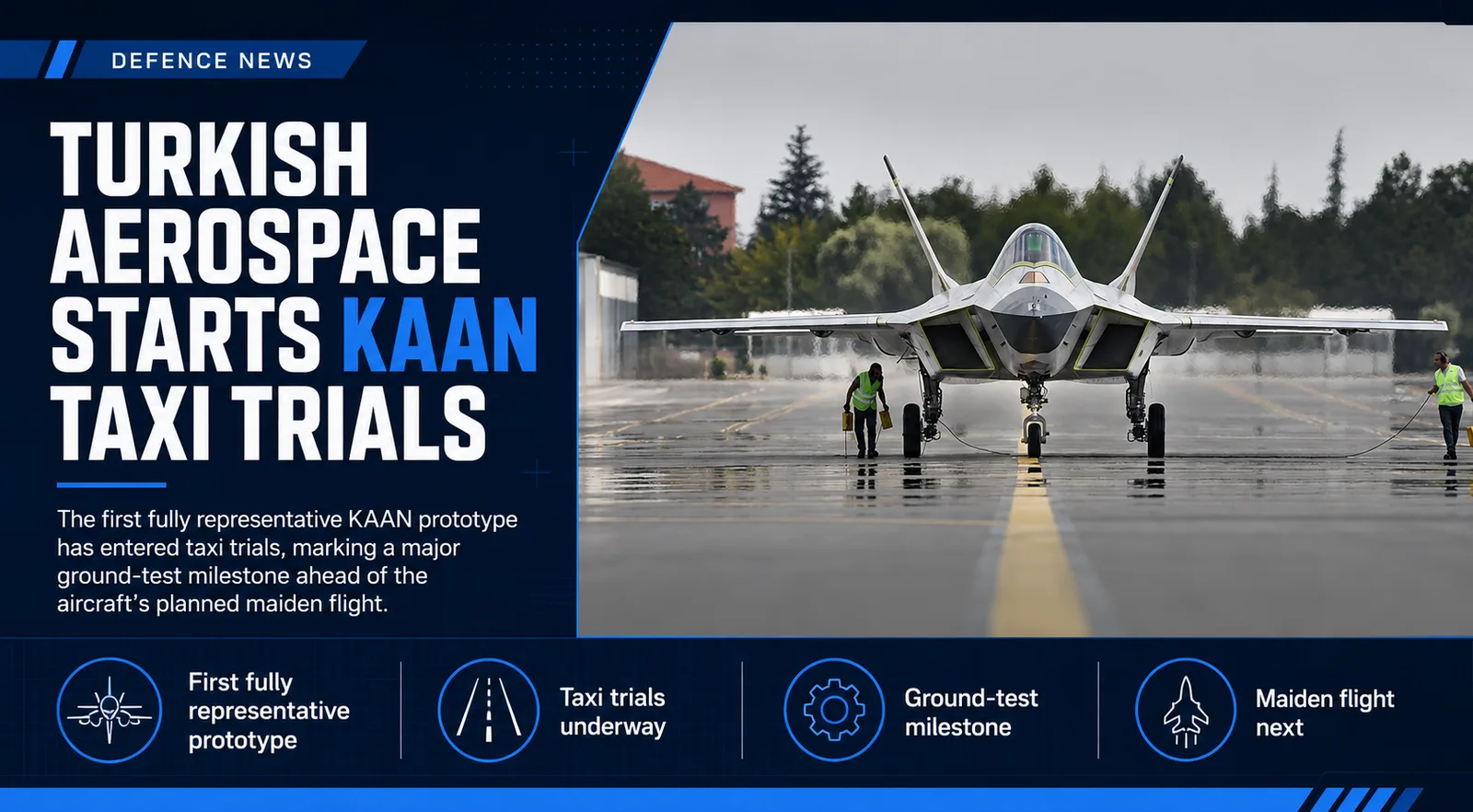
KAAN P1 taxi trials have begun as Turkish Aerospace advances the first fully representative prototype of Türkiye’s indigenous fighter aircraft toward its maiden flight.
Aviation Week reported on 31 July 2026 that imagery released by the manufacturer showed the largely completed aircraft moving along the runway at Turkish Aerospace’s facility near Ankara.
The start of taxi testing marks the transition from assembly and system integration toward aircraft-level ground evaluation. Engineers can now assess steering, braking, propulsion response, flight-control behaviour and the interaction between aircraft systems while the prototype operates under its own power.
Turkish Aerospace has not publicly announced an exact first-flight date for the aircraft. Company management has said that flight will follow the completion of the required ground and system-level tests.
Key Facts
- Aircraft: KAAN P1 flight-test prototype.
- Developer: Turkish Aerospace Industries.
- Milestone: Taxi trials confirmed on 31 July 2026.
- Test location: Turkish Aerospace facilities near Ankara.
- Prototype status: First fully representative KAAN prototype.
- Next major milestone: Maiden flight following ground-test completion.
- Exact maiden-flight date: Not publicly announced.
- Previous aircraft: The P0 development aircraft completed two flights in 2024.
- P0 first flight: 21 February 2024.
- P0 second flight: 6 May 2024.
- Initial powerplant: GE Aerospace F110 afterburning turbofan engines.
- Indigenous engine programme: TF35000, designed to produce 35,000 lbf of thrust.
- Primary role: Multi-role air-to-air and air-to-ground combat.
- Design priorities: Reduced observability, internal weapon carriage, sensor fusion and high situational awareness.
What Has Turkish Aerospace Announced?
Turkish Aerospace released imagery showing the new KAAN prototype taxiing at its Ankara-area facility.
Aviation Week described the aircraft as the first fully representative prototype of the fighter. This distinguishes it from the earlier P0 aircraft, which was primarily used to demonstrate the basic airframe, propulsion and flight characteristics.
The publicly available report does not specify the taxi speed, duration of the test, number of runs completed or whether the activity included high-speed runway testing.
The confirmed milestone should therefore be described as the beginning of taxi trials rather than completion of the full pre-flight ground-test campaign.
What Are Taxi Trials?
Taxi trials allow an aircraft-development team to test the platform on the ground while its engines, flight controls, brakes and other systems operate together.
Testing normally progresses from low-speed manoeuvres to increasingly demanding runway activity. The precise sequence depends on the aircraft, programme requirements and results obtained during each test.
- Nose-wheel steering response
- Main-wheel and emergency braking
- Engine acceleration and deceleration
- Hydraulic and electrical-system performance
- Flight-control surface movement
- Cockpit indications and warning systems
- Landing-gear loading
- Aircraft tracking and directional stability
- Communications between pilot and ground-test personnel
- Thermal performance during sustained engine operation
Successful low-speed testing does not automatically clear an aircraft for flight. Further inspections, system checks, software verification, engine runs and airworthiness reviews may still be required.
Why Is the P1 Prototype Important?
The P1 aircraft is intended to move the KAAN programme beyond basic proof-of-flight activity and into a broader development campaign involving a configuration closer to the planned operational fighter.
The earlier P0 aircraft demonstrated that the large twin-engine airframe could take off, fly and land. The new prototype is expected to support deeper evaluation of integrated aircraft systems, although Turkish Aerospace has not publicly disclosed the complete test allocation for the individual airframes.
A representative prototype provides engineers with a more relevant platform for evaluating flight controls, mission-system interfaces, avionics, propulsion integration, environmental systems and aircraft handling across a larger test envelope.
How Does P1 Differ From the Earlier P0 Aircraft?
| Area | P0 Development Aircraft | P1 Prototype |
|---|---|---|
| Primary programme function | Initial ground and flight demonstration | Representative prototype for expanded testing |
| Flight status | Completed two flights in 2024 | Conducting taxi trials before maiden flight |
| Configuration maturity | Early development configuration | Described as the first fully representative prototype |
| Test emphasis | Basic airframe, propulsion and flight characteristics | Broader aircraft and system-level evaluation |
| First-flight date | 21 February 2024 | Not publicly announced |
Turkish Aerospace has not released a complete technical comparison identifying every structural, aerodynamic, software and equipment difference between the two aircraft. Differences visible in published imagery should not be treated as a complete specification.
What Did the First KAAN Aircraft Demonstrate?
The official Turkish Aerospace KAAN page states that the P0 aircraft completed its maiden flight on 21 February 2024.
The flight lasted 13 minutes. KAAN reached an altitude of 8,000 ft and a speed of 230 kt.
The second test flight took place on 6 May 2024. It lasted 14 minutes, reached 10,000 ft and again achieved 230 kt.
Those flights validated the programme’s initial ability to operate the aircraft safely in a limited flight envelope. They did not constitute full qualification of the combat-aircraft design.
When Will KAAN P1 Make Its First Flight?
Turkish Aerospace has not provided a firm public date.
During the 2026 Farnborough International Airshow, company chief executive Mehmet Demiroğlu said the aircraft still needed to complete several ground and system tests before flying.
He indicated that the flight could occur within the following months and said the company’s broader objective was to have two KAAN flight-test aircraft operating before the end of 2026.
That statement represents a programme objective rather than confirmation of a fixed flight date. Test findings can affect the sequence and duration of pre-flight activity.
What Must Happen Before the Maiden Flight?
- Completion of low-speed taxi testing
- Aircraft braking and steering validation
- Engine ground runs
- Flight-control software verification
- Hydraulic, electrical and fuel-system checks
- Avionics and cockpit-system evaluation
- Landing-gear and weight-on-wheel system testing
- Emergency-system validation
- Aircraft configuration inspections
- Review of test data and identified anomalies
- Airworthiness and flight-safety approval
- Final first-flight readiness review
Turkish Aerospace has not publicly listed which of these activities have already been completed for P1 or published the remaining detailed test schedule.
Which Engines Power the KAAN Prototypes?
The initial KAAN aircraft use General Electric F110 afterburning turbofan engines.
Turkish Aerospace management said during Farnborough 2026 that 10 F110 engines were already in Ankara to support prototype and flight-test activities.
The company is also progressing with the acquisition of 80 additional F110 engines intended to support the initial production tranches.
The presence of F110 engines supports development and early production but does not change Türkiye’s longer-term objective of introducing an indigenous engine into the KAAN programme.
What Is the TF35000 Engine?
The TF35000 programme is being conducted by TEI in partnership with TRMOTOR under the Secretariat of Defence Industries.
TEI states that the engine is being developed to produce 35,000 lbf of thrust and meet the requirements of a fifth-generation combat aircraft.
The company identifies high-temperature superalloys, advanced coatings and cooling technologies among the programme’s principal technology areas.
Turkish Aerospace management has associated the indigenous engine with a later KAAN configuration, including the planned Block 30 aircraft. The engine remains under development and has not yet powered a KAAN flight.
F110 and TF35000 Roles in the KAAN Programme
| Area | GE F110 | TF35000 |
|---|---|---|
| Programme status | Operational engine supporting current development | Indigenous engine under development |
| KAAN application | Prototype, flight-test and initial production planning | Later indigenous-powered configuration |
| Published thrust information | Variant-specific data not disclosed for KAAN in the cited programme update | 35,000 lbf design objective |
| Development responsibility | GE Aerospace | TEI and TRMOTOR under SSB |
| Flight status on KAAN | Used on the flying P0 aircraft | No KAAN flight announced |
What Capabilities Is KAAN Intended to Provide?
Turkish Aerospace describes KAAN as a fifth-generation multi-role fighter intended for air-to-air and air-to-ground missions.
- Reduced radar visibility
- Internal weapon carriage
- High manoeuvrability
- Advanced onboard sensors
- Sensor fusion
- High situational awareness
- Networked information exchange
- Precision air-to-air and air-to-ground engagement
- Artificial-intelligence and neural-network support
- An avionics architecture designed for continuing development
These are programme objectives and manufacturer-described characteristics. Publicly available sources do not disclose measured radar-cross-section figures, the final sensor configuration, the complete internal weapon load or fully validated operational performance.
Does the Start of Taxi Testing Prove KAAN Is Ready for Service?
No. Taxi testing is a significant development milestone, but it is one part of a much larger flight-test and qualification process.
Following the maiden flight, engineers will need to expand the aircraft’s speed, altitude, manoeuvre and load-factor envelopes progressively.
Later testing is also expected to address mission systems, radar, electronic warfare, communications, weapons separation, aerial refuelling and operation with other crewed and uncrewed platforms.
The duration of this process will depend on the number of available test aircraft, flight-test tempo, technical findings and maturity of the supporting systems.
What Does the Milestone Mean for the 2028 Target?
Turkish Aerospace has continued to identify 2028 as the target for the first KAAN deliveries to the Turkish Air Force.
The start of P1 taxi testing supports that schedule by moving a more representative aircraft toward flight evaluation.
However, taxi testing alone does not confirm that the delivery target will be achieved. The programme must still complete a substantial volume of aircraft, propulsion, mission-system, weapon and production-readiness testing.
Delivery in this context may also refer to an early development or initial production configuration rather than the final indigenous-engine configuration planned for later blocks.
Why Does the Milestone Matter for Indonesia?
KAAN’s development now has an export dimension following the agreement covering 48 aircraft for Indonesia.
Turkish Aerospace states that the agreement also includes a framework for local production capabilities and training support.
Progress with representative prototypes is therefore relevant not only to the Turkish Air Force programme but also to the credibility of the planned export and industrial-cooperation schedule.
The company has not publicly provided a complete prototype-to-export delivery schedule or confirmed which KAAN block and engine configuration will be delivered to Indonesia.
What Should Be Watched Next?
- Completion of low-speed taxi tests
- Evidence of higher-speed runway activity
- Formal first-flight readiness approval
- The P1 maiden flight
- Initial flight-envelope expansion
- Flight of the subsequent representative prototype
- Mission-system integration announcements
- Radar and electronic-warfare testing
- Internal weapon-bay and weapon-separation tests
- Progress on F110 engine deliveries
- TF35000 component, core and full-engine testing
- Preparation of the initial production line
Conclusion
The beginning of KAAN P1 taxi trials marks a major transition in Türkiye’s indigenous fighter-aircraft programme.
The aircraft is the first prototype described as fully representative of the developing KAAN configuration and is intended to take the programme beyond the initial proof-of-flight work completed by P0 in 2024.
Taxi trials will provide data on propulsion, steering, braking, flight controls and integrated aircraft systems before a maiden flight can be authorised.
Turkish Aerospace has not announced a firm first-flight date. Company management has said that the flight will follow the completion of the remaining ground and system tests and continues to target two KAAN flight-test aircraft in the air before the end of 2026.
The milestone does not by itself validate KAAN’s planned combat performance or confirm its service-entry schedule. It does, however, place a more mature and representative aircraft on the runway and brings the programme closer to the expanded flight-test campaign needed for initial production.
For related coverage, see Defence Agenda reports on Anduril YFQ-44A production, the US Air Force F-47 test-aircraft programme and the ANKA III production configuration.
Further Reading
- Aviation Week: Turkish Aerospace Industries’ KAAN fighter begins taxi trials
- Aviation Week: Turkish Aerospace programme update from Farnborough 2026
- Turkish Aerospace: Official KAAN programme information
- TEI: TF35000 turbofan engine
- Secretariat of Defence Industries: KAAN development programme
- Turkish Aerospace: Indonesia KAAN contract