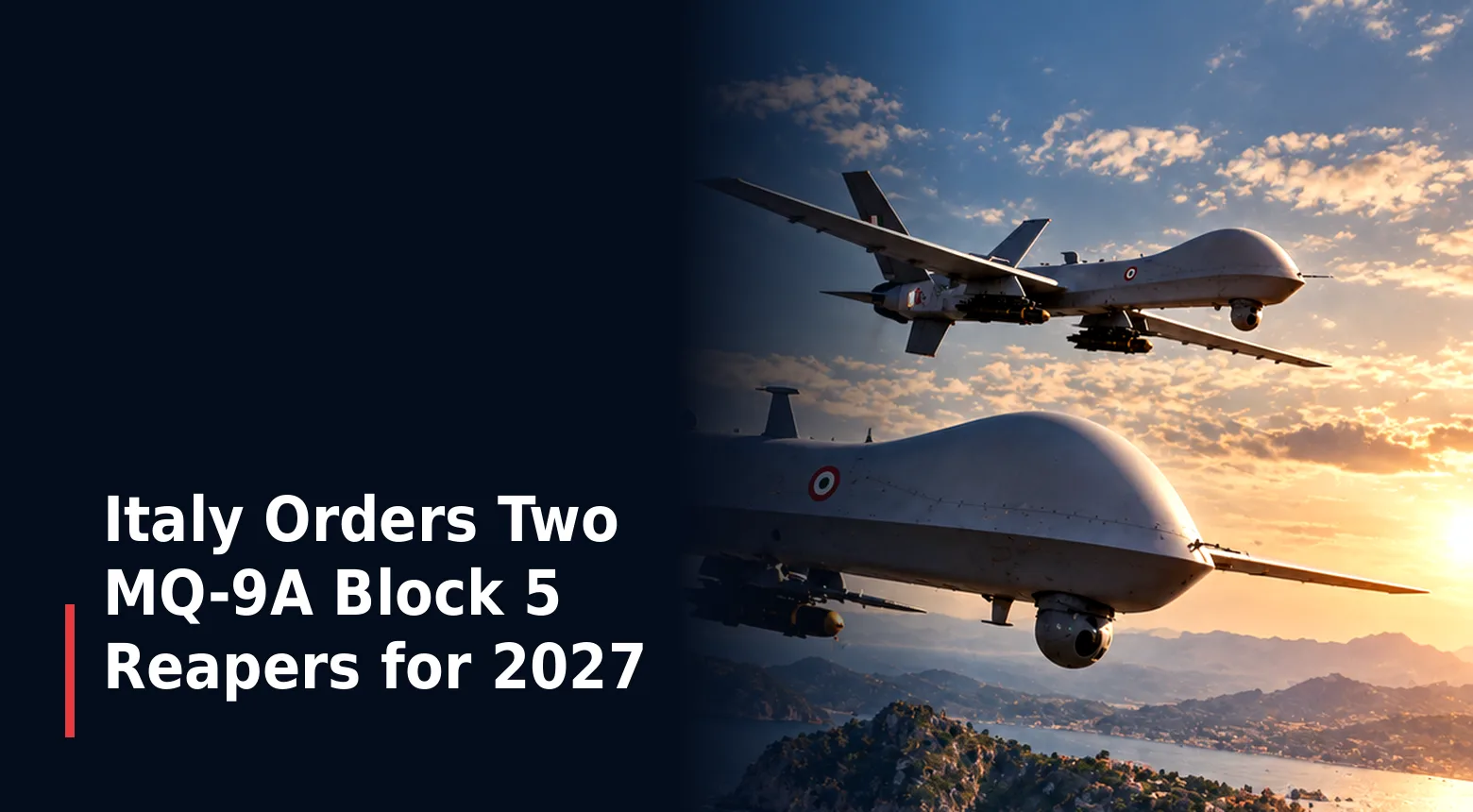
The Italian Air Force has ordered two additional General Atomics MQ-9A Block 5 remotely piloted aircraft through a U.S. Foreign Military Sale, the manufacturer announced on 8 September 2026. Delivery is planned for the end of 2027, and the package also includes ground control stations, reinforcing an established Italian intelligence, surveillance and reconnaissance fleet.
The FMS order extends an existing MQ-9A capability
General Atomics Aeronautical Systems said the two Block 5 aircraft were being acquired as part of a U.S. Foreign Military Sale involving the U.S. Air Force. The package includes ground control stations, which are an essential part of a remotely piloted aircraft system rather than an optional accessory. The manufacturer expects the new airframes to arrive at the end of 2027; its statement did not provide a contract price or specify how many additional stations will be supplied.
Italy has operated MQ-9 aircraft for more than two decades of cooperation with the American manufacturer, using them in national and NATO intelligence, surveillance and reconnaissance operations. The additional acquisition is therefore a fleet-continuity and capacity measure, not Italy's first entry into remotely piloted aviation. It also avoids the immediate training and support burden associated with introducing an unrelated airframe family, although each new aircraft must still pass its own customer acceptance process.
Airframes are only one part of persistent surveillance
The Block 5 design is marketed for long-endurance ISR missions using electro-optical sensing, radar and secure data links. GA-ASI advertises endurance of up to 26 hours and operation at altitudes reaching 45,000 feet under suitable configurations. These are manufacturer performance specifications, not promises that an operational mission with every payload and weather condition will achieve the same results. The source announcement did not identify a new Italian weapons configuration.
For a small fleet, two additional aircraft can help manage competing requirements for training, scheduled maintenance, deployed tasking and mission readiness. Control stations, communications links and qualified mission crews are equally important determinants of sortie availability. A larger inventory without corresponding sustainment and command infrastructure would not necessarily generate a proportional increase in hours on station, which explains the significance of including GCS equipment in the procurement scope.
Mediterranean and NATO requirements shape the programme
Italy's geography gives persistent maritime and airborne surveillance a direct operational value. Aircraft that can remain on station for extended periods can monitor sea lanes, support border and maritime awareness and help build a recognised operating picture in cooperation with allied systems. The actual tasks undertaken by the two new airframes will be decided by the Italian Air Force and should not be inferred from the platform's full advertised mission catalogue.
Interoperability also extends beyond aircraft-to-ground communications. NATO operations depend on common procedures for airspace control, intelligence distribution, cyber protection and the safe handling of remotely piloted flights near civilian traffic. Italy's continued investment in the established MQ-9A family suggests the government values continuity, but the order does not prove a change in the fleet's broader basing or command arrangements.
Budget and delivery remain distinct questions
The relevant public confirmation is the additional order and the manufacturer's end-2027 delivery forecast. An earlier U.S. FMS notification covering a wider potential package should not be used as if it were the final value of these two aircraft. Likewise, possible future options or upgrades would require separate contractual evidence before being reported as confirmed procurement.
The next steps are manufacturing completion, export and airworthiness paperwork, delivery, formal Italian acceptance and integration into operational tasking. The distinction between delivery and fielding matters because operators must establish spares, maintenance plans, crews and software baselines before the additional platforms deliver sustained capability. Public confirmation of those stages will provide a more reliable measure of programme progress than the initial announcement alone.
Implications / Next
Watch GA-ASI delivery releases, Italian Defence Ministry acceptance records and updated fleet basing or mission-system decisions. No additional airframes beyond the two ordered should be counted from this announcement.