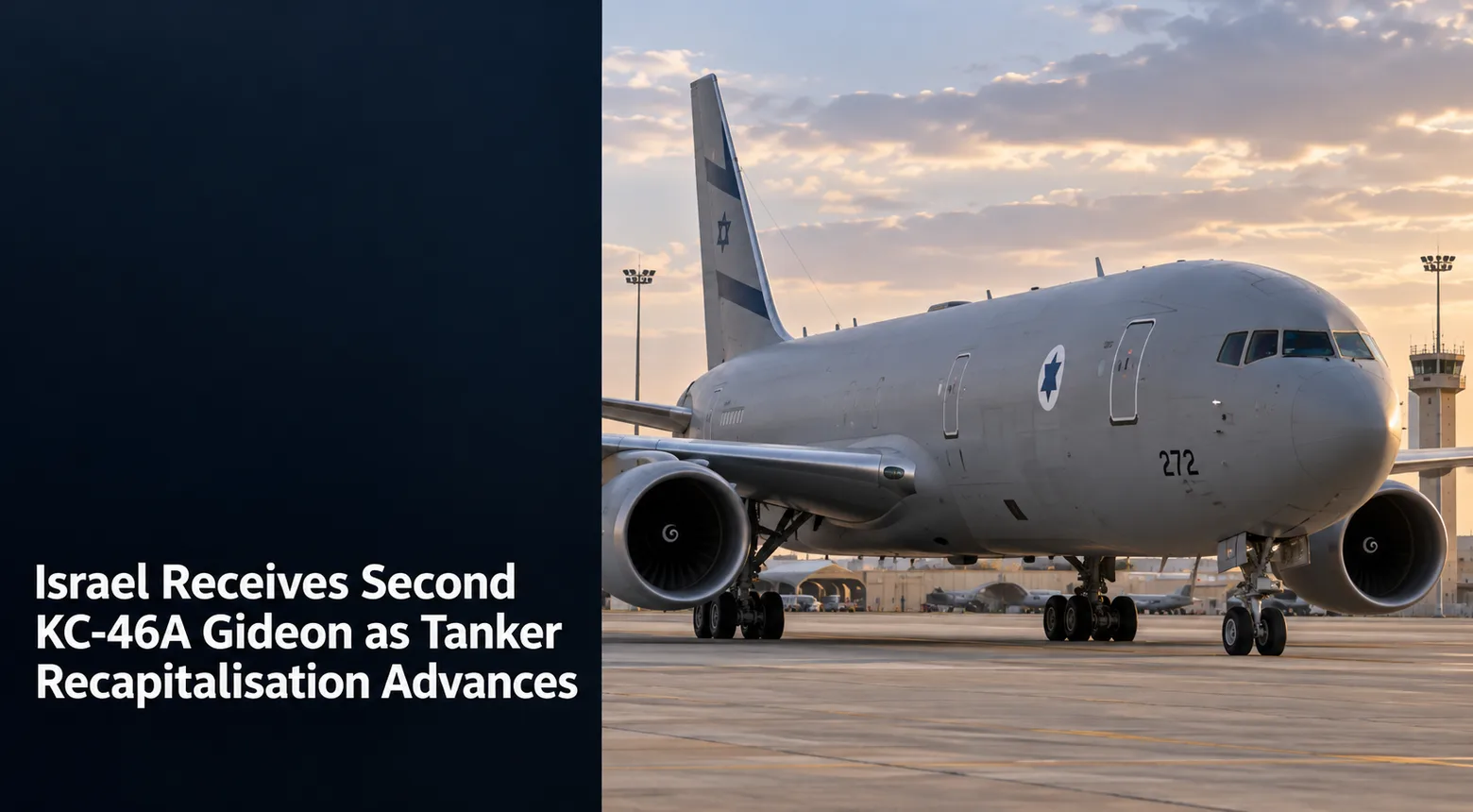
The Israeli Air Force received its second Boeing KC-46A Gideon tanker at Nevatim Air Base on 20 August 2026, advancing a six-aircraft recapitalisation of the country’s strategic aerial-refuelling fleet. The Israel Defense Forces said the aircraft was inducted into the new Gideon refuelling Squadron 46 during a ceremony the same day, with the official account published on 21 August.
The delivery follows the arrival of the first Israeli KC-46A earlier in 2026 and moves the programme from initial introduction toward formation of a usable fleet. Israel acquired six aircraft through the Ministry of Defense purchasing mission in the United States. The KC-46A is replacing ageing tanker capacity while adding a modern platform that can combine aerial refuelling with cargo and passenger transport missions.
Key Facts
- The second KC-46A Gideon landed at Nevatim Air Base on 20 August 2026.
- An induction ceremony was held on 20 August, with the IDF publishing its account on 21 August.
- The aircraft joined the new Gideon aerial-refuelling Squadron 46.
- Israel has procured six KC-46A tankers through its Ministry of Defense purchasing mission in the United States.
- The KC-46A adds both aerial-refuelling and transport capability.
- The second delivery advances fleet recapitalisation but does not represent completion of the six-aircraft programme.
Second Gideon joins Squadron 46 at Nevatim
The development is best assessed as a programme milestone rather than a complete operational endpoint. The verified evidence establishes the event described above, while subsequent procurement, integration, readiness or fielding claims require their own confirmation as the programme advances. That distinction is important for comparing announcements across defence programmes, where testing, production, delivery and operational acceptance are separate maturity stages with different evidentiary thresholds.
Long-range refuelling is central to Israeli air-power planning
Aerial tankers extend the radius, persistence and routing options of combat aircraft by allowing fighters to take fuel after take-off or during long missions. For Israel, which may need to operate far beyond its immediate borders, tanker availability has direct implications for how many aircraft can be supported over distance and how much flexibility commanders have in mission planning. The new fleet therefore has strategic value even though tankers themselves are non-strike platforms.
The KC-46A also provides improved communications, defensive systems and multi-mission flexibility compared with older converted tanker types. Israel is integrating the aircraft under the local Gideon designation and has adapted the programme to national operational requirements. Some details of Israeli-specific systems remain undisclosed, so reporting should distinguish confirmed delivery and squadron assignment from assumptions about classified modifications or mission configurations.
Six-aircraft programme remains incomplete
Receiving the second aircraft is a procurement milestone, not completion of the tanker recapitalisation. Four additional KC-46As remain within the six-aircraft programme, and fleet effectiveness will depend on delivery timing, crew training, maintenance capacity, spares and integration with Israel’s fighter force. A small tanker fleet can also be sensitive to maintenance downtime, making availability rates as important as the headline number of aircraft owned.
The next milestones are delivery of the remaining aircraft and evidence that Squadron 46 has progressed from induction to sustained operational tasking. As the fleet grows, the KC-46A should reduce dependence on legacy tankers and create more predictable support for long-range training and contingency missions. The key editorial distinction is therefore that Israel has reached the second delivery in a six-aircraft recapitalisation programme; it has not yet completed the transition.
Implications / Next
The next publication-grade milestone will be the first independently verifiable step that moves the programme beyond the status described here—such as a follow-on test, formal contract action, delivery, operational deployment or completed transaction, depending on the story. Defence Agenda will treat each maturity stage separately and will not infer production, operational capability or procurement completion from an earlier demonstration or announcement. The most useful follow-up evidence will therefore be dated official documentation, customer acceptance, serial-production data or operational activity that can be cross-checked against the current record.