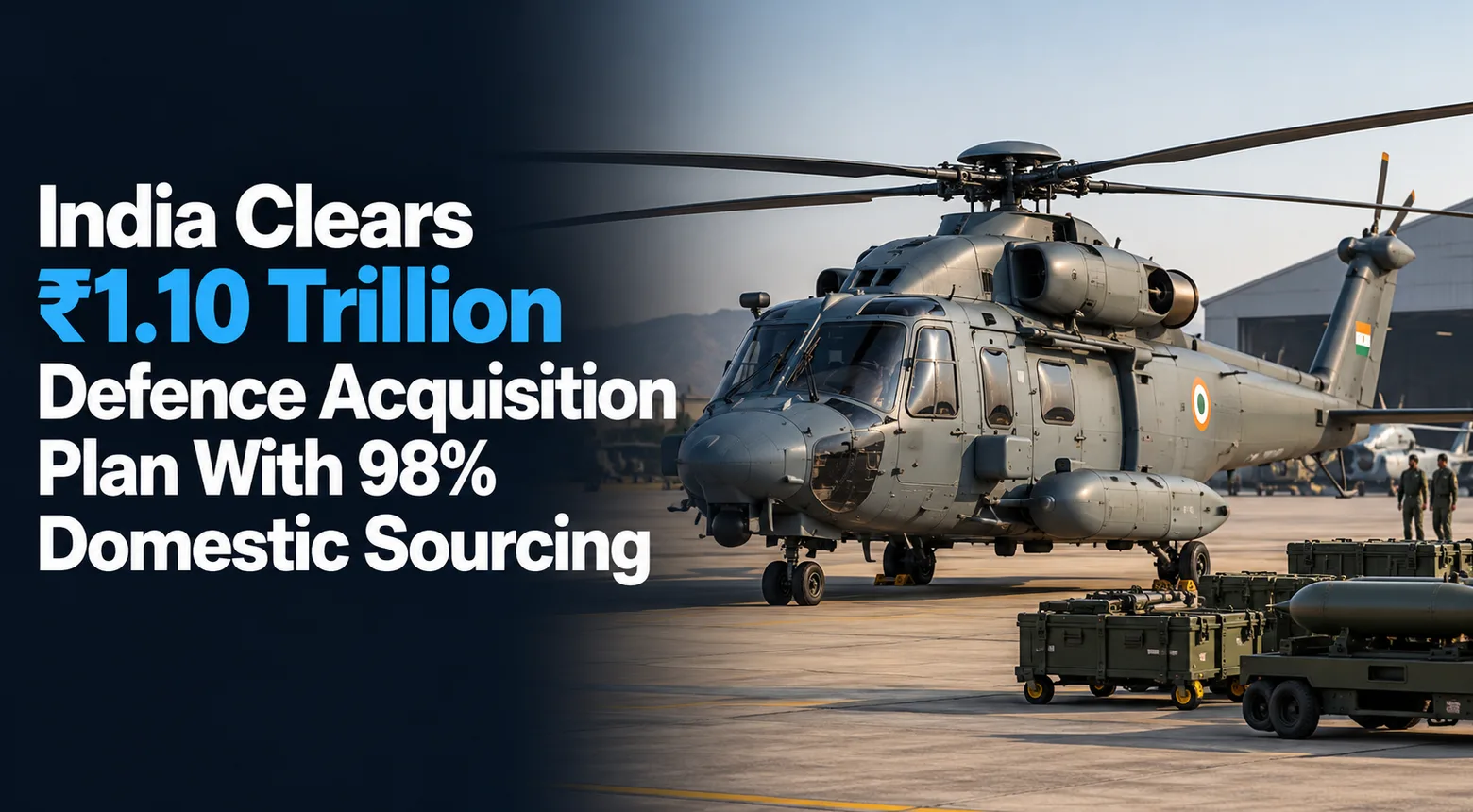
India's Defence Acquisition Council (DAC) granted in-principle approval on 26 October 2026 to military procurement proposals estimated at ₹2.12 trillion (₹2,12,000 crore; approximately US$22.27 billion). The package covers counter-drone systems, short-range air defence, long-range loitering munitions, helicopters, tracked artillery and naval platforms. The decision could shape future demand for Indian defence manufacturers, but it does not represent signed orders or disbursed funding. The Ministry of Defence said approximately 82% of the proposed procurement would be undertaken through Indian industry, highlighting the industrial implications alongside the operational priorities.
Key Facts
- Decision: Acceptance of Necessity (AoN), an in-principle administrative clearance issued by the DAC on 26 October 2026.
- Estimated proposal value: ₹2.12 trillion, equivalent to ₹2,12,000 crore; Reuters reported approximately US$22.27 billion at its stated exchange rate.
- Domestic sourcing: The ministry expects approximately 82% of procurement under the approvals to come from Indian industry.
- Army scope: Tracked self-propelled guns, high-mobility vehicles, light multi-role helicopters, VSHORADS, counter-UAS platforms and several surveillance and strike drone categories.
- Navy scope: Active offboard missile decoys and unspecified major naval platforms.
- Air Force scope: Helicopters, air-defence equipment, weapons and mobile X-band Doppler weather radar.
- Contract status: The ministry did not announce suppliers, award values for individual systems, final quantities, payment milestones or delivery dates.
Context
India is pursuing a broad re-equipment effort across land, maritime and air forces, with particular attention to the integration of air defence and uncrewed systems. The new decision follows an earlier DAC approval worth approximately ₹1.10 trillion in September 2026. That previous Indian acquisition package also concerned proposals at the AoN stage, rather than a set of executed purchase contracts. The two decisions should be treated as separate rounds of administrative authorisation, not as proof of aggregate expenditure.
India's defence procurement system distinguishes an initial acceptance that a capability is required from subsequent competition, negotiation, contracting, production and acceptance into service. That sequence is essential to understanding today's announcement: the headline figure indicates the estimated scale of proposals that may advance, rather than money already paid to industry.
What Happened
The Indian Ministry of Defence's official statement, published by the Press Information Bureau at 16:21 Indian Standard Time on 26 October, said Defence Minister Rajnath Singh chaired the DAC meeting. The council accorded AoN to acquisition proposals for all three services with an estimated aggregate cost of ₹2,12,000 crore. Reuters reported the decision later that day, expressing the value as about US$22.27 billion.
For the Army, the official list spans mobility, artillery, early warning, aviation and unmanned strike systems. The Navy's proposed acquisitions include active offboard decoys designed to improve defence against anti-ship missiles, as well as major naval platforms whose types and numbers were not identified. The Air Force approvals include special utility helicopters and mobile X-band weather radars intended to provide more localised weather information in forward areas.
Technical and Operational Details
The Army's very short-range air defence requirement is intended to address small, emerging aerial threats. A separate platform-based counter-uncrewed aerial system is described as enhancing tank survivability, suggesting a focus on protecting manoeuvre formations from drone attacks. These are approved requirements; the announcement does not establish which specific interceptors, sensors or electronic-warfare suites will be selected.
The proposed drone portfolio covers long-range uncrewed aircraft, surveillance UAVs, integrated surveillance-and-strike systems and long-range kamikaze drones. Together, these categories reflect demand for persistent intelligence, target acquisition and precision engagement. They should not be conflated with an earlier, distinct Indian Army loitering-munition order, which Defence Agenda has reported separately.
For naval defence, the active offboard decoy requirement addresses threats from anti-ship missiles by placing countermeasures away from a protected vessel. The ministry did not give the decoy's technical specifications, effectiveness, production source or integration schedule. Similarly, no individual helicopter model, radar manufacturer or gun-system quantity was confirmed in the DAC release.
Procurement and Industry Impact
The most commercially significant signal is the stated intention to source approximately 82% of the newly approved procurement from domestic industry. That may create opportunities for Indian prime contractors and component suppliers across missiles, sensors, vehicles, electronics and shipbuilding. However, the percentage should not be represented as a signed domestic contract value or as guaranteed revenue for particular manufacturers.
The distinction between an AoN and a contract is especially important for investors and suppliers. A future tender may specify a different equipment configuration, competition may change the supplier mix, and final acquisition values can vary from initial estimates. Funding provision, negotiated prices, industrial participation and delivery schedules remain future steps.
The announcement does not allocate the ₹2.12 trillion total across Army, Navy and Air Force programmes. Without that breakdown, drawing conclusions about the largest beneficiaries or the number of systems that will enter service would be speculative.
What Comes Next
The next verifiable milestones will be service-specific procurement documents, tender or selection decisions, final contract awards and production or delivery announcements. Defence Agenda will distinguish each of those stages from the DAC's initial clearance as they occur.
For now, the confirmed development is a substantial administrative approval that establishes procurement priorities in drone warfare, layered air defence, mobility and maritime survivability. Its eventual operational and industrial impact will depend on whether the proposals become funded contracts and delivered equipment.