India’s DAC Approves a Broad Multi-Service Acquisition Package
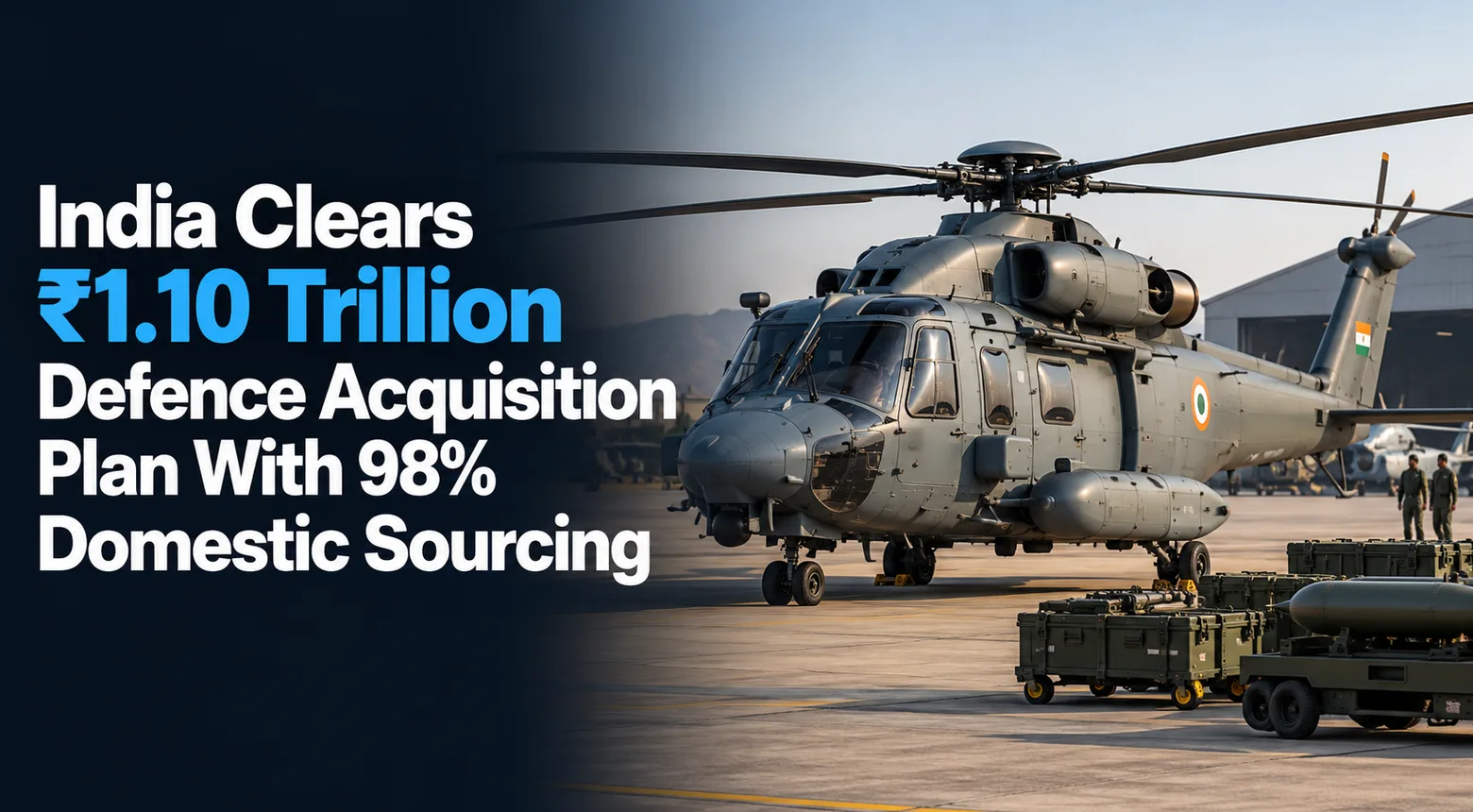
India’s Defence Acquisition Council approved capital-acquisition proposals estimated at about ₹1.10 trillion on 7 September 2026, covering Army, Navy and Air Force requirements across mobility, aviation, electronic warfare, surveillance and naval propulsion. The Ministry of Defence described the action as Acceptance of Necessity, or AoN, which is the administrative gateway that allows procurement cases to proceed into later tendering, contracting and execution stages. That distinction matters: the announcement signals policy approval and budgetary intent, but it is not a bundle of signed contracts and does not yet establish final quantities, suppliers or delivery schedules for every line item.
The package spans several operational problems rather than one flagship platform. For the Army, the approved cases include CBRN reconnaissance vehicles, high-mobility vehicles, self-propelled mechanical mine layers, advanced light helicopters, trawl tanks and Sarvatra bridge systems. The Navy received AoN for Arudhra radars and for the design, development and subsequent procurement of marine gas turbines, while Air Force-related approvals include ground-based multi-purpose jammers and secure digital access-card infrastructure. The breadth of the list suggests India is trying to close readiness gaps at the subsystem and enabling-capability level while simultaneously feeding demand into its domestic defence industrial base.
The 98% Domestic-Sourcing Target Is the Industrial Story
The most strategically important number in the Ministry’s release is not the headline value but the claim that approximately 98% of the approved procurement will be sourced from Indian industry. That proportion aligns with New Delhi’s continuing shift toward domestic design, manufacture and long-term sustainment, while still allowing foreign technology to enter through licensed production, partnerships, imported subsystems or joint development where required. If the sourcing ratio survives the transition from AoN to signed contracts, the package could translate into a substantial order pipeline for Indian public-sector and private-sector manufacturers.
The mix of equipment also spreads industrial demand across multiple tiers. Helicopters and radars generate high-value prime-contract activity, but vehicles, bridges, mine systems, electronics, propulsion components and secure-access infrastructure can involve a wider supplier base. For programme offices, this means domestic content will need to be measured in more than final assembly; the real industrial effect will depend on local control of design authority, critical components, software, propulsion, repair capacity and lifecycle support. India’s recent procurement policy has increasingly treated those attributes as part of strategic autonomy rather than as purely commercial offsets.
AoN Is Not a Contract, and Execution Risk Remains
Acceptance of Necessity provides momentum but leaves several acquisition gates ahead. Individual cases may still face staff requirements, tender documentation, commercial negotiation, technical evaluation, field trials and contract approval before money converts into delivered capability. Quantities and final prices can also change as procurement cases mature. Defence Agenda therefore treats the ₹1.10 trillion figure as the estimated value of approved proposals rather than the value of concluded awards.
Execution will also depend on the production capacity of Indian suppliers. A large simultaneous demand signal can strengthen investment and localisation, but it can also create bottlenecks in engines, sensors, specialised electronics, forgings, composites, test facilities and skilled labour. The practical test will be whether India can turn a very high domestic-sourcing ambition into predictable contracting and delivery without stretching schedules or relying on imported critical-path items that dilute the resilience objective.
Implications / Next
The next measurable milestones will be requests for proposal, named vendors, signed contracts and programme-specific delivery schedules. Particular attention should go to the marine gas-turbine effort because the official release explicitly links it to reducing dependence on foreign suppliers, making it a test of whether India can move from local assembly toward deeper propulsion sovereignty. The Arudhra radar and jammer cases will similarly indicate how strongly India’s electronics sector can absorb demand from a large cross-service acquisition cycle.
For the broader market, the approval reinforces India’s position as one of the world’s largest defence procurement growth stories while making access increasingly dependent on local industrial participation. Foreign OEMs may still find opportunity, but the commercial model will favour technology partnerships, Indian production and long-term sustainment structures over straightforward import sales. The package is therefore as much an industrial-policy signal as a military-modernisation decision.