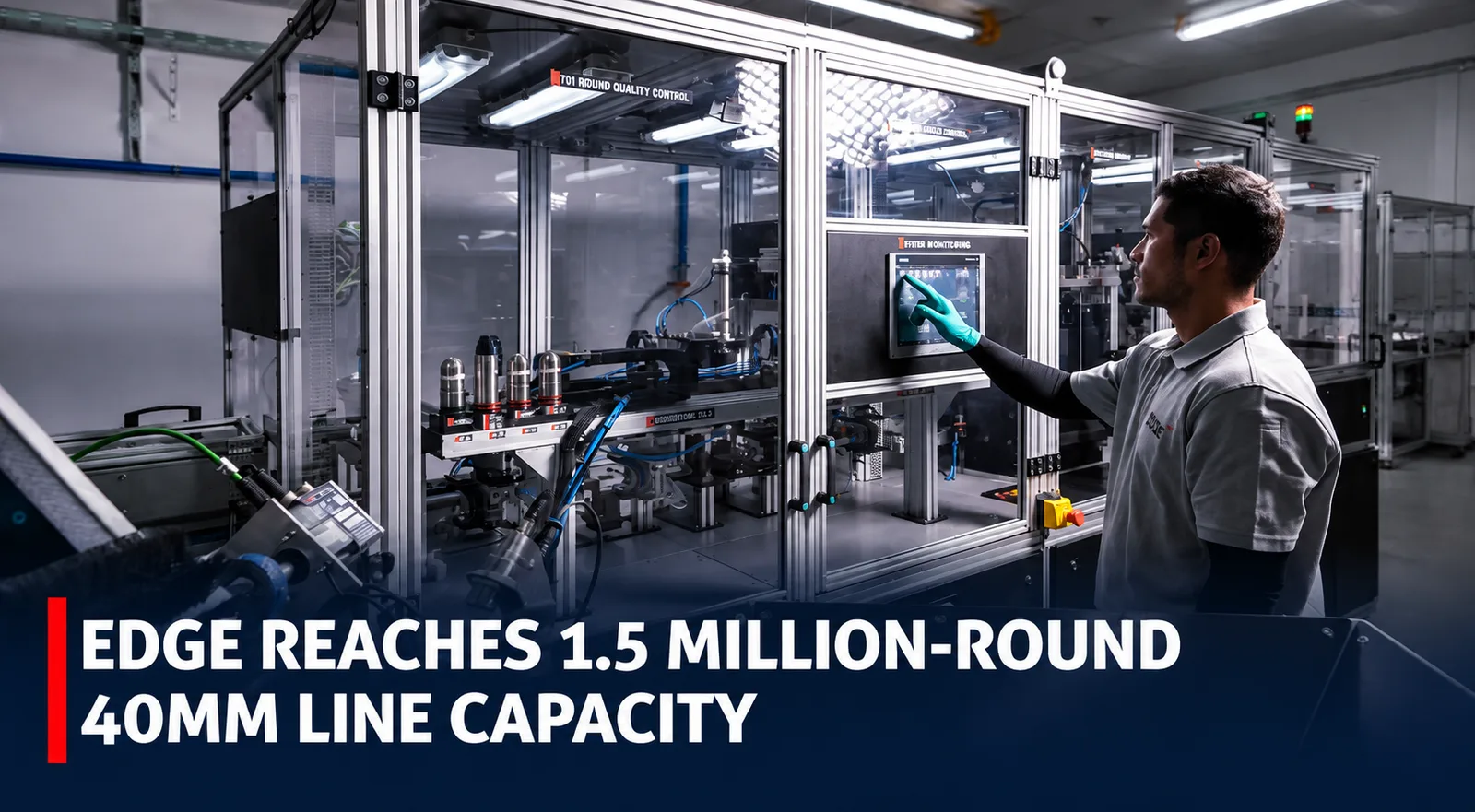
United Arab Emirates defence group EDGE announced on 22 October 2026 that LAHAB’s automated 40×53 mm ammunition line had reached full-rate production, with a stated maximum capacity of 1.5 million rounds annually. The milestone is an industrial capacity announcement rather than an award for that number of munitions.
Three-module line covers the assembly chain
EDGE says the installation entered operation at the end of 2025 and now covers cartridge-case assembly and filling, projectile filling and assembly, and final assembly and belting. The company describes movement from incoming sub-components to finished linked ammunition without manual intervention between those core manufacturing steps. The announced configuration centres on 40×53 mm ammunition, a common high-velocity grenade calibre.
The published annual figure is a stated production-line capacity, not a delivered quantity or verified annual utilisation. Operating at full-rate production in the company’s terminology does not establish that every day of the year will achieve peak throughput, or that 1.5 million rounds have already been produced and accepted by customers.
Automation targets labour and quality bottlenecks
LAHAB chief executive Mohammed Arbabi said the new line has reduced manual labour requirements by nearly 60%. EDGE also reports live process monitoring, performance dashboards and recordkeeping across the three modules, allowing deviations to be identified while work is still underway. Such systems can reduce process variation if inspection, calibration and traceability are maintained.
Automated manufacturing is not a substitute for proof testing, ammunition qualification or end-user acceptance. Energetic-material handling, safety controls, batch documentation, packaging and transport remain important. A sustained production advantage depends on the reliability of the entire factory and supplier network, not only on the final assembly machinery.
EDGE is applying a wider Industry 4.0 programme
The company places the line within a broader industrial modernisation campaign, saying it completed more than 68 Industry 4.0 projects across 28 facilities during 2025. EDGE reports capacity doubling at 13 group entities and cites automation at its HALCON guided-weapons manufacturing business and CARACAL storage operations as other examples.
Those internal programme-wide percentages should not be extrapolated to the 40 mm line or converted into group-wide ammunition output. Different products have different production bottlenecks and qualification regimes. The defensible claim here is the published capacity and manufacturing configuration of LAHAB’s particular assembly line.
Production capacity changes procurement options
High-volume 40 mm ammunition can be important for grenadier, vehicle and counter-small-UAS roles, although actual demand varies by customer, weapon and tactical concept. A regional manufacturing base with greater automation could offer buyers shorter replenishment cycles and potentially greater resilience against interruptions in labour-intensive assembly.
Buyers still need data on per-batch acceptance, interchangeability with qualified launchers, energetic-material sourcing, contracted deliveries and storage life. EDGE did not disclose a new contract quantity, customer identity or export destination in its 22 October industrial release, so none should be inferred from the factory milestone.
An annual capacity figure is most useful when linked to a clear production definition. Manufacturers may quote theoretical mechanical throughput, planned shifts, qualified completed rounds or actual shipments, and those values can differ substantially. For government customers and suppliers, the relevant measure is ammunition that has cleared inspection, proof testing and documentation and can be delivered within an agreed schedule. As EDGE expands automated manufacturing, the availability of cartridge components, propellant inputs and quality-control personnel will influence the usable output of the LAHAB line. Another important question is how quickly production can be changed between qualified variants without costly downtime. Public details on shift patterns, average utilisation and accepted batch volumes would allow more meaningful comparisons with other international ammunition investments. No such operating dataset was released with the headline 1.5 million-round capacity statement.
Implications / Next
Follow verified production output, test acceptance rates, any new 40 mm ammunition contracts and expansion of upstream component capacity. The announcement supports a capacity claim of up to 1.5 million rounds a year, not an assumption about firm orders or filled inventories.