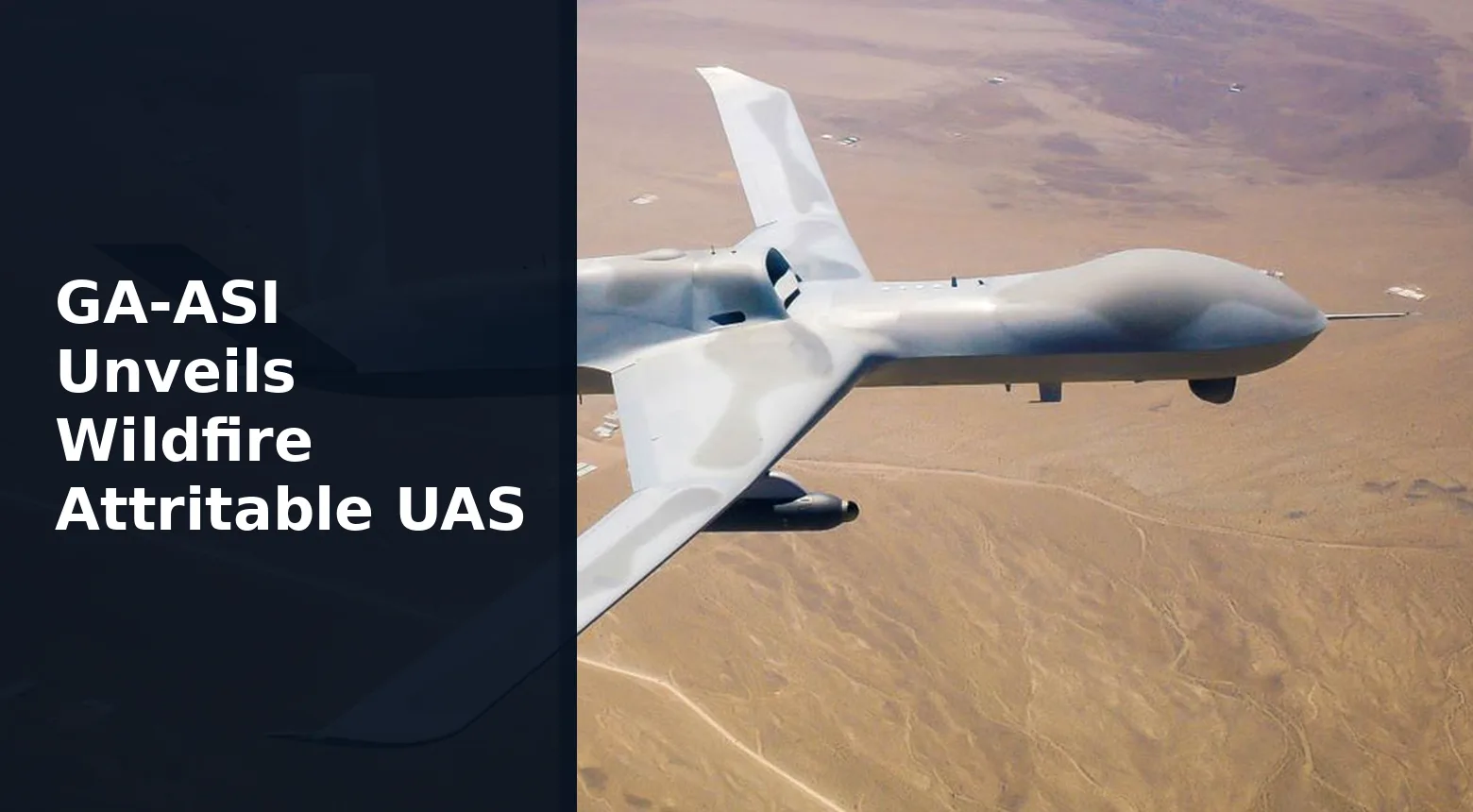
General Atomics Aeronautical Systems has unveiled Wildfire, a clean-sheet uncrewed aircraft proposed for the U.S. Air Force and Defense Innovation Unit Massed Modular Aircraft competition. The company presents it as lower-cost, modular and attrition-tolerant; it has not been announced as the competition winner or an operational aircraft. Wildfire shows a leading endurance-UAS supplier adapting to demand for mass, open architecture and standoff payload carriage. The key acquisition test is whether the design can deliver those attributes at a repeatable price and schedule without inheriting exquisite-platform support costs.
Wildfire is a proposal for a massed-aircraft requirement
GA-ASI links the design to the Air Force and DIU Massed Modular Aircraft competition. That establishes the intended customer problem but not a contract award. Public reporting should distinguish the company’s aircraft concept, a government competition entry and any later prototype or production selection.
The advertised payload and range are manufacturer claims
The company cites a ferry range above 8,000 nautical miles and depicts carriage of two Long Range Anti-Ship Missiles or four Joint Strike Missiles. Those figures describe design intent until a representative airframe demonstrates them under relevant conditions. Weapon separation, mission radius and survivability remain separate test questions.
Attritable economics depend on the entire operating model
A lower acquisition price can be offset by specialised support, runway demand, mission-planning infrastructure or low production yield. Wildfire’s modular architecture and autonomy could reduce integration time and crew burden, but only if interfaces remain genuinely open and government-controlled. Sustainment evidence will be as important as the airframe cost.
GA-ASI brings scale experience but is entering a different market
The company has delivered more than 1,600 large UAS across established families. Wildfire seeks to apply that industrial experience to a platform designed for greater acceptable loss and faster production. Success will require cultural as well as technical adaptation because massed systems place different priorities on certification, repair and replacement.
Programme and procurement context
This development must be read at its exact maturity level. General Atomics Aeronautical Systems has unveiled Wildfire, a clean-sheet uncrewed aircraft proposed for the U.S. Air Force and Defense Innovation Unit Massed Modular Aircraft competition. The company presents it as lower-cost, modular and attrition-tolerant; it has not been announced as the competition winner or an operational aircraft. Defence programmes pass through distinct stages: policy announcement, requirement definition, competition, contract, testing, production, delivery, acceptance and operational fielding. Collapsing those stages into a single claim can overstate both near-term military utility and industrial certainty.
For acquisition teams, the decisive evidence is funded scope, customer acceptance, integration responsibility and a supportable schedule. Wildfire shows a leading endurance-UAS supplier adapting to demand for mass, open architecture and standoff payload carriage. The key acquisition test is whether the design can deliver those attributes at a repeatable price and schedule without inheriting exquisite-platform support costs. Public announcements rarely resolve every dependency. Training, secure data, range access, infrastructure, export approval and supplier capacity can delay useful capability even after a technically successful milestone.
Source discipline is equally important. Company releases naturally emphasise momentum; government notices may describe only funded scope; exercise reports show activity without proving full readiness. Values should be labelled as contract ceilings or estimates when appropriate, performance figures as manufacturer claims until independently demonstrated, and dates as targets unless a customer confirms completion. Later primary records should replace early reporting as the programme matures.
The operational question is not whether the technology can be shown once, but whether users can employ it repeatedly under representative conditions. That requires realistic testing, configuration control, trained personnel, spares and an accountable command chain. Industrial significance also depends on repeatable production and quality assurance rather than prototype output alone.
Implications / Next
Track DIU down-selection, prototype funding, first flight, verified payload demonstrations, government-owned interface standards and a disclosed unit-cost basis. Do not treat the fiscal 2031 objective or advertised loadouts as achieved capability.
This item remains a draft pending final image-rights review, CMS media assignment and canonical publication data. A later report should be treated as a separate update only if it materially changes the programme status described here.
Further Reading
Saab A3 High-End Collaborative Combat Aircraft