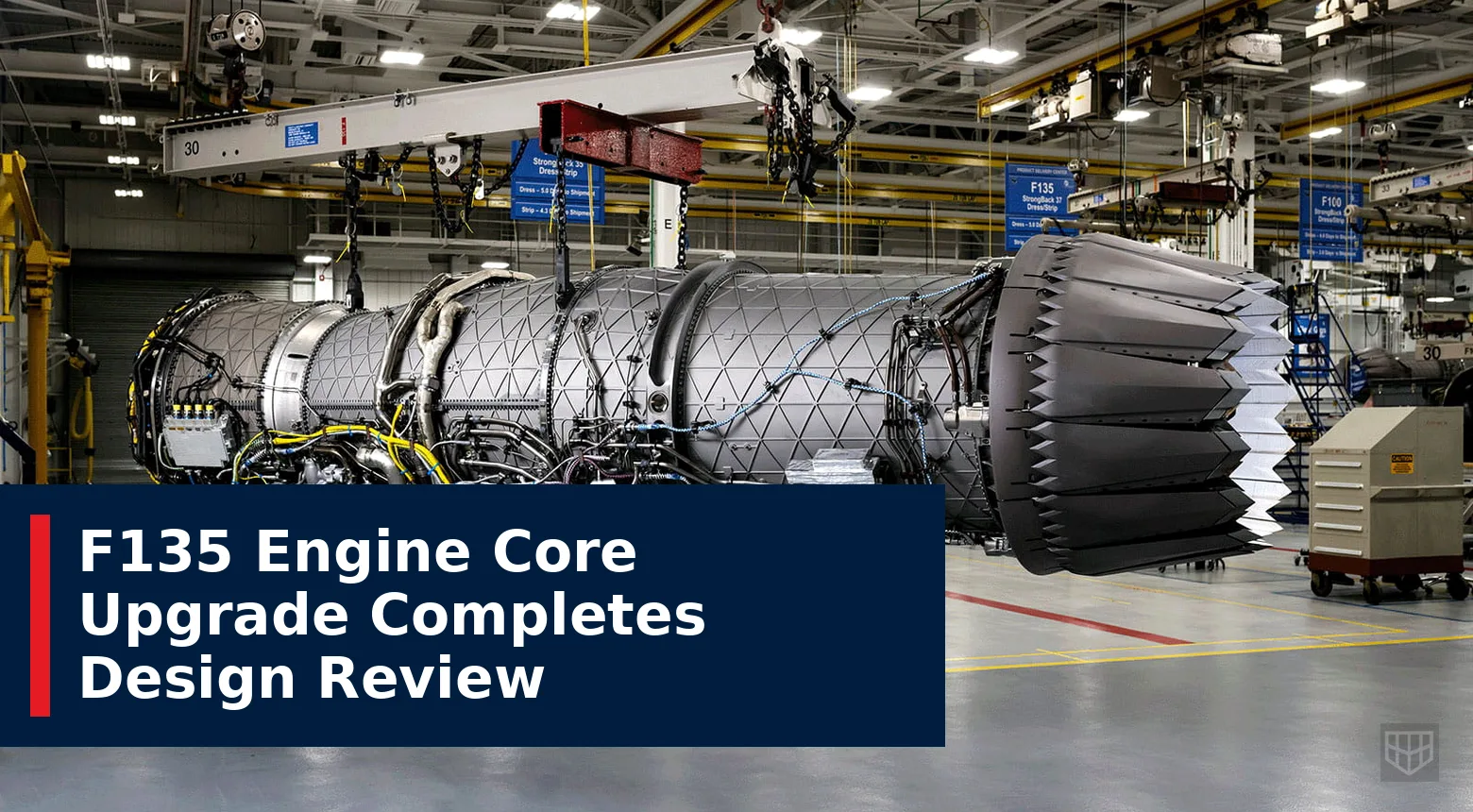
Pratt & Whitney has completed the F135 Engine Core Upgrade Risk Reduction Design Review, advancing the propulsion modernisation effort for F-35 Block 4.
What the review established
Pratt & Whitney has completed the Risk Reduction Design Review for the F135 Engine Core Upgrade, or ECU. Announced on 15 September 2026, the review examined detailed design elements, propulsion technologies, aircraft-integration considerations and the activities intended to reduce risk before full-scale test and production. It also assessed whether the supply base is preparing for future manufacturing and retrofit demand.
A Risk Reduction Design Review is a maturity checkpoint, not a production decision. The company says the result advances ECU towards production, but the upgrade still needs to pass later design, ground and flight-test gates. The announcement did not establish that operational aircraft can yet be modified, nor did it provide a fielding date approved by the F-35 Joint Program Office.
Power and cooling for Block 4
F-35 Block 4 introduces sensors, processing, electronic-warfare functions and weapons that create additional electrical and thermal demand. ECU is intended to restore engine-life margin while providing the power and thermal-management capacity needed to support those capabilities. The requirement applies across the conventional-take-off F-35A, carrier-capable F-35C and short-take-off and vertical-landing F-35B.
That common requirement is technically demanding because the variants operate with different aircraft constraints, and the F-35B’s lift-system integration is particularly sensitive. Pratt & Whitney describes ECU as a drop-in core upgrade based on the existing F135 architecture. Maintaining commonality can reduce the burden of introducing a completely different engine, but it does not eliminate the need to verify performance and airworthiness in each variant.
Production and retrofit concept
The company says ECU can be incorporated in new-production engines or retrofitted through F135 depot facilities. That approach is intended to support one global fleet configuration and use the existing production and sustainment enterprise. More than 1,500 production F135 engines have been delivered to a customer base spanning 20 allied nations, according to RTX.
The size of the installed fleet makes configuration planning a strategic issue. Operators will need to sequence upgrades without creating unacceptable aircraft downtime, while depots, spare-engine pools and training pipelines adapt to the new core. Supply-base readiness is therefore not a secondary administrative concern; it can determine how quickly an approved design becomes usable fleet capacity.
Testing before fleet introduction
The risk-reduction effort is supported by a contract awarded in 2024 and covers design maturation, integration and test preparation. Specialist reporting has pointed to ground testing beginning in late 2027 and flight testing around 2030, with production expected later if the programme clears its remaining reviews. Those dates remain schedule expectations rather than achieved milestones.
The next evidence should include completion of the full critical design process, delivery of test hardware, ground runs under representative thermal loads and aircraft flight testing. Cost, retrofit duration and demonstrated life improvement will shape operator confidence. The completed review is meaningful because it narrows design uncertainty; it should not be used to imply that the F-35’s future power and cooling shortfall has already been solved in service.
Operators will also need a transparent funding and installation plan. An engine-core upgrade competes for depot capacity with routine overhaul and unscheduled repair, so retrofit demand cannot be considered separately from fleet readiness. The programme will have to define which aircraft receive ECU first, how older cores are managed and whether national support arrangements can perform the work. Measured fuel use, thrust margin, component life and cooling performance under Block 4 loads will be more decisive than design-review language. If the upgrade delivers those outcomes while preserving commonality, it could limit disruption across the multinational fleet; if not, schedule and sustainment effects will reach well beyond the engine production line.