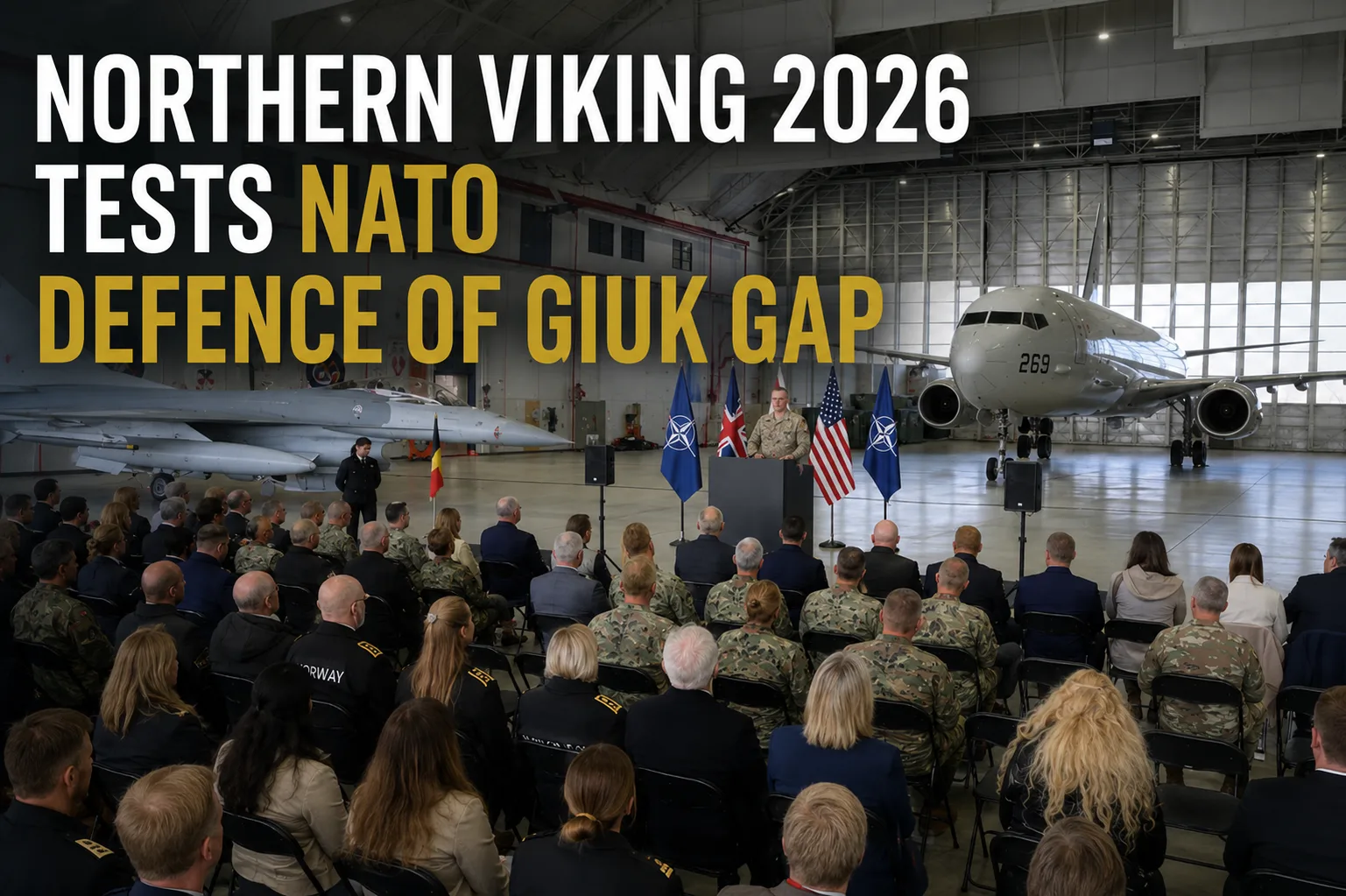
Northern Viking 2026 is placing the defence of Iceland and the Greenland-Iceland-United Kingdom Gap back at the centre of NATO’s North Atlantic training as U.S., Icelandic and Allied forces prepare for anti-submarine warfare, mine countermeasures, counter-drone defence and multi-domain operations around one of the Alliance’s most strategically important maritime corridors.
U.S. Sailors, Marines, Airmen and Soldiers joined the Icelandic Coast Guard and NATO Allies at Keflavik for the opening of the U.S. Sixth Fleet-led exercise on 18 August 2026. The iteration also marks the 75th anniversary of the 1951 bilateral defence agreement between Iceland and the United States.
The anniversary provides the political backdrop, but the operational significance is more immediate. Northern Viking is testing whether NATO can protect Iceland, keep reinforcement routes across the North Atlantic open and coordinate maritime, air and land forces in an environment increasingly shaped by submarines, unmanned systems, contested infrastructure and high-speed data-driven warfare.
Key Facts
- Exercise: Northern Viking 2026, led by U.S. Sixth Fleet and hosted with the Icelandic Coast Guard.
- Opening: 18 August 2026 at Keflavik Air Base, Iceland.
- Main exercise period: The 18 August U.S. release states 22 August–3 September 2026.
- Anniversary: 75 years since the 1951 U.S.-Iceland Bilateral Defense Agreement.
- Core missions: Anti-submarine warfare, mine countermeasures, expeditionary construction, search and rescue, humanitarian medical response and disaster response.
- Newer warfare themes: Defence against proliferating uncrewed systems, real-time data integration and AI-enabled decision support.
- Strategic geography: Defence of Iceland and sea lines of communication through the GIUK Gap linking North America and Europe.
Northern Viking 2026 Returns the GIUK Gap to Centre Stage
The geographical logic behind Northern Viking has changed less than the technology used to defend it.
Iceland sits immediately north of the Greenland-Iceland-United Kingdom Gap, the maritime passages connecting the Norwegian and Arctic seas with the wider North Atlantic.
For NATO, those routes are central to movement between North America and Europe. Reinforcement forces, merchant shipping, logistics vessels and naval task groups can all depend on secure Atlantic sea lines of communication during a major European contingency.
The same geography also makes the area important for anti-submarine warfare. Submarines moving between northern waters and the Atlantic must account for the GIUK operating environment, while NATO can use Iceland-based aircraft and maritime forces to extend surveillance over the region.
Northern Viking therefore combines defence of Iceland itself with protection of the wider transatlantic bridge.
Seven Nations Are Listed in the Latest Opening Release
The U.S. Department of Defense article covering the 18 August opening ceremony lists Belgium, Denmark, France, Iceland, Norway, Poland and the United States as participating nations.
Specialised personnel and capabilities from NATO Allied Maritime Command and Joint Force Command Norfolk are also participating.
Public U.S. exercise material is not completely aligned, however. A DVIDS Northern Viking 2026 feature page prepared before the opening lists a different and broader group including Canada, Finland, Germany and the Netherlands and describes the activity as a nine-day event.
For publication purposes, Defence Agenda therefore uses the later 18 August opening release as the current baseline while noting that the force list may continue to change as assets arrive.
ASW Remains a Core Northern Viking Mission
Anti-submarine warfare remains one of the exercise’s principal training areas.
This is consistent with earlier Northern Viking iterations. During Northern Viking 2022, NATO surface combatants and maritime patrol aircraft conducted submarine-hunting serials in the North Atlantic while forces simultaneously defended Keflavik infrastructure and practised maritime security missions.
Modern ASW increasingly depends on more than a frigate and its organic sonar. Maritime patrol aircraft, submarines, surface combatants, sonobuoys, fixed sensors and emerging uncrewed platforms can all contribute to a distributed detection network.
Defence Agenda has examined that evolution in NATO’s New Underwater Mission Network, where Allied countries are developing a common architecture intended to connect crewed and uncrewed underwater warfare systems.
Northern Viking gives NATO a geographically realistic environment in which to test the operational side of that problem around the North Atlantic approaches.
Mine Countermeasures Protect the Reinforcement Route
Mine countermeasures form another major element of NV26.
The requirement is closely connected to reinforcement and port access. A strategically important harbour or sea approach does not need to be physically destroyed to become unusable; a credible mine threat can slow traffic, divert specialised assets and create substantial uncertainty.
Modern mine warfare is also becoming increasingly autonomous.
Navies are shifting hazardous mine-search missions toward uncrewed surface and underwater vehicles equipped with sonar and autonomous navigation, keeping crewed minehunters and sailors further from suspected minefields.
This mirrors the wider experimentation visible in REPMUS/Dynamic Messenger, where NATO has been testing uncrewed mine warfare, undersea surveillance and multi-domain maritime command-and-control at increasing scale.
Counter-UAS Is Now Part of North Atlantic Base Defence
Northern Viking 2026 also reflects how rapidly the threat to military bases has changed.
Gen. Alexus G. Grynkewich, Supreme Allied Commander Europe and commander of U.S. European Command, said the exercise would practise defence against rapidly proliferating uncrewed systems.
That requirement is particularly relevant to Keflavik.
An air base supporting maritime patrol aircraft, transport aircraft and NATO reinforcement operations represents a high-value node. Small drones can threaten aircraft on the ground, fuel infrastructure, communications facilities and logistics activity without requiring a conventional air attack.
Base defence therefore increasingly needs a layered architecture combining surveillance, electronic warfare, kinetic interceptors and potentially directed-energy systems.
The addition of counter-UAS activity to an exercise historically associated with maritime and Icelandic defence is a useful indicator of how drone warfare is reshaping even rear-area NATO infrastructure.
AI-Enabled C2 Is Becoming Part of the Exercise
The command-and-control layer is also changing.
Grynkewich said Northern Viking would use data and AI-enabled decision-support tools while integrating information streams in real time.
The objective is not simply to add artificial intelligence to an exercise for experimentation purposes.
A North Atlantic defence operation can involve surface ships, submarines, maritime patrol aircraft, fighters, ground units, coastguard assets and NATO headquarters operating across a large geographical area.
Commanders therefore face a data-fusion problem before they face a weapons problem.
Tracks from multiple national sensors must be correlated quickly enough to identify threats, allocate forces and prevent different headquarters from acting on conflicting operational pictures.
Defence Agenda’s analysis of NATO Multi-Domain Operations highlights precisely this gap between Alliance-level concepts and the practical integration of national data, networks and command structures.
Keflavik Is More Than an Airfield
Keflavik Air Base remains the principal physical hub for the exercise.
The location provides NATO with a forward operating point for maritime patrol and reconnaissance aircraft covering the North Atlantic while also supporting logistics, command and reinforcement operations.
During earlier Northern Viking exercises, U.S. forces practised establishing alternative aircraft refuelling points after simulated attacks disabled normal base infrastructure.
That remains relevant because modern base resilience increasingly assumes that fixed fuel, communications and logistics facilities will be attacked during the opening stages of a high-intensity conflict.
The presence of U.S. Navy Seabees before NV26 reflects this expeditionary requirement.
DVIDS imagery dated 16 August 2026 shows Naval Construction Battalion 27 establishing an expeditionary camp at Keflavik to support forces participating in the exercise.
Expeditionary Construction Is Operational Resilience
Expeditionary construction may appear less dramatic than submarine hunting, but it is essential to the exercise’s strategic purpose.
Alliance forces deploying from North America into a contested European theatre require airfields, fuel storage, shelters, communications infrastructure, medical support and rapidly repairable operating locations.
If major installations are struck, engineers must restore or replace essential services faster than an adversary can suppress them.
Northern Viking therefore tests the logistics and infrastructure behind combat power rather than limiting the exercise to ships and aircraft.
Search and Rescue Reflect Iceland’s Unique Defence Structure
Iceland’s role is structurally different from that of most NATO Allies.
The country has no standing military, making the Icelandic Coast Guard and civilian authorities central to national security, maritime surveillance, air-defence support and crisis response.
Search and rescue, humanitarian medical response and disaster response are therefore not peripheral additions to Northern Viking.
They exercise the mechanisms through which Icelandic institutions and visiting Allied military forces would have to cooperate during a real emergency.
The model also means host-nation support is particularly important. NATO can deploy sophisticated combat platforms to Iceland, but those forces still depend on local infrastructure, airspace coordination, policing, emergency services and Coast Guard expertise.
The 1951 Agreement Still Underpins Iceland’s Defence
The 2026 exercise marks 75 years since the United States and Iceland signed their bilateral defence agreement on 5 May 1951.
The agreement created an unusual security structure in which the United States made arrangements for Iceland’s defence within the NATO framework because Iceland did not maintain its own armed forces.
For decades, that relationship centred on the permanent U.S. military presence at Keflavik.
The permanent force structure changed significantly when Naval Air Station Keflavik closed in September 2006, but the bilateral defence agreement remained in force.
The modern model relies more heavily on rotational deployments, exercises, maritime patrol activity and rapid reinforcement.
Northern Viking is therefore a practical demonstration of how the 1951 framework has evolved from permanent Cold War basing toward a more distributed NATO reinforcement architecture.
Northern Viking Has Operated Since 1982
The Northern Viking exercise series was first held in 1982 and is now conducted on a biennial basis.
Its recurring purpose has been to test Icelandic defence plans and improve the ability of U.S. and Allied forces to operate together in the High North and North Atlantic.
The training scenarios have evolved with the threat environment.
Earlier iterations emphasised air-base defence, maritime security, amphibious operations, anti-submarine warfare and logistics. NV26 retains those missions but adds increasingly explicit attention to uncrewed threats, data integration and AI-supported command decisions.
That continuity is strategically useful: the geography remains the same while the Alliance repeatedly updates the technologies and operating concepts used to defend it.
European Allies Are Expected to Carry More Responsibility
The exercise also contains a clear burden-sharing message.
Vice Adm. J. T. Anderson, Commander of U.S. Sixth Fleet, linked Northern Viking to an environment in which European Allies can assume greater responsibility for deterrence and defence in the European theatre.
That has direct implications for the North Atlantic.
The United States remains essential to transatlantic reinforcement, undersea warfare, strategic lift and high-end command capability, but European navies and air forces will increasingly be expected to maintain the maritime security environment through which U.S. reinforcements move.
Northern Viking therefore tests interoperability while simultaneously demonstrating how that redistribution of operational responsibility might function in practice.
The North Atlantic Is Becoming a Networked Battlespace
The broader strategic trend is toward persistent networked surveillance across the North Atlantic.
Aircraft, satellites, submarines, surface combatants, seabed sensors and autonomous systems are increasingly expected to contribute to one shared maritime picture.
This is particularly important for submarine detection, where no single sensor can provide continuous coverage of a region as large and environmentally complex as the North Atlantic.
NATO’s emerging underwater mission-network architecture aims to connect precisely these distributed systems.
The operational relevance to Northern Viking is direct: safeguarding the GIUK Gap will increasingly depend on the network linking sensors and commanders rather than only on the number of frigates or maritime patrol aircraft deployed around Iceland.
The Exercise Begins Before the Main Training Window
The chronology of NV26 requires some clarification.
The formal opening ceremony took place at Keflavik Air Base on 18 August 2026, while the latest U.S. release identifies the principal exercise period as 22 August to 3 September.
Forces were already arriving and constructing support infrastructure before the opening.
As of 20 August 2026, the main exercise serials therefore remain ahead rather than having been completed.
This is important editorially because early announcements describe planned training opportunities; final results on ASW, counter-UAS, mine warfare and AI-enabled C2 should be assessed only after the operational phase has taken place.
Implications / Next
The first issue to watch will be the actual multinational order of battle once the main exercise begins on 22 August. Public pre-exercise and opening materials currently provide different participant lists, so ship, aircraft and unit arrivals will clarify the final force structure.
The second is anti-submarine warfare. The specific submarines, maritime patrol aircraft, surface combatants and sensor architectures used during NV26 will indicate how NATO is refining surveillance around the GIUK Gap.
The third is counter-UAS. Details on the sensors and effectors used to defend Keflavik could show how NATO is adapting strategic air-base protection to increasingly inexpensive unmanned threats.
The fourth is AI-enabled command and control. Grynkewich’s emphasis on real-time data integration makes NV26 a useful test of whether NATO can convert multi-domain sensor inputs into faster operational decisions rather than merely collect more data.
Finally, the exercise will provide another measure of European burden sharing. Northern Viking’s operational value will increasingly be judged by whether European Allies can sustain maritime and air defence of the North Atlantic while remaining interoperable with U.S. reinforcement forces.
Conclusion
Northern Viking 2026 marks 75 years of U.S.-Iceland defence cooperation, but its greater significance lies in how that relationship is being adapted for a new North Atlantic security environment.
The strategic geography has not changed. Iceland still anchors the northern approaches to the GIUK Gap, and secure Atlantic sea lines remain essential to reinforcement between North America and Europe.
The threats and technologies, however, have changed considerably.
NV26 combines traditional anti-submarine warfare and mine countermeasures with counter-UAS defence, expeditionary infrastructure, distributed data, AI-enabled decision support and multinational command-and-control.
That combination makes the exercise a useful indicator of NATO’s evolving North Atlantic defence model: fewer assumptions about secure rear areas, greater reliance on resilient infrastructure and distributed sensors, and increasing pressure to connect national forces into one operational network.
The main training phase begins on 22 August 2026. Its results will show whether Northern Viking can translate those concepts into practical interoperability around one of NATO’s most important maritime chokepoints.
Further Reading
- U.S. Department of Defense: Exercise Northern Viking Marks 75 Years of Defense Cooperation
- DVIDS: Northern Viking 2026 Exercise Feature
- U.S. Navy: Northern Viking 2024 and Defence of Iceland
- U.S. Navy: Northern Viking 2022 Operational Lessons
- Defence Agenda: NATO’s New Underwater Mission Network
- Defence Agenda: NATO Multi-Domain Operations — Closing the 2030 Gap
- Defence Agenda: REPMUS/Dynamic Messenger 2025 Begins
- Defence Agenda: ASELBUOY P and POD Expand UAV-Based ASW