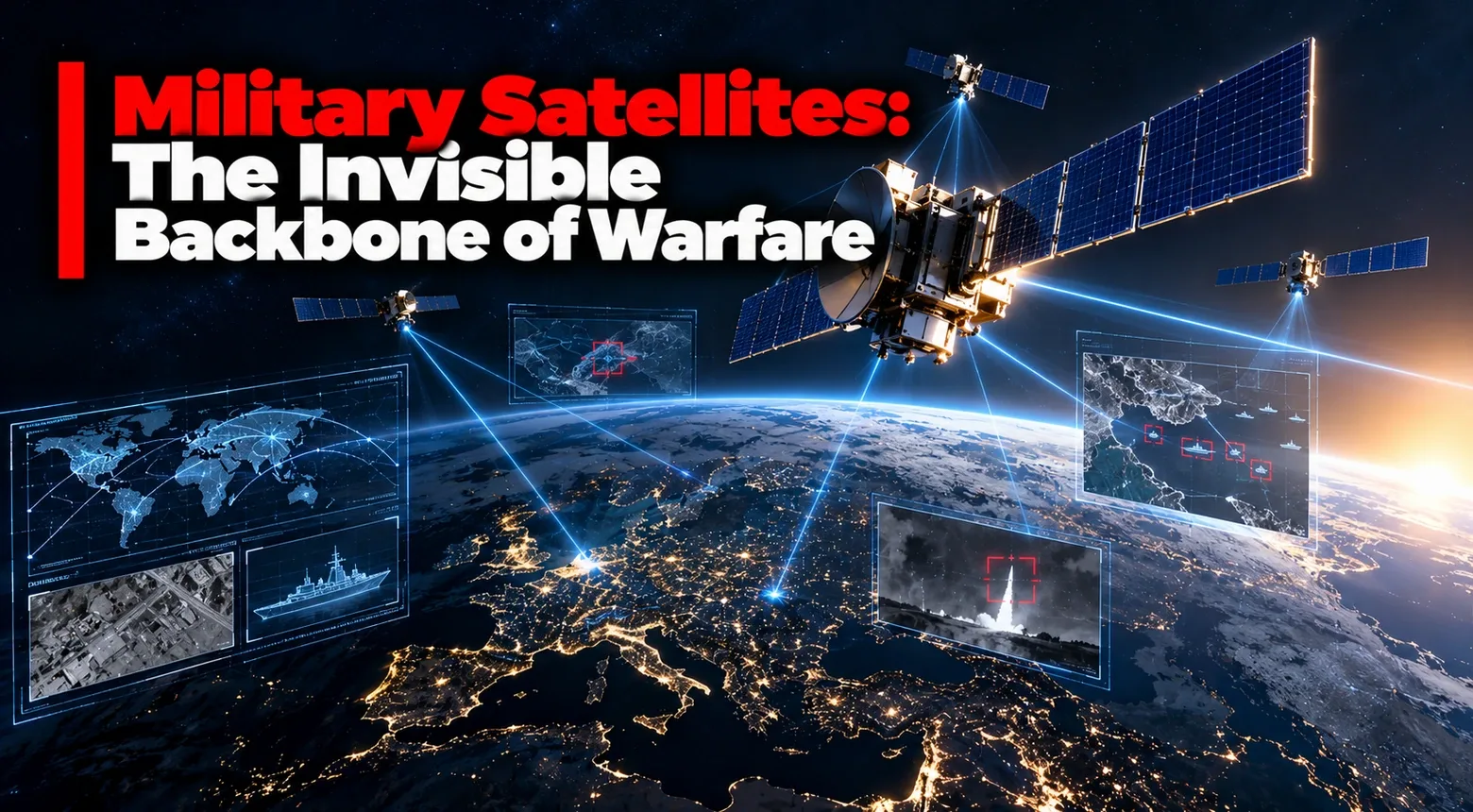
Military satellites have become indispensable to modern warfare, connecting dispersed forces, supporting precision navigation, providing intelligence and helping detect missile launches. On 10 October 2026, the US Space Development Agency (SDA) reported that another 21 Tranche 1 data-transport satellites had reached orbit, bringing the programme's on-orbit total to 84. The milestone highlights an increasingly important defence priority: building not just powerful satellites, but networks that continue functioning when individual spacecraft, ground stations or communications links are disrupted.
The fourth Tranche 1 orbital-plane launch does not mean that all 84 satellites are already delivering a complete operational service. SDA says initial Tranche 1 warfighting capability is expected beginning in 2027. That distinction matters as the United States, NATO and other governments invest in interconnected constellations intended to support forces operating across air, land, sea, cyber and space.
The underlying question is no longer simply who has the most satellites. It is which military can turn satellite data into timely, secure and resilient decisions, and how its forces operate when that connection is degraded.
Key Facts
- Latest US milestone: SDA announced its fourth Tranche 1 launch on 10 October 2026 from Vandenberg Space Force Base in California.
- Satellites deployed: A SpaceX Falcon 9 carried 21 Northrop Grumman-built Transport Layer spacecraft, bringing the reported on-orbit Tranche 1 total to 84, not a count of fully operational satellites.
- Expected service milestone: Initial Tranche 1 warfighting capability is planned to begin in 2027, according to SDA.
- NATO surveillance: The Alliance Persistent Surveillance from Space (APSS) programme reached initial operational capability on 4 December 2025.
- NATO integration: Eight Allies, including Türkiye, launched the HALO satellite-network initiative on 7 July 2026.
- Programme risk: The US Government Accountability Office (GAO) reported in January 2026 that the wider Proliferated Warfighter Space Architecture involves 300–500 planned satellites and expenditure approaching $35 billion through fiscal year 2029, with schedule and technical concerns.
- Orbital environment: ESA's 14 September 2026 report documented growing congestion and debris risk using observations through the end of 2025.
What Do Military Satellites Actually Do?
Military satellites perform several different roles. Their importance comes from the combined architecture rather than any single spacecraft. Communications satellites provide connectivity when terrain, distance or damaged terrestrial networks prevent direct links. Positioning, navigation and timing (PNT) systems support navigation, synchronised networks and precision-dependent operations. Imaging and signals-intelligence systems contribute to reconnaissance. Dedicated infrared sensors can detect and follow missile launches. Space-domain-awareness capabilities monitor objects and activity in orbit.
The NATO explanation of space as an operational domain identifies secure communications, PNT, missile warning, intelligence, reconnaissance and environmental monitoring as core services supporting operations in other domains.
That makes military satellites analogous to infrastructure rather than independent combat platforms. A satellite may identify activity, but commanders still need a way to validate information, move it across secure networks, interpret it and issue lawful orders. The value of space-based intelligence depends on the reliability of the entire chain from sensor to user.
For the public, one simple example is satellite navigation. A ship, aircraft or ground unit may use satellite-derived positioning, but an accurate position alone does not guarantee that the unit has reliable maps, current intelligence or a protected route. Similarly, an image of a missile launcher is not automatically a continuously updated targeting track. Timing, coverage, data analysis and command approval remain separate requirements.
The 10 October 2026 Launch: More Than a Satellite Count
According to the SDA's 10 October announcement, a Falcon 9 delivered 21 Northrop Grumman-built satellites into low Earth orbit (LEO). They form part of the Tranche 1 Transport Layer, intended to provide secure, low-latency, beyond-line-of-sight data transport and support advanced missile tracking.
LEO networks differ from traditional reliance on a small number of high-altitude spacecraft. Numerous satellites can create multiple routes for data and expand coverage, particularly when equipped with compatible inter-satellite and ground links. The architecture can be harder to disable by the loss of a single spacecraft, although satellites at lower altitudes require a larger constellation, frequent handovers and sustained replenishment.
SDA described both optical and Ka-band connectivity in its plans for Tranche 1. These are ways of carrying information, not guarantees that every terminal or allied user can automatically access the network. Operational performance depends on compatible ground equipment, functioning spacecraft, encryption, data-management software, network routing and agreed command procedures.
Crucially, the 84-satellite figure refers to Tranche 1 spacecraft reported in orbit after the fourth orbital-plane launch. It is not the final size of the entire Proliferated Warfighter Space Architecture (PWSA), nor proof that every satellite has completed testing. SDA says the full Tranche 1 launch campaign will continue, and it places the first operational capability milestone in 2027.
Missile Warning: Seeing a Threat Is Not the Same as Stopping It
Space-based missile warning is one of the most consequential defence applications. Infrared sensors can detect signatures associated with launches; tracking networks aim to maintain awareness as a threat moves. The difficulty becomes greater when trajectories are less predictable or when sensors must observe a moving object against challenging backgrounds.
On 8 September 2026, the US Space Force's Space Systems Command reported completion of a critical design review for the first two orbital planes of its Resilient Missile Warning and Tracking Epoch 2 medium Earth orbit (MEO) programme. The command said the planned Epoch 2 spacecraft would build upon the initial Epoch 1 architecture, which includes 12 satellites across two orbital planes. A completed critical design review is a design milestone—not a launch, a demonstrated interception or operational acceptance.
In a separate 9 January 2026 procurement announcement, Space Systems Command identified planned launches for Tranche 2 Tracking Layer satellites and an eight-spacecraft on-orbit fire-control demonstration. Those are acquisition and launch-support decisions. The relevant systems must still be delivered, integrated, tested and assessed.
For missile defence, the distinction between detection, tracking, fire-control-quality data and successful interception is essential. Each step involves different technical requirements and verification. Neither an orbital launch nor a favourable simulation establishes the ability to intercept a particular missile under operational conditions.
NATO's APSS and HALO: Space Power Through Integration
The European and transatlantic response is increasingly networked. The NATO Communications and Information Agency reported that APSS reached initial operational capability on 4 December 2025. The programme's Aquila model combines nationally owned and commercial satellite intelligence sources to make imagery and analysis available to Alliance operations. Initial operational capability is meaningful but is not the same as completion of every future surveillance and exploitation function.
NATO then announced HALO — Hybrid Alliance Layered Operations in Space — on 7 July 2026 at the Defence Industry Forum in Ankara. The initial eight participating Allies were Canada, Denmark, Finland, Germany, the Netherlands, Norway, Sweden and Türkiye. HALO is intended to connect nationally controlled military satellites into an integrated network supporting resilient communications, intelligence and missile tracking. It should be treated as a new initiative and integration objective, not as an already deployed mega-constellation.
The same NATO announcement said Spain became the 19th participant in APSS. It also recorded Türkiye's plan to develop two additional high-resolution satellites following IMECE, alongside investment intentions relating to low-orbit military communications and early-warning radar. These are announced plans; the source does not establish that the two new satellites are already in orbit.
This architecture matters for procurement. A country may retain control of its own satellite while contributing approved data to a wider alliance network. Yet the benefits rely on common standards, permissions, security classification, latency requirements and operational interoperability. A set of sovereign assets does not become a coherent military service simply by being described as connected.
The Commercial Space Question: Faster Access, Different Dependencies
Commercial operators offer imagery, launch capacity and satellite connectivity on a scale that governments would struggle to reproduce quickly. NATO's joint intelligence, surveillance and reconnaissance guidance recognises the value of integrating commercial and national assets through APSS. The Alliance's Commercial Space Strategy, endorsed in February 2025, reflects a similar interest in using commercial services for military requirements.
However, commercial availability does not equal assured wartime availability. Service-level agreements, licensing, export controls, data access, terminal security, sovereign command authority and possible restrictions on use can become significant operational constraints. Government buyers must distinguish between procuring satellite capacity and controlling the network, operational priorities and continuity arrangements.
This debate is particularly visible around the distinction between commercial Starlink connectivity and military-oriented Starshield services. A Reuters explainer published on 14 October 2026 examined their differing intended customers and the implications of control over services. The broader procurement question is not whether private providers are useful; it is how governments ensure appropriate contractual authority, access and redundancy.
Germany offers a sovereign alternative. Defence Agenda previously examined the proposed SATCOMBw4 military satellite project, including the prospective acquisition schedule and questions surrounding industrial competition. A domestic or allied satellite programme may offer political and security advantages, but it still faces financing, launch, terminal-integration and lifecycle costs.
Why an Orbital Network Needs Ground Infrastructure
Satellites are only one component of an operational capability. Ground stations receive and transmit data; terminals connect users; processing software converts sensor output into information; and command networks route that information to authorised units. Failures on the ground can therefore affect a functioning constellation in orbit.
US efforts to create a more flexible orbital-data environment illustrate this challenge. Defence Agenda's coverage of the Space Force Data Network vendor expansion highlighted the prospective benefits of cross-network routing and the importance of proving interoperability rather than assuming it exists. Such approaches could allow a user to receive service from alternative compatible networks, but real-world performance must still be demonstrated.
The central engineering objective is graceful degradation: a force should retain useful, though potentially reduced, communications, navigation and awareness if a satellite link is jammed or lost. Terrestrial fibre, radio networks, airborne relays, inertial navigation and disciplined procedures remain relevant layers. None can replace every satellite function globally, but over-reliance on a single orbital service can create an avoidable single point of failure.
In a digitally intensive force, the ultimate limitation may be information assurance rather than raw bandwidth. Data can arrive quickly yet still be late for a particular decision, incompatible with another system, mislabelled or insufficiently verified. Resilience requires attention to identity management, data provenance, software configuration and human oversight as well as launch cadence.
What Threatens Military Satellites?
Space systems face several categories of risk. Electronic interference can degrade links or positioning signals. Cyber incidents can affect connected ground infrastructure and data services. Spacecraft are also vulnerable to physical damage, technical failure, environmental conditions and collisions with orbital debris. Some states have tested counterspace capabilities, raising concern about deliberate attacks, although the practical threat posed to any given constellation is scenario-dependent and often classified.
NATO describes space as an increasingly contested operational domain and has emphasised sharing information about interference and threats. Defence Agenda's earlier analysis of US Space Command's kinetic and non-kinetic space requirements addresses the strategic debate over how military operators defend orbital capabilities without escalating a conflict or worsening the debris environment.
Space debris is a security problem even without hostile action. ESA's 2026 Space Environment Report, published on 14 September 2026, assessed developments using data through the end of 2025. It found continuing growth in active satellite constellations and debris, with orbital congestion increasing collision-management demands. These observations are about the overall space environment; they do not mean that a specific newly launched military constellation has suffered a collision.
A proliferated network can tolerate the loss of individual spacecraft better than a small, concentrated constellation in some circumstances. It also creates recurring requirements for satellite manufacture, launch, collision avoidance, space tracking, software maintenance and replacement. Resilience is not free, and a large number of spacecraft does not automatically solve ground-segment or spectrum vulnerabilities.
Military Satellite Programmes: Status Versus Promise
| Programme or capability | Verified position by 21 October 2026 | Main military role | What remains to be shown |
|---|---|---|---|
| US SDA Tranche 1 Transport Layer | 84 satellites reported in orbit after 10 October launch; initial capability planned from 2027 | Low-latency data transport and support for missile tracking | Operational acceptance, terminal integration and tested service resilience |
| US resilient MEO warning/tracking, Epoch 2 | Critical design review completed for initial two orbital planes on 8 September 2026 | Missile warning and tracking | Satellite production, launches and end-to-end performance |
| NATO APSS / Aquila | Initial operational capability declared 4 December 2025 | Multinational space-based ISR | Wider scale, exploitation speed and integration maturity |
| NATO HALO | Eight Allies launched initiative on 7 July 2026 | Connect sovereign satellite assets for communications, ISR and missile tracking | Integration milestones and operational fielding |
| Germany SATCOMBw4 | Future constellation and late-2026 contracting discussed in public reporting | Sovereign protected satellite communications | Contract award, configuration, schedule and delivery |
Methodology: The table compares disclosed programme milestones, not satellite quality or mission success rates. A design review, programme launch, orbital deployment and operational certification are distinct events.
Procurement Economics: More Satellites Do Not Mean Cheaper Capability
A central attraction of proliferated satellites is distribution of risk. A larger constellation may provide more routing options and a more flexible replenishment model than dependence on a few exceptionally capable spacecraft. Small satellites can also be acquired through competitive industrial cycles that permit design improvements over time.
Nevertheless, the GAO report GAO-26-107085, published on 28 January 2026, identified important issues in the US PWSA programme. GAO said the architecture plans at least 300–500 satellites, with expected expenditure approaching $35 billion through fiscal year 2029. The estimate covers the wider programme; it should not be divided by 84 to invent an individual spacecraft unit price.
GAO also reported that some critical technologies had been assessed as more mature than the subsequent work supported, contributing to unplanned contractor effort and schedule pressures. The report questioned how transparently users' requirements were being incorporated and recommended better system-level scheduling. The findings represent a material counterweight to publicity centred on rapid launches.
Constellation economics include more than the spacecraft. They encompass launch contracts, ground stations, cybersecurity, optical and radio terminals, software, testing, sustainment, spectrum management and replacements. GAO noted that SDA's tranche approach involves spacecraft replacement on a roughly five-year cycle. Recurring procurement can strengthen industrial capacity, but it can also lock governments into continuous renewal expenditure.
For prime contractors and suppliers, the opportunities span satellite buses, sensors, inter-satellite terminals, high-reliability electronics, propulsion, antennas and mission software. For procurement authorities, the decisive evaluation questions are interoperability, verified performance, upgrade pathways, vendor dependence, total lifecycle cost and operational availability under stress.
The Counterargument: Conventional Redundancy Still Matters
There is a reasonable counterargument to presenting satellites as indispensable in every tactical situation. Many military missions can continue using terrestrial communications, local navigation, airborne reconnaissance and decentralised command when orbital services are degraded. Modern forces should train for these conditions rather than assume uninterrupted space access.
But this does not make satellites incidental. At strategic distances and across dispersed theatres, space assets offer coverage and connectivity that alternative systems may provide only partially or at much greater operational cost. The strongest concept is therefore not an all-satellite military. It is an architecture in which orbital capabilities expand operational reach while terrestrial and airborne systems reduce dependence on any one network.
The same principle applies to intelligence. Faster commercial imagery can improve awareness but cannot substitute for analytical confidence or decision authority. More sensors can increase the workload on collection managers and analysts if data standards and processing tools lag behind acquisition. In military space, the bottleneck may shift from receiving information to deciding which information is trustworthy and relevant.
Implications / Next: Five Milestones to Watch
The first benchmark is SDA's promised 2027 initial Tranche 1 capability, including whether transport satellites, optical links, ground nodes and tactical users work together at the advertised standard. Additional orbital launches alone are not enough to demonstrate that outcome.
Second, the US MEO missile-warning architecture needs to advance from design review to spacecraft delivery, launch and operational validation. Observers should distinguish launch procurement awards from completed deployments and distinguish tracking performance from actual interception.
Third, NATO's HALO partners must define workable arrangements for cross-national interoperability, data governance and sovereign control. APSS's 2025 initial operational capability provides an existing intelligence-sharing foundation, but integrating new communications and missile-tracking functions is a further undertaking.
Fourth, industrial capacity and spending will warrant scrutiny. GAO's concerns about programme schedules, replacement cycles and requirements traceability suggest that the economically sustainable rate of satellite fielding matters as much as early deployment headlines.
Finally, policymakers must address orbital sustainability. ESA's 2026 findings demonstrate why debris mitigation, collision avoidance and deorbiting plans are relevant even to military programmes designed primarily around national security.
Conclusion
Military satellites are the invisible backbone of modern warfare because they link information, navigation, communications and warning across otherwise disconnected operations. The US achievement of 84 Tranche 1 spacecraft in orbit by 10 October 2026 and NATO's APSS and HALO initiatives show how military planners are moving towards distributed, interoperable constellations. Yet the most consequential milestone is not the number of launches: it is independently demonstrated, secure operational capability that remains useful when parts of the network fail.
For related Defence Agenda reporting, see our analysis of the Space Force Data Network, Germany's SATCOMBw4 satellite programme and the counterspace doctrine debate.
Further Reading
- SDA — Tranche 1 fourth orbital-plane launch, 10 October 2026
- NATO — Allies launch HALO, 7 July 2026
- NCIA — APSS initial operational capability, 9 December 2025
- GAO — Missile Warning Satellites, 28 January 2026
- ESA — Space Environment Report 2026
- Defence Agenda — Space Force Data Network vendor expansion
- Defence Agenda — Germany's SATCOMBw4 procurement challenge
- Defence Agenda — US Space Command and counterspace capabilities