Space Force Space Data Network development is moving toward a more diversified industrial architecture as the service brings five companies into connectivity demonstrations designed to prove that future military data can move across systems supplied by different vendors.
Space Systems Command announced the new investment as part of its effort to build a resilient, multi-vendor architecture for the next generation of military space communications. DefenseScoop reported on 13 August 2026 that five companies have been tapped for Space Data Network connectivity demonstrations.
The development matters because the Space Force is trying to solve a problem larger than satellite communications capacity. The objective is to create a network in which military and commercial spacecraft, ground infrastructure and tactical users can exchange data through multiple pathways even if one provider, constellation or communications link becomes unavailable.
Key Facts
- Programme: U.S. Space Force Space Data Network, or SDN.
- New development: Five companies have been selected for connectivity demonstrations supporting a resilient multi-vendor architecture.
- Core missions: Space data transport, tactical communications and broadband SATCOM for the Joint Force.
- Backbone: SpaceX received a $2.29 billion firm-fixed-price OTA in May 2026 for the SDN Backbone.
- Backbone milestone: A fully operational prototype capability is required by the end of 2027.
- Architecture: SDN is intended to integrate government-owned and commercial systems across multiple networks and orbital layers.
- Strategic role: The architecture is expected to provide data pathways connecting sensors, command systems and effectors, including capabilities supporting Golden Dome.
Space Force Space Data Network Expands Beyond One Vendor
The five-company demonstration effort addresses one of the central questions surrounding the Space Data Network: whether the architecture can become a genuinely interoperable military network rather than a collection of separate satellite systems.
The Space Force has repeatedly identified multi-vendor interoperability as part of the SDN force design.
The requirement has strategic as well as acquisition implications. A military network dependent on one satellite provider could inherit a single point of industrial, technical or operational failure.
A multi-provider architecture instead allows the government to distribute communications across different systems and potentially reroute traffic if one part of the network is degraded.
That resilience becomes increasingly important in a contested space environment where satellites, ground stations, communications links and cyber infrastructure may all face disruption.
SDN Is a Network of Networks
The Space Data Network should not be interpreted as a single satellite constellation.
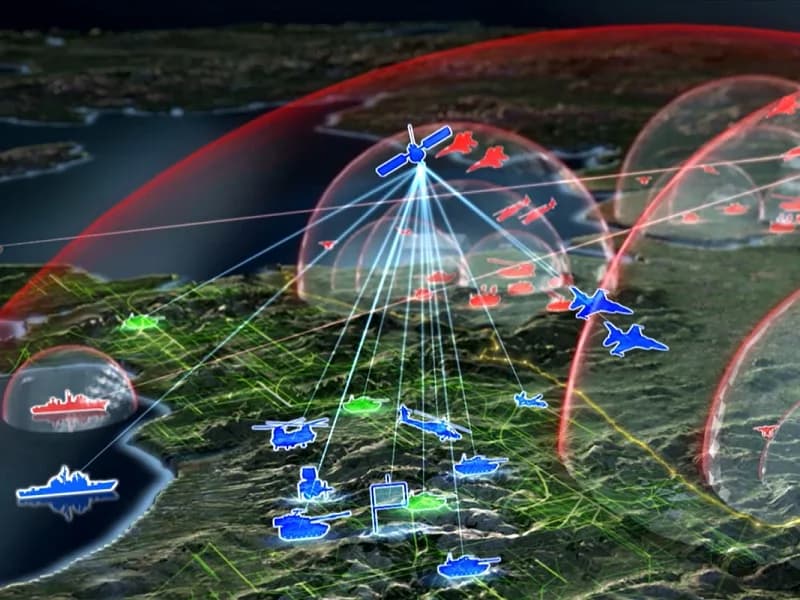
The Space Force describes SDN as a family of systems connecting military and commercial space capabilities into one broader data-transport architecture.
A Space Systems Command request for information for the SDN Mission Operations Center describes an architecture integrating Department of War and commercial proliferated low-Earth-orbit, medium-Earth-orbit and geostationary systems.
The network is intended to support private data transport, tactical data links and broader communications services across those constellations.
That makes SDN conceptually closer to an orbital communications fabric than a conventional satellite programme.
$2.29B SpaceX Contract Builds the Backbone
The largest publicly disclosed SDN award to date remains the Backbone contract announced on 26 May 2026.
Space Systems Command awarded SpaceX a $2.29 billion firm-fixed-price Other Transaction Authority agreement to accelerate development of the SDN Backbone.
The Backbone is a proliferated low-Earth-orbit network designed to provide high-capacity, low-latency global data transport.
SSC says the system will use an expanded optically interconnected mesh of satellites to provide tactical and broadband communications.
SpaceX is required to deliver a fully operational prototype capability by the end of 2027.
Five-Vendor Demos Address the Concentration Risk
The new connectivity demonstrations are strategically relevant partly because of the concentration created by the SpaceX Backbone award.
SpaceX provides mature proliferated-LEO infrastructure and manufacturing scale, allowing the Space Force to field capacity rapidly. However, relying too heavily on one provider can create strategic, procurement and technical dependencies.
The Space Force has therefore emphasised that SDN will extend beyond one contractor.
When it announced the Backbone award in May, SSC said it had created an SDN consortium specifically to solve integration and architectural challenges across multiple vendors.
The five-company demonstration effort represents a concrete step toward proving that model.
Interoperability Is the Hard Part
Using satellites from multiple companies is relatively easy compared with making them operate as one military network.
Different satellite operators can use different radio frequencies, optical terminals, network protocols, encryption systems, command architectures and ground infrastructure.
Without standard interfaces, adding vendors can create additional complexity rather than resilience.
The Space Force therefore needs common network standards and gateways capable of moving data between otherwise incompatible systems.
The challenge is comparable to building an internet across several separately designed satellite networks while preserving military-grade security, latency and availability.
The SDN Consortium Targets Common Standards
Space Systems Command has been formalising industry participation around that integration problem.
An Industry Consortium for Space-to-Space Communications was structured to address cooperative technology demonstrations, open standards and interface controls, interoperable networking, cybersecurity, test infrastructure, constellation management and broadband interoperability.
These issues determine whether SDN becomes an open architecture or remains dependent on proprietary interfaces.
Open interfaces also affect future competition. If the architecture allows new suppliers to connect without redesigning the rest of the network, the Space Force can introduce newer technology as the commercial market evolves.
Space-to-Space Links Are a Critical Enabler
Connectivity between satellites is particularly important.
A sensor satellite detecting a target may need to transfer its data to another spacecraft, route that information through several nodes and deliver it to a ground station or weapon platform within an operationally relevant timeframe.
Optical intersatellite links can carry large quantities of data between satellites without requiring every transmission to return immediately to the ground.
Radio-frequency links remain important for tactical users and for communications requirements where optical systems are not the appropriate interface.
The emerging architecture is therefore likely to remain hybrid, combining optical backbone transport with RF connectivity to different mission systems.
Link-182 Is Part of the Interoperability Work
One publicly visible Space Force effort in this area is Link-182.
On 22 April 2026, Space Systems Command awarded SpaceX a $57.3 million contract for Link-182 Space-to-Space Communications System development and demonstration.
BAE Systems subsequently received an $11.79 million competitive contract for Link-182 development and demonstration on 27 April 2026.
The contracts support resilient communications in proliferated low-Earth orbit and illustrate the Space Force’s wider effort to create common connectivity between systems supplied by different companies.
The five-company SDN demonstrations should not automatically be treated as identical to these earlier Link-182 awards unless the Space Force explicitly identifies the relationship, but both efforts address the broader interoperability problem.
SDN Works Alongside SDA’s Transport Layer
The architecture also incorporates capabilities developed by the Space Development Agency.
SSC says the SDN Backbone works alongside SDA’s Transport Layer to build the low-Earth-orbit portion of the broader hybrid mesh network.
The Transport Layer has already demonstrated tactical communications capabilities, including moving data through proliferated LEO satellites toward operational users.
On 16 July 2026, another 21 Tranche 1 Transport Layer spacecraft were launched from Vandenberg Space Force Base.
Space Systems Command said the spacecraft will support secure, low-latency beyond-line-of-sight tactical communications and missile-threat tracking.
Defence Agenda has previously examined how optical communications and proliferated LEO networks are changing the military data-link architecture.
The Architecture Is Central to Golden Dome
The Space Data Network has also become an enabling component for Golden Dome missile defence.
Missile defence increasingly depends on moving data rapidly between distributed sensors and interceptors.
A space-based sensor may detect and track a ballistic, hypersonic or cruise-missile threat, but that information has limited operational value unless it can reach command systems and an appropriate interceptor quickly enough to support an engagement.
SDN is intended to provide part of that communications layer.
Golden Dome Director Gen. Michael Guetlein identified the Space Data Network among the space capabilities being accelerated under the missile-defence architecture in March 2026.
Defence Agenda’s analysis of space-based interceptor constellations has highlighted how communications latency and sensor-to-shooter connectivity can become as important as interceptor performance itself.
Sensor-to-Shooter Latency Is the Operational Metric
The military value of SDN will ultimately be measured in time.
Modern sensors can generate enormous quantities of information, but a Joint Force operating against mobile or high-speed targets needs relevant data within seconds rather than minutes.
The network therefore needs high throughput, but bandwidth alone is insufficient.
Routing decisions, encryption, satellite handovers, gateway availability and command-system integration all affect end-to-end latency.
A multi-vendor demonstration should help the Space Force determine whether traffic can move between heterogeneous systems without unacceptable delays or manual intervention.
Resilience Requires Multiple Routes
The second major performance metric is resilience.
Traditional satellite communications can depend on a relatively small number of highly capable spacecraft and ground stations.
A proliferated architecture changes that model by distributing capability across many nodes.
A multi-provider architecture potentially adds another layer of resilience. If one constellation, ground segment or commercial service is degraded, network management software could route data through another available path.
This requires the network to understand link availability and dynamically manage traffic rather than depending on fixed communications paths.
Commercial Space Changes the Acquisition Model
SDN also reflects the Space Force’s wider move toward commercial integration.
Space Systems Command’s acquisition strategy increasingly follows an “exploit what we have, buy what we can, build only what we must” model.
Commercial companies already operate large satellite constellations, global gateways and high-capacity communications infrastructure.
Replicating every commercially available capability through bespoke government programmes would increase cost and slow deployment.
The challenge is integrating commercial capacity without allowing critical military missions to become dependent on architectures the government cannot sufficiently control or protect.
Multi-Vendor Architecture Also Preserves Competition
Industrial competition is another reason for the five-vendor approach.
Once a communications architecture becomes dependent on proprietary interfaces, switching suppliers can become technically and financially difficult.
That creates vendor lock-in.
Common standards and demonstrated interoperability can give the government greater leverage by allowing several companies to compete for future spacecraft, terminals, gateways or network services.
SSC officials have repeatedly stated that the acquisition strategy is intended to broaden the industrial base rather than consolidate the network around one contractor.
The Main Technical Risk Is Integration at Scale
The main challenge is whether interoperability demonstrated between a limited number of systems can scale into a global operational architecture.
SDN may eventually connect large constellations, ground gateways, tactical terminals, mission systems and external networks simultaneously.
Network management must determine which route provides the right combination of security, latency, bandwidth and availability for each mission.
The architecture must also operate under cyberattack, electronic warfare, satellite failures and changing orbital geometry.
A successful demonstration is therefore an important milestone, but it is not equivalent to proving the complete wartime network at scale.
The Main Strategic Risk Is Overdependence on Commercial Infrastructure
The Space Force also has to manage the balance between commercial speed and military assurance.
Commercial satellite companies can provide capacity and technology faster than many conventional military acquisition programmes.
However, commercial systems are designed around business models, customer markets and architectures that may not always match military requirements.
The government therefore needs redundancy across providers as well as contractual and technical mechanisms that ensure access during major conflict.
The five-vendor demonstration approach is consistent with reducing that dependence by ensuring that no single commercial architecture becomes the only practical route for critical data.
The Main Opportunity Is a Programmable Orbital Network
The longer-term opportunity is an orbital network that behaves more like modern digital infrastructure than traditional satellite communications.
Instead of assigning one mission permanently to one satellite system, traffic could potentially move dynamically across different constellations according to operational conditions.
Missile-warning data could receive priority over routine traffic. A disrupted gateway could be bypassed. A tactical user could connect through whichever compatible satellite network provides the best available route.
Such an architecture would make communications resilience a network property rather than a characteristic of an individual satellite.
Implications / Next
The first milestone to watch is the outcome of the five-company connectivity demonstrations and whether Space Systems Command identifies which technical interfaces successfully operate across vendors.
The second is the expansion of the SDN industry consortium. SSC said in May 2026 that participation would grow over the summer as the service worked through architecture and integration challenges.
The third is the SDN Backbone schedule. SpaceX is required to produce a fully operational prototype by the end of 2027.
Congressional funding will also remain important. The FY2027 request places billions of dollars across SDN research, development and procurement, including efforts specifically intended to broaden the provider base.
Finally, integration with Golden Dome, SDA’s Transport Layer and future space-based sensing systems will determine whether SDN becomes a genuine Joint Force network rather than another satellite communications programme.
Conclusion
The Space Force Space Data Network is evolving from a satellite-construction effort into a network-integration programme.
SpaceX’s $2.29 billion Backbone award provides the initial scale, but the five-company connectivity demonstrations address a different requirement: ensuring that future military communications do not depend on one vendor or one proprietary architecture.
That distinction is central to resilience.
A distributed constellation can survive the loss of individual satellites. A truly multi-vendor network could go further by surviving the degradation of an entire provider, communications pathway or ground segment.
If the Space Force can establish common interfaces, dynamic routing and secure interoperability across military and commercial constellations, SDN could become the communications fabric linking sensors, command systems and effectors across the Joint Force.
The five-company demonstrations are therefore less about adding more satellite manufacturers and more about proving that the Pentagon can build an orbital network in which no single company owns the only path through which critical warfighting data must travel.
For further Defence Agenda coverage, read our analysis of the shift toward an optical military data backbone, space-based interceptor constellations and sensor-to-shooter latency and Golden Dome command-system integration.
Further Reading
- Space Systems Command: Space Force invests in resilient multi-vendor architecture
- DefenseScoop: Space Force taps five companies for Space Data Network connectivity demos
- Space Systems Command: Space Data Network Backbone for global warfighter connectivity
- SAM.gov: Space Data Network Mission Operations Center
- Space Systems Command: Tranche 1 expands proliferated data transport architecture
- Defence Agenda: Link 16 Phaseout — Optics Take the Load
- Defence Agenda: SBI Constellations Reshape Missile Defence
- Defence Agenda: Golden Dome Command Systems Move Toward Integration