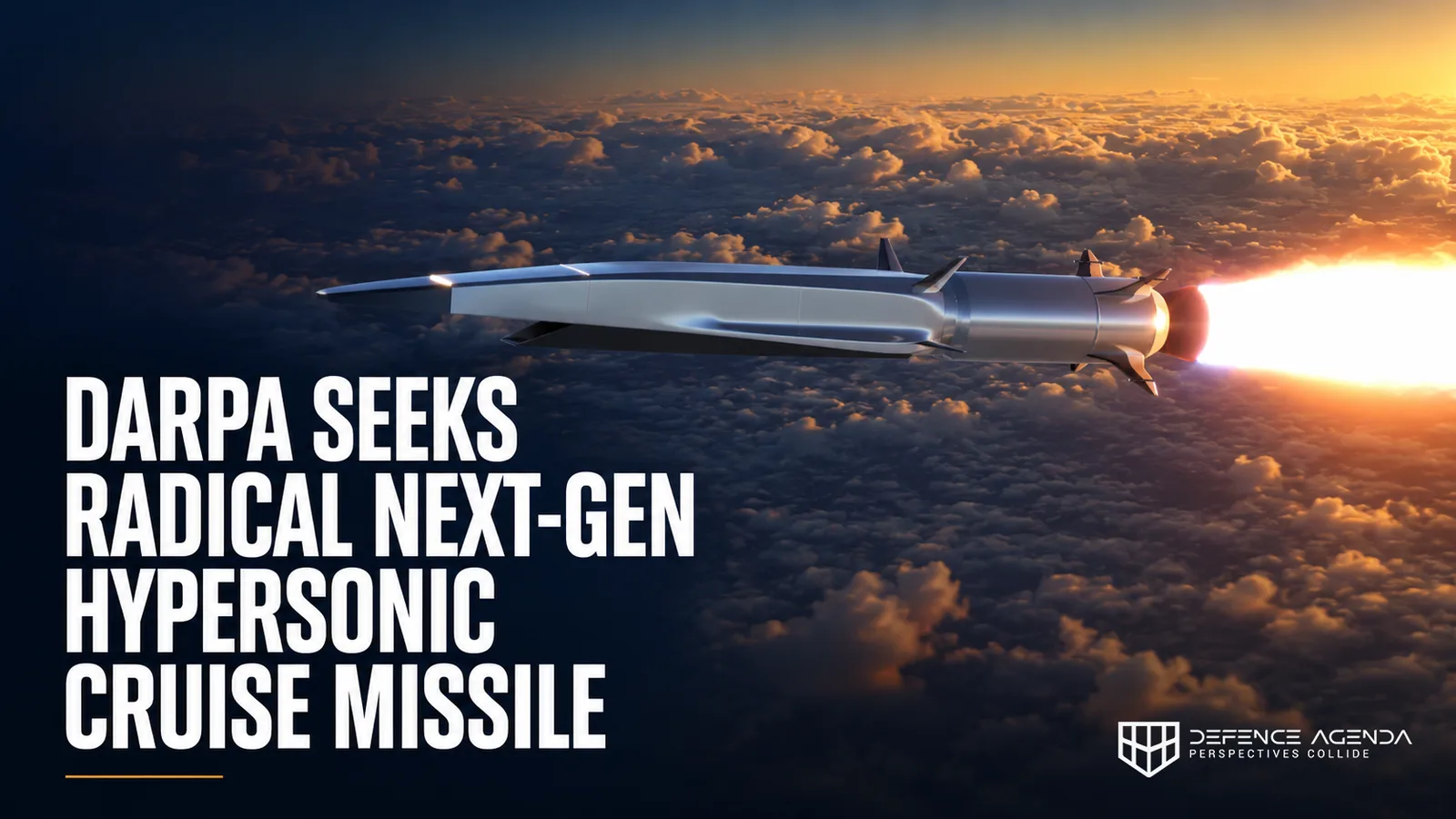
DARPA hypersonic cruise missile research is moving beyond the first generation of U.S. air-breathing weapons as the agency seeks unconventional concepts capable of delivering substantially greater speed, range, operating altitude and survivability.
Breaking Defense reported that the Defense Advanced Research Projects Agency is asking industry to think beyond established hypersonic cruise missile configurations, using an unusually open design space for what could become a successor generation to technologies demonstrated under earlier U.S. programmes.
The significance is not simply that DARPA wants another weapon capable of flying above Mach 5. The agency is looking for concepts that could change the performance envelope itself, potentially forcing new trade-offs across propulsion, thermal management, vehicle geometry, altitude, range, payload and survivability.
Key Facts
- Agency: Defense Advanced Research Projects Agency.
- Focus: Next-generation hypersonic cruise missile concepts.
- Design approach: DARPA is seeking unconventional and comparatively unconstrained concepts rather than incremental improvements to existing configurations.
- Performance areas: Speed, range, altitude and survivability are central to the emerging requirement.
- Technology lineage: DARPA previously completed the Hypersonic Air-breathing Weapon Concept, or HAWC, programme with the U.S. Air Force.
- Current U.S. air-breathing programme: The Air Force’s Hypersonic Attack Cruise Missile, or HACM, represents the operational transition of scramjet-powered air-launched hypersonic technology.
- Parallel activity: The U.S. Navy opened a separate Next Generation Hypersonics prototype opportunity in July 2026.
DARPA Hypersonic Cruise Missile Pushes Beyond HAWC
The clearest historical reference point is HAWC.
DARPA and the U.S. Air Force developed the Hypersonic Air-breathing Weapon Concept to demonstrate technologies required for an effective and affordable air-launched hypersonic cruise missile.
The programme concentrated on advanced vehicle configurations, hydrocarbon-fuelled scramjet propulsion, thermal management and affordable manufacturing. DARPA now lists HAWC as completed.
That distinction matters. HAWC was designed to prove that an air-breathing hypersonic weapon could operate successfully. The next challenge is no longer only feasibility. It is how far the architecture can be pushed beyond the performance achieved by the first generation.
“Unconstrained” Does Not Mean Without Engineering Limits
The most important word in the new effort may be “unconstrained.”
In practical terms, this should not be interpreted as a missile without size, cost, propulsion or integration limits. Physics still determines what a hypersonic vehicle can do.
Instead, the language indicates that DARPA wants industry to challenge assumptions inherited from current weapon designs.
A future concept may therefore involve different propulsion cycles, unusual vehicle geometry, higher cruise altitude, alternative booster arrangements, new thermal-management techniques or combinations of technologies that have not traditionally been packaged inside one tactical weapon.
Speed, Range and Altitude Are Interconnected
Improving one hypersonic performance metric usually affects several others.
Higher speed increases aerodynamic heating. Higher altitude can reduce atmospheric drag and heating but creates different challenges for air-breathing propulsion because the atmosphere becomes thinner. Longer range increases fuel requirements, which affects weapon size, launch-platform compatibility and payload capacity.
The problem is therefore not simply to maximise every number independently.
The real engineering task is to find an architecture that produces a more useful combination of speed, range, altitude and survivability than existing systems while remaining practical enough to manufacture and deploy.
Propulsion Could Become the Critical Breakthrough
Propulsion is one of the most obvious areas where radical concepts could change the missile design.
Traditional hypersonic cruise missiles generally use a rocket booster to accelerate the vehicle before an air-breathing scramjet can take over.
That creates a difficult packaging problem. The missile must carry a booster large enough to reach the engine's operating condition while preserving enough internal volume for fuel, payload, avionics and thermal protection.
New propulsion technologies could alter that balance.
Defence Agenda previously examined GE Aerospace and Lockheed Martin's rotating detonation ramjet work, where the companies are testing an architecture intended to improve efficiency and potentially enable lower-speed ignition.
If technologies of this type mature, designers could gain additional flexibility in booster size, fuel volume, range and overall missile dimensions.
Thermal Management Remains a Fundamental Constraint
Every increase in sustained atmospheric speed brings a thermal penalty.
Hypersonic vehicles experience extreme aerodynamic heating because they travel through the atmosphere at several kilometres per second. The vehicle structure, control surfaces, electronics and propulsion system must continue functioning under those conditions.
HAWC explicitly treated thermal-stress management as one of its major technology challenges. A significantly faster successor would make that problem more demanding rather than remove it.
The next-generation design space may therefore depend as much on materials science, cooling and manufacturing as on propulsion.
DARPA Is Also Working on Hypersonic Manufacturing
DARPA's wider 2026 portfolio shows that the agency is already attacking some of these industrial constraints separately.
The Carbon Crunch programme is intended to accelerate production of carbon-carbon hypersonic aeroshells through faster and more scalable composite-manufacturing techniques.
The programme targets the complete process from raw materials through near-net-shape densification, with the goal of improving manufacturing throughput and reducing design-cycle time.
This is strategically relevant to a next-generation cruise missile. A vehicle that achieves extraordinary flight performance but depends on extremely slow or expensive thermal-material production would be difficult to procure at operationally meaningful scale.
Survivability Is More Complex Than Flying Faster
Survivability is another central part of the new performance equation.
Hypersonic weapons compress defensive reaction time because of their speed. Their atmospheric flight profiles and manoeuvrability can also complicate detection, tracking and interception.
However, higher speed does not automatically make a weapon invulnerable.
Defence Agenda's analysis of the race for hypersonic missile defence shows that the defensive architecture is evolving through space-based tracking, improved command-and-control and new interceptors designed specifically for manoeuvring high-speed threats.
A next-generation offensive missile must therefore be designed against the defensive systems expected to exist when it becomes operational, not only the defences fielded today.
Higher Altitude Could Change the Defensive Geometry
Operating altitude is particularly important because hypersonic weapons exploit the boundary between traditional air defence and ballistic missile defence.
Flying higher can extend radar line of sight for defenders, but it can also move the weapon outside the effective engagement envelope of some conventional surface-to-air systems.
Flying lower may delay radar detection through the curvature of the Earth but increases atmospheric density, drag and thermal loading.
DARPA's interest in altitude therefore suggests that the agency is examining the complete engagement geometry rather than treating the missile only as a propulsion problem.
HACM Remains the Current Operational Reference
While DARPA explores a future generation, the U.S. Air Force continues to develop the Hypersonic Attack Cruise Missile.
HACM is an air-launched, scramjet-powered weapon intended to hold high-value and time-sensitive targets at risk from standoff distances in contested environments.
The Air Force awarded Raytheon a $985.3 million contract in 2022 to develop and demonstrate HACM prototypes.
The programme is directly connected to technology matured through the U.S.-Australian SCIFiRE effort and the earlier DARPA HAWC work.
HACM therefore provides the nearest programme-level benchmark for understanding what DARPA may want the next generation to exceed.
Next Generation Does Not Necessarily Mean HACM Replacement
It is important not to overstate the programme relationship.
The current DARPA concept search should not automatically be interpreted as a formal HACM replacement programme. DARPA's role is generally to mature disruptive technologies and demonstrate new capabilities before military services decide whether to transition them into acquisition programmes.
The concepts being requested could therefore influence a future Air Force weapon, support another service or generate enabling technologies used across several hypersonic programmes.
The eventual transition path has not yet been publicly established.
The Navy Is Pursuing a Separate Next-Generation Hypersonics Track
DARPA's activity is occurring alongside a broader U.S. push for next-generation hypersonic technology.
On 9 July 2026, the Naval Surface Warfare Center Crane Division published a separate Next Generation Hypersonics for the Department of War opportunity through the S2MARTS consortium.
The Navy described that project as an effort to integrate, mature and demonstrate advanced prototype hypersonic capabilities for future operational applications.
The Navy initiative and DARPA's cruise-missile concept search are distinct efforts. However, together they indicate that the Pentagon is already looking beyond the weapons currently moving toward fielding.
The U.S. Is Moving From First-Generation to Portfolio Competition
The U.S. hypersonic enterprise is becoming increasingly diverse.
Boost-glide weapons such as the Army's Long Range Hypersonic Weapon and the Navy's Conventional Prompt Strike use rocket boosters and a common hypersonic glide body.
HACM takes a different route through sustained air-breathing propulsion.
Private companies are also proposing alternative architectures. Ursa Major, for example, unveiled its HAVOC concept in February 2026 around a throttleable liquid rocket propulsion approach rather than a conventional scramjet-powered cruise architecture.
The result is no longer a single race toward Mach 5. It is becoming a competition between architectures optimised for different combinations of speed, range, cost, payload and launch-platform compatibility.
Affordability Will Still Matter
Radical performance cannot be separated from cost.
DARPA's original HAWC programme explicitly included affordability as one of its principal objectives. That requirement remains relevant because hypersonic weapons compete for procurement funding with ballistic missiles, stealthy subsonic cruise missiles and emerging lower-cost precision weapons.
Defence Agenda has examined the opposite end of this spectrum through the Pentagon's Low-Cost Containerized Munitions initiative, which aims to create much larger inventories of lower-cost strike weapons.
The future U.S. strike portfolio is therefore likely to be layered economically as well as technically: expensive hypersonic weapons for the hardest and most time-sensitive targets, complemented by larger inventories of less expensive missiles for missions that do not require extreme performance.
The Main Technical Risk Is the Performance Trade Space
The biggest challenge for a radical next-generation concept is that every performance improvement carries consequences elsewhere in the vehicle.
More speed can demand stronger thermal protection. More fuel can increase diameter or length. Higher altitude can complicate combustion. A larger booster may reduce the number of aircraft or launchers able to carry the weapon.
A design that maximises one variable can therefore become operationally less useful if it sacrifices too much in another.
DARPA's real opportunity is to identify a technology that changes those relationships rather than merely accepting the current trade-offs.
The Main Strategic Opportunity Is Greater Standoff
Longer range would have direct consequences for combat-aircraft survivability.
An air-launched missile that can travel significantly farther allows the launch aircraft to remain farther outside an adversary's integrated air-defence network.
That could reduce the need for penetrating launch platforms for some missions and allow tactical aircraft to contribute to strikes against deeply defended targets.
The same principle has shaped the development of increasingly long-range conventional cruise missiles. Hypersonic speed adds the additional advantage of reducing the target's reaction time after launch.
China and Russia Keep the Requirement Moving
U.S. interest in a second generation of hypersonic weapons also reflects the pace of competitor development.
China and Russia continue to develop and field high-speed strike systems across ballistic, boost-glide and cruise-missile categories.
The operational consequence is that a U.S. weapon entering service late in the decade must be designed for a threat and defensive environment that will have evolved significantly from the environment in which HAWC began development.
This is one reason DARPA's willingness to reopen the architecture rather than simply optimise the existing design could be strategically significant.
Implications / Next
The immediate indicator to watch is what technical concepts industry places in front of DARPA.
The most consequential proposals would be those that alter the traditional hypersonic cruise missile trade space rather than delivering incremental improvements to today's scramjet architectures.
Propulsion will be one area to watch. Thermal materials, manufacturing processes, guidance, vehicle geometry and booster integration will be others.
A second milestone will be whether DARPA converts the concept search into a funded demonstration programme with measurable flight objectives.
A third will be transition. If a concept demonstrates a genuine performance leap, the question will shift to whether the Air Force, Navy or another Pentagon organisation is prepared to turn it into an operational weapon.
Until those steps occur, the initiative should be treated as an exploratory next-generation technology effort rather than a fielded missile programme with confirmed performance specifications.
Conclusion
The DARPA hypersonic cruise missile search marks an important transition in U.S. high-speed weapons development.
HAWC demonstrated that an air-launched, air-breathing hypersonic cruise architecture could work. HACM is taking that technology toward operational capability.
DARPA is now asking a different question: what comes after the first generation?
By opening the design space to radical concepts, the agency is effectively challenging industry to find a new combination of propulsion, thermal management, altitude, range and survivability that breaks today's performance constraints.
The answer may still resemble a conventional hypersonic cruise missile. It may also involve an architecture that looks substantially different from HAWC and HACM.
The programme's real significance will therefore depend not on another Mach-number headline, but on whether DARPA can produce a technology that fundamentally shifts the range–speed–survivability equation while remaining manufacturable enough to become a weapon rather than another experimental vehicle.
For further Defence Agenda coverage, follow our missile technology, defence technology and air warfare sections. Related analysis includes GE and Lockheed's rotating detonation ramjet tests, the race for hypersonic missile defence and the Pentagon's Low-Cost Containerized Munitions programme.
Further Reading
- Breaking Defense: DARPA seeks unconstrained, radical concepts for next-gen hypersonic cruise missile
- DARPA: Hypersonic Air-breathing Weapon Concept — HAWC
- U.S. Air Force: Hypersonic Attack Cruise Missile contract award
- SAM.gov: Next Generation Hypersonics for the Department of War
- U.S. GAO: DOD Needs Comprehensive Strategy to Field Hypersonic Missile Capability
- Defence Agenda: GE and Lockheed Test Rotating Detonation Ramjet for Hypersonics
- Defence Agenda: Race for Hypersonic Missile Defence
- Defence Agenda: Pentagon Low-Cost Containerized Munitions Plan