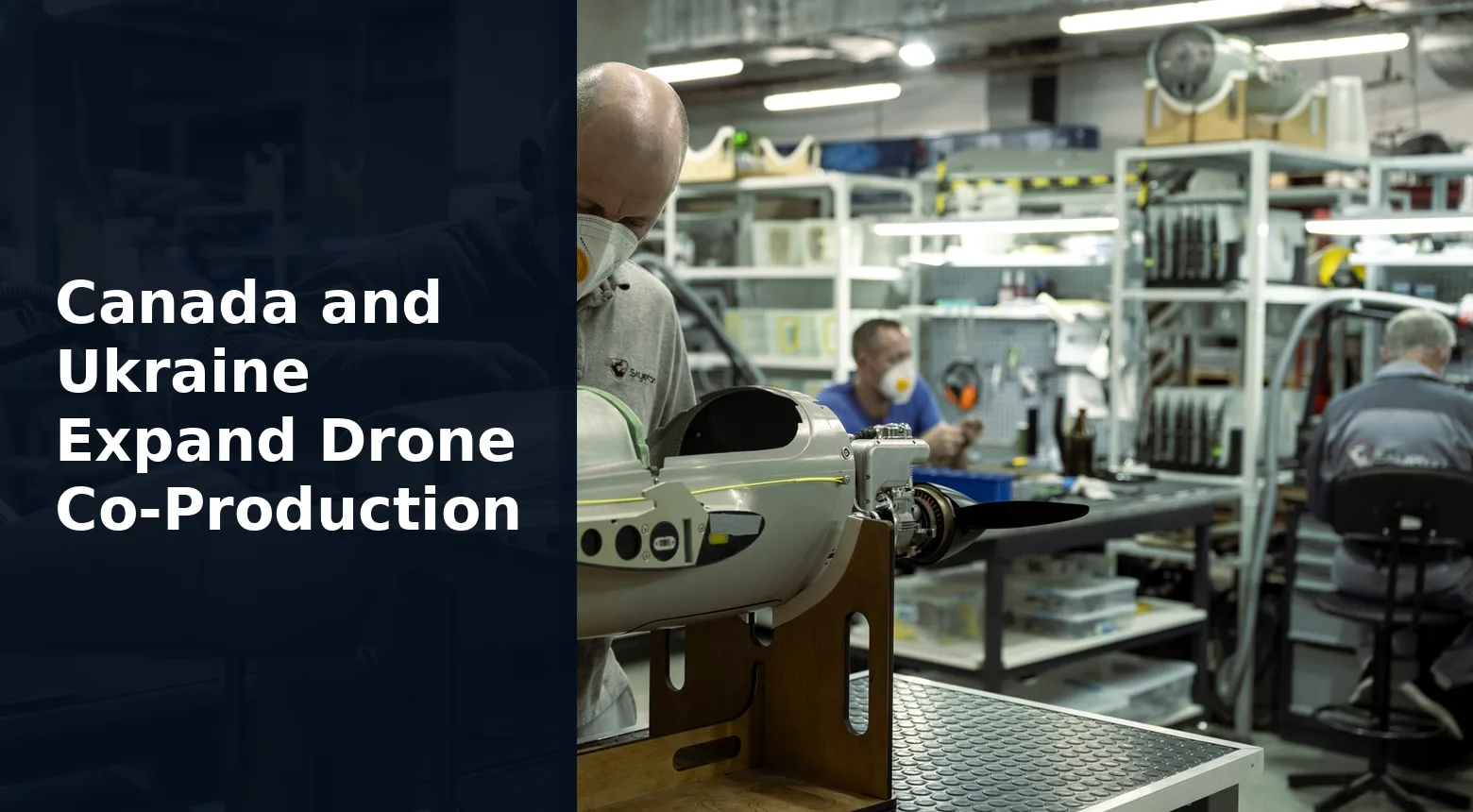
Ukrainska Pravda reported on 7 September 2026 that a European joint venture is beginning production of Ukraine's BARS jet-powered drone, with the first products planned for delivery to Ukrainian forces from 10 October. The arrangement follows a July Ukraine-Germany agreement under the Build with Ukraine initiative, under which Germany is financing the initial production phase. The development shifts part of the manufacturing base outside Ukraine while keeping output directed toward Ukrainian defence requirements.
BARS Is Moving From Ukrainian Development Into European Production
This is more than an export announcement because the stated objective is additional production capacity. Moving manufacturing into Europe can reduce exposure to strikes on Ukrainian facilities and give the programme access to a broader supplier and investment base. At the same time, the new plant or joint venture must still prove that it can deliver repeatable output at the planned schedule.
The Developer Says Turbojet Supply Is the Main Bottleneck
The BARS developer told RBC-Ukraine that the current constraint on scaling production is the lead time for turbojet engines sourced internationally. That is a revealing industrial detail because it shows that airframe assembly is not necessarily the limiting step. Jet-powered one-way strike systems depend on propulsion supply chains that are more specialised than those used by many electric FPV drones.
The developer also says it has completed tests of an indigenous engine and that more than 74% of the BARS system is locally produced. These are company claims and should be treated as such until production data or independent technical evidence is available. If a domestic engine becomes repeatably manufacturable, it could reduce one of the programme's most important supply dependencies.
Published Performance Figures Remain Manufacturer Claims
Current reporting attributes a range of up to 1,000 kilometres, a payload of up to 60 kilograms and speeds above 700 kilometres per hour to the developer. Earlier BARS versions were described with lower range and payload, reflecting continuing design changes. These numbers are useful for understanding the design ambition but should not be presented as independently verified operational performance under all mission configurations.
The modular concept reportedly allows fuel and payload to be traded depending on mission type, with long-, medium- and shorter-range configurations. That flexibility can be valuable in production because one basic airframe architecture may support several missions. It can also complicate simple range comparisons, since a maximum-range configuration may not carry the same payload as a shorter-range version.
October Deliveries Will Be the First Test of the New Industrial Model
The most immediate milestone is whether the European production line delivers its first systems from 10 October as planned. Follow-on evidence should include output rate, engine availability and whether production continues at scale after the initial financed phase. Public reporting does not disclose a firm total quantity for the joint venture, so claims of mass production should be tied to observed delivery data.
The programme is also strategically relevant to the wider European push to manufacture Ukrainian-designed weapons outside Ukraine. If the model works, it can combine Ukrainian combat-driven design cycles with European finance and industrial capacity. If propulsion or supply-chain bottlenecks persist, however, the location of final assembly alone will not guarantee the volume Ukraine seeks.
Implications / Next
The next publication-grade milestone will be the first independently verifiable event that changes the programme status described above, such as a delivery, acceptance event, production start, exercised option, operational test or formal fielding decision. Defence Agenda will continue to separate these maturity stages and will not treat an announcement, contract or first test as proof that the full capability has already entered operational service.