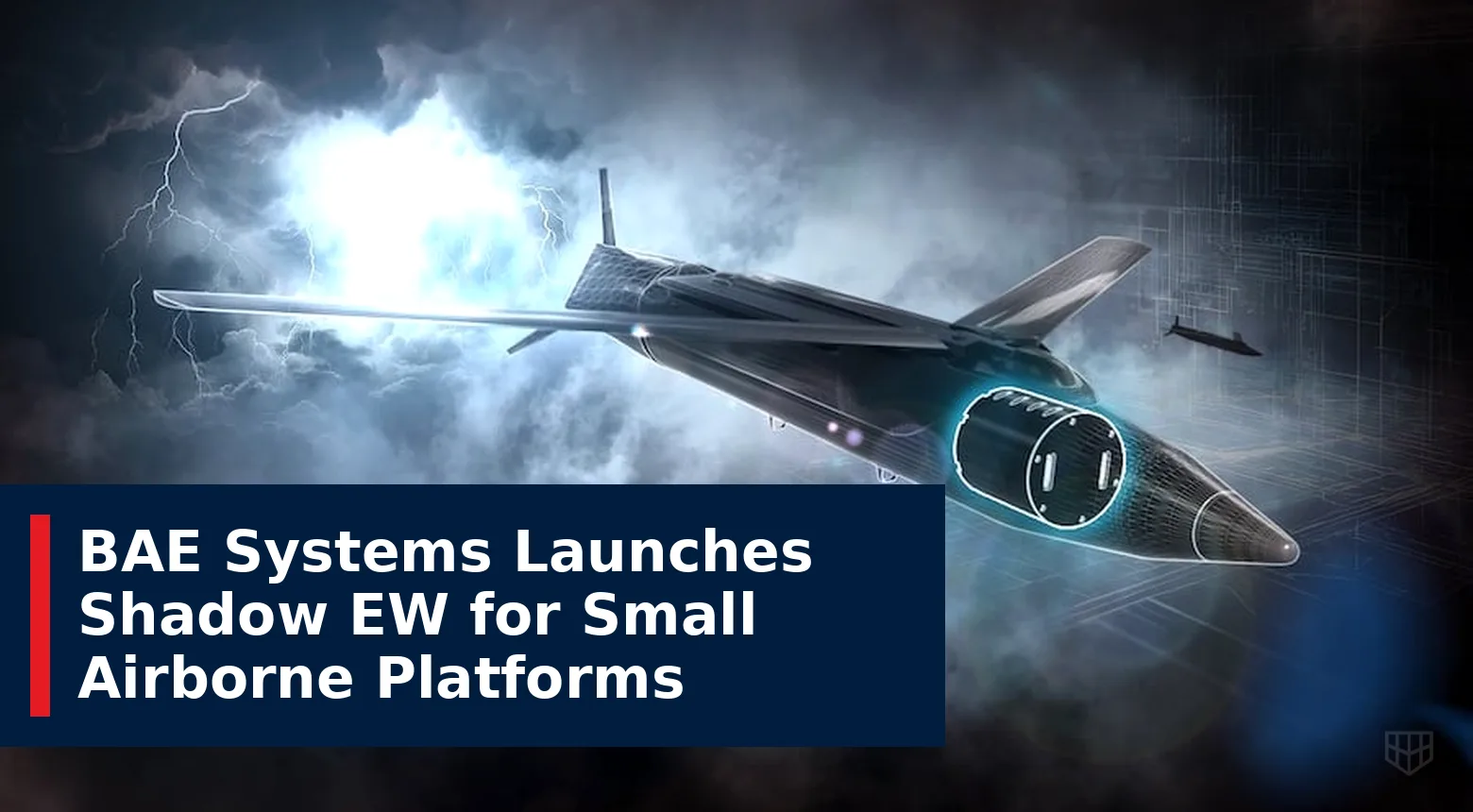
BAE Systems has unveiled the Shadow family of compact electronic-warfare systems for small uncrewed and crewed airborne platforms.
A compact electronic-warfare family
BAE Systems has introduced Shadow, a family of compact electronic-warfare products designed for small crewed and uncrewed airborne platforms. Announced on 15 September 2026, the line is presented as a low-size-weight-and-power alternative to larger dedicated systems. The company says Shadow can support situational awareness, targeting, deception, self-protection, survivability and collaborative effects, depending on the selected configuration and software.
The announcement is a product launch rather than a procurement milestone. BAE Systems did not name a launch customer, contract value, ordered quantity or service-entry date. Nor did it publish independent test results showing performance against specific emitters or threats. The family should therefore be treated as an available industrial offering whose operational maturity may vary by configuration, not as a system already fielded across an identified fleet.
Three disclosed configurations
Specialist reporting identifies three initial products. Shadow 100 is associated with coverage from 70 MHz to 6 GHz. Shadow 120 extends down to 5 MHz and is described for radar electronic warfare as well as signals- and communications-intelligence roles. Shadow 500 extends from 10 MHz to 18 GHz and adds edge processing for missions that require a broader view of the electromagnetic spectrum.
Frequency coverage alone does not define effectiveness. Receiver sensitivity, instantaneous bandwidth, direction finding, geolocation accuracy, processing latency, transmitter power, antenna design and the threat library all influence operational value. BAE Systems has not released enough engineering detail for a direct performance comparison with larger pods or integrated aircraft suites, and the mix of passive sensing and active effects may differ across the product line.
Commercial electronics and open architecture
BAE Systems says Shadow uses commercial microchips and an open architecture to reduce cost and support field-upgradable software-defined functions. This approach can shorten technology refresh cycles and allow new algorithms or signal libraries to be introduced without redesigning the complete payload. It may also make the systems more practical for platforms that cannot carry the power and cooling burden of traditional equipment.
Commercial technology brings trade-offs. Components need to meet military environmental, security and supply-chain requirements, while export controls and trusted sourcing can restrict availability. Open interfaces only create interoperability when standards, data rights and software assurance are implemented consistently. The company will need to show that update speed does not weaken configuration control, cyber security or mission-data validation.
Distributed effects and production claims
The operational concept is to distribute electronic-warfare functions across more aircraft. A group of small platforms could search different sectors, share detections and create coordinated effects, reducing dependence on a few high-value assets. Some nodes might be expendable or attritable, but that label should not be assumed from size alone; platform, payload and mission-system costs still determine acceptable risk.
Air & Space Forces Magazine reported broad price bands ranging from thousands to hundreds of thousands of dollars across the family. These are approximate company indications, not negotiated unit prices, and they may exclude integration, antennas, support and software. BAE Systems says production will draw on facilities in Cedar Rapids, Iowa, while software and design work is centred in Nashua, New Hampshire.
The next evidence should be an identified customer, platform integration and representative flight trials. Data on detection range, geolocation, jamming effectiveness, networked operation and performance under countermeasures would help establish where each Shadow product sits between a sensor, a self-protection suite and an electronic-attack payload. The launch signals a deliberate move towards lower-cost distributed EW, but contract and test disclosures are still needed before claims of operational transformation can be assessed. Integration will also reveal whether the antenna placement and host-aircraft power supply allow the advertised spectral coverage to be used without unacceptable blind sectors, interference or cooling penalties.