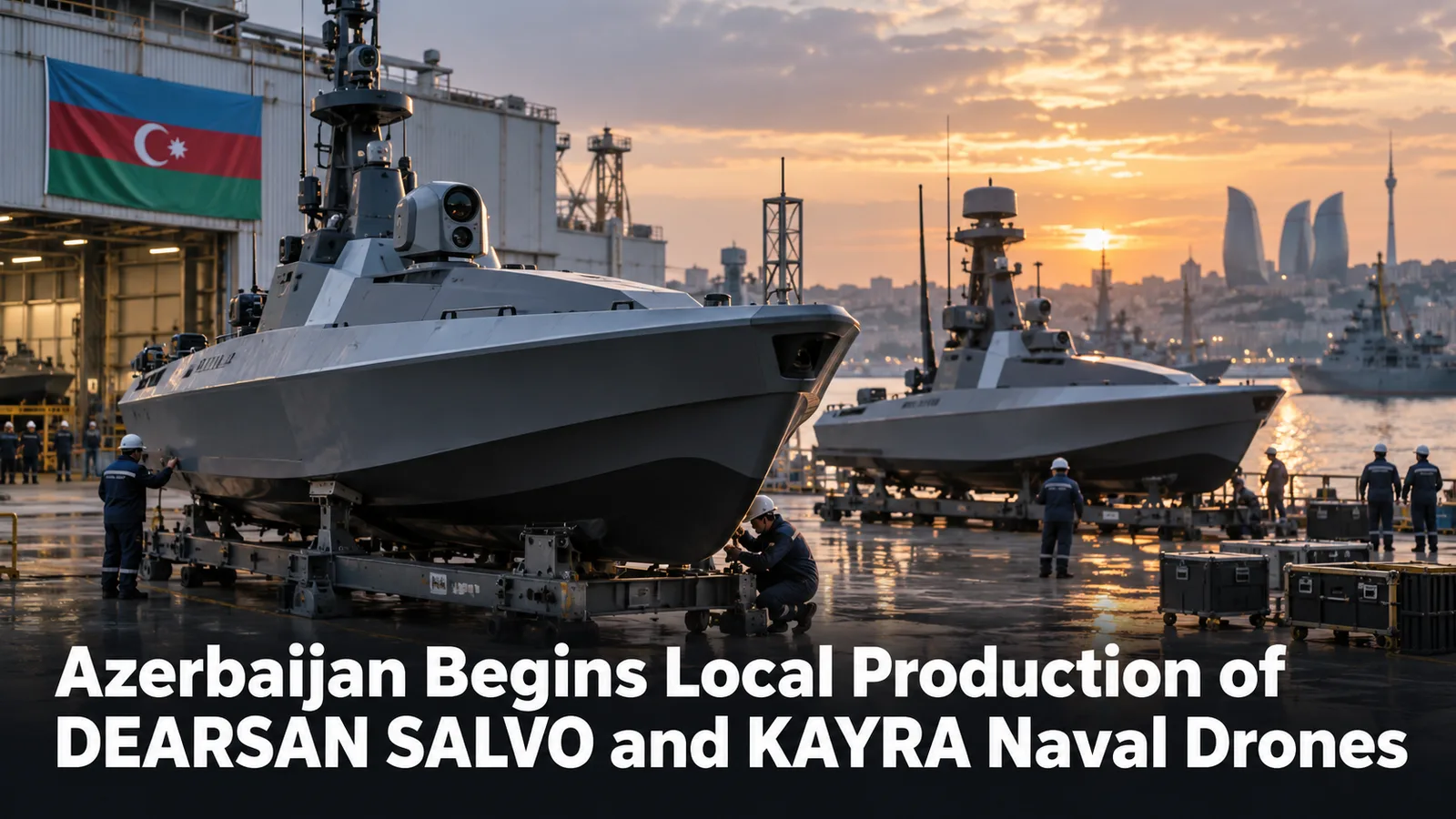
Azerbaijan has begun producing SALVO armed unmanned surface vessels and KAYRA kamikaze unmanned surface vessels domestically through a joint production facility operated by MIRAS Military-Industrial Company and Türkiye’s DEARSAN Shipyard.
President Ilham Aliyev inspected the facility on Sept. 6, and Azerbaijan’s presidency and defence ministry say craft produced there were subsequently put through practical testing.
Local Production Marks a Deeper Industrial Relationship
Azerbaijan had already displayed the Turkish-designed SALVO in naval service, but the latest milestone is industrial rather than simply operational: production activity is now taking place inside Azerbaijan under a MIRAS–DEARSAN arrangement. The shift moves the relationship from platform acquisition toward local manufacturing, sustainment and potentially deeper technology transfer, although neither side has disclosed a local-content percentage or annual production rate. An official visit by President Ilham Aliyev and First Lady Mehriban Aliyeva to the joint facility adds stronger evidence that the programme has progressed beyond exhibition models and into practical local build activity.
The Azerbaijani presidency says the locally produced unmanned vessels were practically tested during the visit. That confirms functional craft are emerging from the local site, but it does not reveal how many units are complete, accepted by the Navy or scheduled for serial delivery. The distinction matters because local production can range from assembly of imported kits to broader hull, propulsion, electronics and mission-system manufacturing, and the public material does not yet define that depth.
SALVO and KAYRA Provide Different Mission Profiles
DEARSAN’s current product page lists SALVO at 14.79 m length and 3.85 m beam, with maximum speed above 35 knots and range up to 400 nautical miles. The aluminium-hulled platform is offered for surface warfare, littoral operations, surveillance, interception, border patrol and support missions, giving Azerbaijan a reusable armed USV with broader endurance and mission flexibility. Those figures are current manufacturer specifications and may differ from earlier public reporting on other configurations.
KAYRA is smaller at 7.6 m, uses a composite hull and is designed around a faster attack profile, with DEARSAN publishing maximum speed above 60 knots, continuous speed above 45 knots and range of 300 nautical miles. The company describes missions including attack on surface targets, naval bases, ports and critical shore infrastructure, as well as anti-access and asymmetric warfare. Together, SALVO and KAYRA give Azerbaijan two different unmanned maritime roles rather than two variants of the same operational concept.
Caspian and Industrial Significance
For Azerbaijan, local production can shorten sustainment chains and build domestic expertise around hull construction, autonomy, propulsion, mission systems and maintenance. In the Caspian, uncrewed surface craft can extend reconnaissance and strike reach while reducing risk to crewed patrol vessels, with SALVO suited to reusable armed missions and KAYRA offering a faster attack profile. For Türkiye, the arrangement deepens naval-industrial cooperation with Azerbaijan and demonstrates an export model based on local manufacturing rather than finished-platform delivery alone.
Limitations and Counterpoint
No contract value, planned fleet quantity, annual production rate or local-content percentage has been published. The official visit and practical testing confirm that functional locally produced craft exist, but they do not establish full-rate serial production at a disclosed scale. Earlier SALVO performance figures have also varied by configuration, so Defence Agenda uses DEARSAN’s current product data as the baseline instead of treating all historical specifications as directly comparable.
Implications / Next
The next indicators are formal acceptance into Azerbaijani Navy units, disclosed serial-production quantities and identification of local suppliers responsible for hulls, propulsion, electronics or mission systems. Additional DEARSAN technology-transfer agreements would show whether the current facility is the start of a broader unmanned-maritime industrial partnership. Operational exercises in the Caspian would also clarify how Azerbaijan intends to combine SALVO and KAYRA with crewed naval forces.