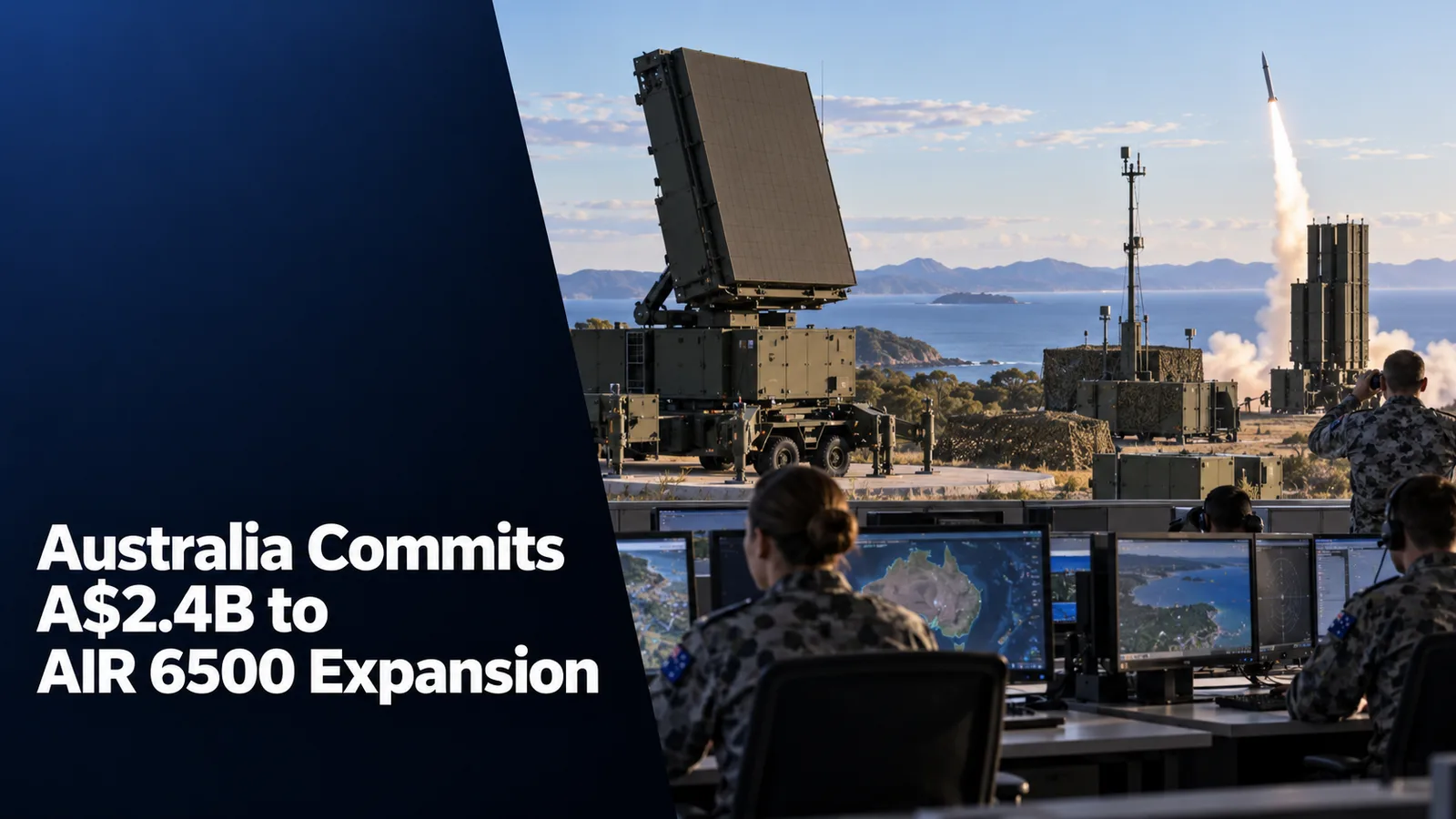
The Australian Government announced on 9 September 2026 that it will invest A$2.4 billion over six years in the second tranche of AIR 6500, the programme underpinning Australia's Joint Air Battle Management System. The government describes AIR 6500 as a critical element of a wider A$30 billion investment over the coming decade in layered integrated air and missile defence. Lockheed Martin Australia remains the strategic industry partner.
Canberra Is Funding the Next AIR 6500 Expansion
Asian Military Review reports that an A$1.32 billion contract has been awarded to Lockheed Martin Australia within Tranche 2B. That figure should be distinguished from the government's A$2.4 billion total investment, which covers the wider tranche and associated defence-industry activity. Treating the two numbers as interchangeable would overstate the value of the prime contract.
JABMS Is Intended to Connect Sensors, Shooters and Commanders
AIR 6500 is not a single missile or radar purchase. Its purpose is to create a command-and-control architecture that fuses information from air, land, sea and other domains into a common operational picture and supports engagement decisions. The Australian government says the system will modernise air surveillance and aircraft-control functions while improving coordination of defence operations in Australia and overseas.
That architecture becomes more important as the Australian Defence Force introduces additional sensors and long-range effectors. F-35A fighters, Hobart-class destroyers, ground-based air-defence systems and new radar assets can generate different types of information. The operational challenge is turning those inputs into trusted tracks and timely decisions without creating stovepipes between services or platforms.
The Investment Also Targets a Sovereign Industrial Base
The government says the six-year investment will support more than 360 highly skilled jobs in the Hunter Region and South Australia. That industrial component is deliberate: software integration, mission-system engineering, cyber security and sustainment are recurring requirements for a battle-management network. Keeping part of that expertise in Australia can reduce dependence on overseas engineering teams for every change to the system.
Local industry participation can also make upgrades more responsive to Australian requirements, but sovereign involvement does not mean the architecture is independent of allied technology. AIR 6500 is designed around interoperability with U.S. and allied systems, and Lockheed Martin remains central to delivery. The strategic objective is therefore sovereign capacity within an allied network rather than technological isolation.
Integration, Not Announcement Value, Will Define Success
The A$2.4 billion commitment establishes funding and programme direction, but the military value will depend on integration testing and operational acceptance. Networked air defence is particularly sensitive to software maturity, data standards, cyber resilience and the quality of sensor tracks. A system that connects many platforms but cannot maintain engagement-quality information would not meet the underlying mission.
The next milestones are contracted subsystem deliveries, integration events, operational tests and evidence that the JABMS can coordinate multiple sensors and effectors under realistic conditions. Tranche 2B should therefore be followed as an integration programme rather than judged only by headline investment. Australia's IAMD ambition will be credible when the network can repeatedly connect and control a growing mix of national and allied capabilities.
Australia will also need to manage incremental capability growth without destabilising the baseline network. AIR 6500 must remain usable while new radars, weapons and data sources are added, which puts a premium on open interfaces, disciplined software releases and verification. That integration discipline will determine whether the system can evolve faster than the threats it is intended to track.
Implications / Next
The next publication-grade milestone will be the first independently verifiable event that changes the programme status described above, such as a delivery, acceptance event, production start, exercised option, operational test or formal fielding decision. Defence Agenda will continue to separate these maturity stages and will not treat an announcement, contract or first test as proof that the full capability has already entered operational service.