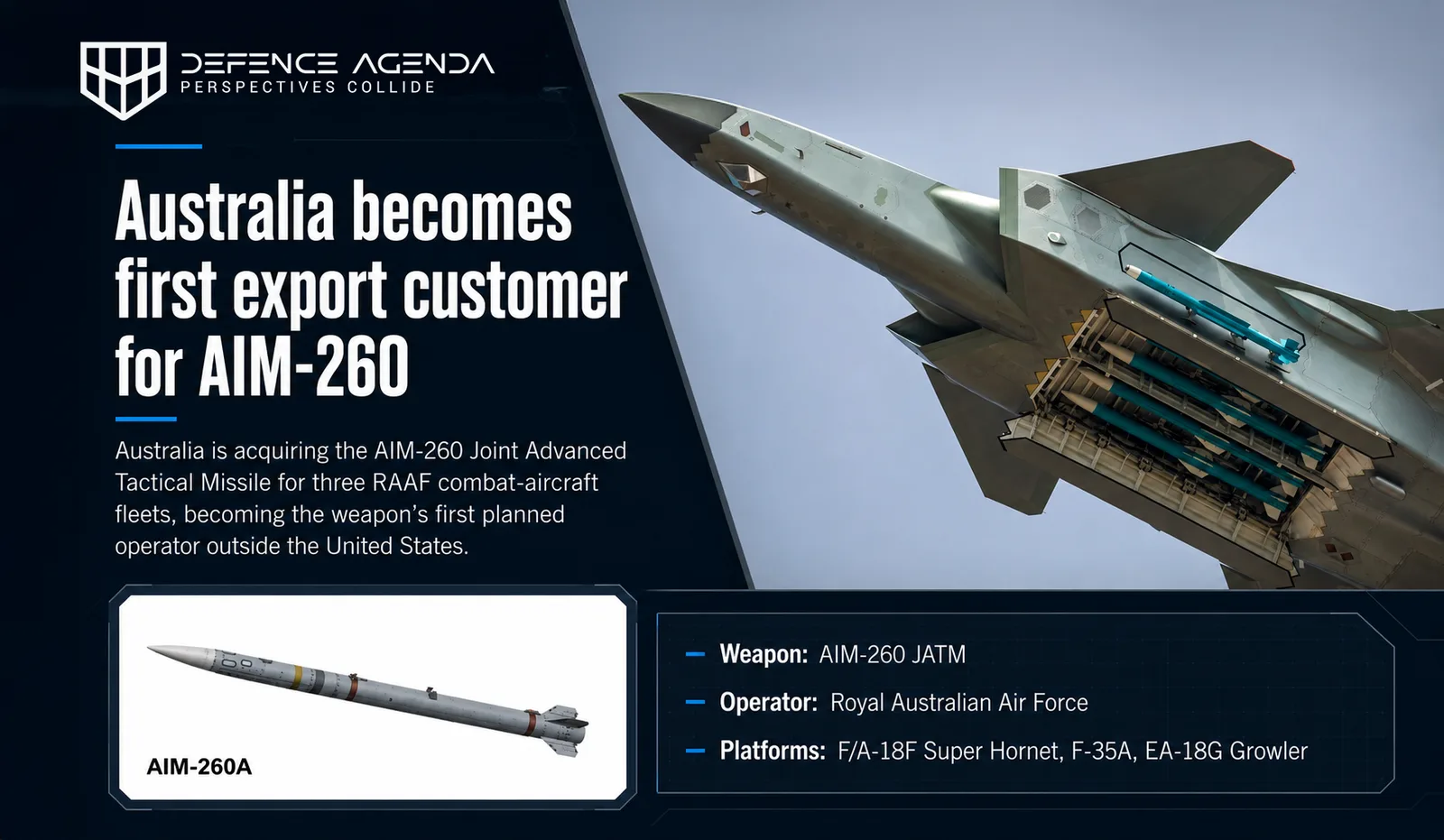
Australia is acquiring the AIM-260 Joint Advanced Tactical Missile in an investment worth almost A$736 million, giving the Royal Australian Air Force a new long-range air-to-air weapon for three combat-aircraft fleets.
The Australian government announced the acquisition on 6 August 2026 during Exercise Pitch Black in Darwin.
AIM-260 will be integrated first onto Australia’s F/A-18F Super Hornet, followed by the F-35A Lightning II and EA-18G Growler. The missiles are being acquired from the United States Government through the Foreign Military Sales process.
Australia is expected to become the first country to operate AIM-260 outside the United States once delivery, aircraft integration, testing and operational introduction have been completed.
A separate US congressional arms-sales notification authorised a potential package containing up to 450 operational missiles, five Integration Test Vehicles and 30 Guided Test Vehicles.
The US notification carries an estimated ceiling of US$3.16 billion, while the Australian government’s current announcement identifies an investment of almost A$736 million. The public documents do not explain the difference in scope between these two figures.
Key Facts
- Weapon: AIM-260 Joint Advanced Tactical Missile.
- Role: Long-range air-to-air and air-superiority missile.
- Australian investment: Almost A$736 million.
- Acquisition route: United States Foreign Military Sales.
- First Australian platform: F/A-18F Super Hornet.
- Subsequent platforms: F-35A Lightning II and EA-18G Growler.
- Export status: Australia is planned to become the first operator outside the United States.
- Maximum FMS quantity: Up to 450 operational missiles.
- Integration test assets: Up to five Integration Test Vehicles.
- Flight-test assets: Up to 30 Guided Test Vehicles.
- Maximum US FMS case value: US$3.16 billion.
- Principal contractor: Lockheed Martin Missiles and Fire Control.
- Announcement date: 6 August 2026.
- Announcement location: Exercise Pitch Black, Darwin.
- Delivery schedule: Not publicly announced.
- Final contracted quantity: Not publicly announced in the Australian release.
What Has Australia Announced?
The Albanese Government has approved an investment of almost A$736 million to introduce the AIM-260 JATM into Royal Australian Air Force service.
The government describes the missile as a high-speed, long-range air-to-air weapon intended to provide a credible deterrent against airborne targets.
The acquisition will complement Australia’s existing air-to-air weapons and the surface-based elements of the Australian Defence Force’s developing air and missile defence architecture.
The release does not disclose the number of missiles covered by the A$736 million investment, the expected delivery year or the date on which the first aircraft will be declared operational with AIM-260.
How Many AIM-260 Missiles Could Australia Receive?
The Australian announcement does not state a final contracted quantity.
A US Foreign Military Sales notification delivered to Congress in January 2026 established a potential ceiling of up to 450 operational AIM-260 missiles.
The same notification included up to five Integration Test Vehicles and 30 Guided Test Vehicles.
A maximum FMS notification is not the same as a final delivery contract. It allows the proposed sale to proceed up to the notified quantity and value, but the purchaser may ultimately order fewer systems or execute the programme in several phases.
| Item | Maximum Quantity in US Notification | Purpose |
|---|---|---|
| AIM-260 JATM | Up to 450 | Operational air-to-air missiles |
| Integration Test Vehicle | Up to five | Captive testing and aircraft-integration activity |
| Guided Test Vehicle | Up to 30 | Instrumented flight testing with the warhead replaced by telemetry equipment |
Why Are Two Different Acquisition Values Being Reported?
The Australian government identifies an investment of almost A$736 million. The earlier US notification assigns a maximum estimated value of US$3.16 billion to the wider potential FMS case.
| Published Figure | Source | What It Represents |
|---|---|---|
| Almost A$736 million | Australian government announcement, August 2026 | Current Australian investment in the acquisition |
| US$2.61 billion | US congressional FMS notification | Maximum estimated value of Major Defense Equipment |
| US$550 million | US congressional FMS notification | Maximum estimated value of other equipment, services and support |
| US$3.16 billion | US congressional FMS notification | Maximum estimated value of the complete notified case |
The documents use different currencies and may cover different quantities, programme stages, support packages or payment periods.
Neither government has publicly stated that all 450 operational missiles are included in the A$736 million announcement. Dividing either package value by 450 would therefore not produce a verified unit price.
Which Aircraft Will Carry AIM-260?
Australia has identified three aircraft fleets for AIM-260 integration.
| Aircraft | Planned Integration Sequence | Relevant Role |
|---|---|---|
| F/A-18F Super Hornet | First | Multirole combat aircraft and initial Australian JATM platform |
| F-35A Lightning II | Subsequent integration | Low-observable multirole fighter with fused sensors and networked targeting |
| EA-18G Growler | Subsequent integration | Airborne electronic-attack aircraft with an additional planned air-to-air capability |
The government has not provided separate integration schedules for the three fleets.
Aircraft integration normally requires software development, carriage testing, separation testing, weapons-system evaluation, training and airworthiness approval. Selection of a platform does not mean that the weapon is immediately available for operational use.
Why Will the Super Hornet Receive AIM-260 First?
The Australian release confirms the sequence but does not explain the programme decision in detail.
Initial Super Hornet integration may provide Australia with a path to introduce the weapon before completing the separate technical and certification work required for the F-35A and Growler fleets.
That explanation is an inference from the announced sequence rather than an official description of the integration strategy.
What Is Publicly Known About AIM-260?
Public technical information about AIM-260 remains limited.
The Australian government describes it as a high-speed, long-range air-to-air missile.
The US arms-sales notification describes AIM-260 as a GPS-aided air-superiority missile offering increased range and effectiveness compared with existing air-to-air weapons.
The notification also states that the system uses protected Precise Positioning Services provided through Selective Availability Anti-Spoofing Module or M-Code technology.
Anti-tamper measures are incorporated to protect the missile’s software from exploitation.
The highest classification level associated with the equipment and services in the notified package is Secret.
What AIM-260 Specifications Remain Undisclosed?
- Verified maximum engagement range
- No-escape-zone performance
- Maximum speed
- Propulsion architecture
- Seeker type and operating modes
- Datalink configuration
- Warhead specifications
- Electronic-counter-countermeasure performance
- Dimensions and launch weight
- Internal carriage configuration on the F-35A
- Australian delivery schedule
- Operational test and evaluation milestones
Open-source estimates or unofficial artwork should not be presented as confirmed programme information.
What Is an Integration Test Vehicle?
The US notification defines the AIM-260 Integration Test Vehicle as a modified missile used for captive testing.
Captive tests allow engineers to evaluate mechanical carriage, electrical interfaces, software communications, environmental effects and aircraft-system interaction without launching an operational missile.
The five authorised test vehicles are separate from the maximum quantity of 450 operational missiles.
What Is a Guided Test Vehicle?
A Guided Test Vehicle is an instrumented version of AIM-260 intended for flight testing.
The notification states that its warhead is replaced by a telemetry unit that records missile parameters during live-fire trials.
The proposed package includes up to 30 Guided Test Vehicles, providing a larger test inventory for flight evaluation and aircraft integration.
What Other Equipment Is Included in the FMS Case?
- Ammunition containers
- Shoe jettison assemblies
- KGV-135A embedded communications-security devices
- Spare parts and consumables
- Repair-and-return support
- Component parts and spare equipment
- Training aids and training equipment
- Weapon-system support and test equipment
- Classified and unclassified software
- Technical publications and documentation
- Personnel training
- Transportation support
- Site surveys
- Warranties
- US government and contractor engineering support
- Technical and logistics services
The inclusion of these elements explains why a total FMS case value cannot be treated as a missile-only price.
How Does the Foreign Military Sales Process Work?
Under the Foreign Military Sales system, the United States Government manages the transfer rather than Australia purchasing the complete package directly through a conventional commercial contract.
The congressional notification establishes the maximum proposed scope and estimated value. It does not itself confirm that every authorised item will be ordered.
Detailed quantities, prices, delivery terms and support arrangements are subsequently defined through Letters of Offer and Acceptance and related implementation actions.
The August announcement confirms that Australia is proceeding with an acquisition, but the government has not released the complete contractual schedule.
Who Will Manufacture Australia’s AIM-260 Missiles?
The US notification identifies Lockheed Martin Missiles and Fire Control in Orlando, Florida, as the principal contractor.
No Australian production arrangement, local assembly commitment or AIM-260 technology-transfer package was announced in the August release.
The earlier US notice stated that the US Government was not aware of an offset agreement at the time of notification. It added that any future offset arrangement would be negotiated between the purchaser and contractor.
Australia’s wider investment in a sovereign guided-weapons industry should therefore not be treated as confirmation that AIM-260 will be manufactured domestically.
What Does AIM-260 Add to Australia’s Air-Combat Capability?
A long-range air-to-air missile is intended to allow a combat aircraft to threaten hostile aircraft at greater distance and complicate an adversary’s operational planning.
The effect depends on more than missile range. Sensors, electronic warfare, datalinks, targeting information, rules of engagement and aircraft survivability all contribute to the outcome of a beyond-visual-range engagement.
Integration across three aircraft types can provide the RAAF with greater flexibility in assigning air-superiority, escort and electronic-attack missions.
The acquisition does not independently establish a complete layered air-defence architecture. It represents one airborne effector within a wider network of aircraft, sensors, command systems and surface-based weapons.
Why Is Growler Integration Significant?
The EA-18G Growler is primarily associated with airborne electronic attack, threat detection and support to other aircraft.
Planned AIM-260 integration would give the platform an additional long-range air-to-air option while it performs missions in contested electromagnetic environments.
The government has not disclosed the intended loadout, tactical employment concept or whether Growler integration will differ from the Super Hornet configuration.
How Does the Acquisition Support Australia–US Interoperability?
Operating the same next-generation missile can support common training, mission planning, logistics and technical standards between Australian and US forces.
The Australian government explicitly linked the purchase to stronger interoperability with the United States.
Common equipment does not by itself guarantee full interoperability. Secure data exchange, aircraft software, communications architecture, tactical procedures and weapons-release certification must also be aligned.
Why Was the Announcement Made at Exercise Pitch Black?
The AIM-260 announcement was made during Exercise Pitch Black 2026 in Darwin.
The exercise brought together approximately 100 aircraft, 2,500 personnel and 20 participating countries for high-end multinational air-combat training from bases in northern Australia and Queensland.
The setting reinforced the government’s emphasis on coalition interoperability, regional deterrence and combined air operations.
Participation in the exercise does not indicate that AIM-260 was already available or used during Pitch Black 2026.
How Does AIM-260 Fit Australia’s 2026 Defence Strategy?
The 2026 National Defence Strategy and Integrated Investment Program prioritise long-range strike, integrated air and missile defence and a more lethal, integrated force.
AIM-260 supports the airborne component of that strategy by improving the potential engagement reach of RAAF combat aircraft.
The Australian government has identified up to A$36 billion in guided-weapons and explosive-ordnance investment over the following decade.
That broader investment includes multiple weapon types, industrial activities and support requirements. It should not be interpreted as funding dedicated exclusively to AIM-260.
What Has Not Yet Been Announced?
- The exact operational-missile quantity in the current Australian commitment
- Delivery dates
- The first Australian live-fire test
- Initial operational capability
- Full operational capability
- Integration completion dates for each aircraft
- Australian training-unit arrangements
- Storage and sustainment locations
- Missile production schedule
- Any Australian industrial workshare
- The final contracted value of the complete FMS case
- Whether all authorised test vehicles will be acquired
- Publicly releasable missile performance specifications
AIM-260 Australia Acquisition Timeline
| Date | Milestone | Status |
|---|---|---|
| 23 January 2026 | Proposed FMS case delivered to the US Congress | Up to 450 operational missiles and 35 test vehicles notified |
| March 2026 | Public US arms-sales notice published | Maximum estimated value set at US$3.16 billion |
| 20 July 2026 | Exercise Pitch Black 2026 officially opens | Multinational air-combat exercise begins in Australia |
| 6 August 2026 | Australian government announces AIM-260 acquisition | Almost A$736 million committed |
| Future milestone | F/A-18F integration and testing | Date not publicly announced |
| Future milestone | F-35A and EA-18G integration | Dates not publicly announced |
What Should Be Watched Next?
- Confirmation of the final contracted missile quantity
- Publication of a Letter of Offer and Acceptance value
- First deliveries to Australia
- F/A-18F captive-carriage trials
- Guided flight-test activity
- F/A-18F operational certification
- F-35A software and internal-carriage integration
- EA-18G Growler integration milestones
- Australian pilot and maintainer training
- Any announced domestic-industry participation
- Additional US or allied AIM-260 export approvals
- Evidence of operational introduction with the RAAF
Conclusion
Australia’s AIM-260 acquisition represents a significant upgrade to the Royal Australian Air Force’s planned long-range air-combat capability.
The missile will be introduced first on the F/A-18F Super Hornet before being integrated onto the F-35A Lightning II and EA-18G Growler.
The Australian government has committed almost A$736 million and says Australia will become AIM-260’s first operator outside the United States.
A separate US notification permits a much larger potential package of up to 450 operational missiles, five Integration Test Vehicles and 30 Guided Test Vehicles with a maximum estimated value of US$3.16 billion.
The two financial figures cover different publicly undefined scopes and should not be combined or used to calculate a missile unit price.
Delivery dates, final quantities and operational-certification milestones remain undisclosed. The next meaningful indicators will be the start of Super Hornet integration, flight testing and confirmation of the first missile deliveries.
Further Reading
- Australian Defence Ministers: Delivering new advanced missiles for Australia’s Air Force
- US Congressional Record: Australia AIM-260 Foreign Military Sales notification
- Australian Defence Ministers: 2026 National Defence Strategy and Integrated Investment Program
- Australian Defence Ministers: Exercise Pitch Black 2026
- Australian Defence Ministers: Australian guided-weapons industrial investment