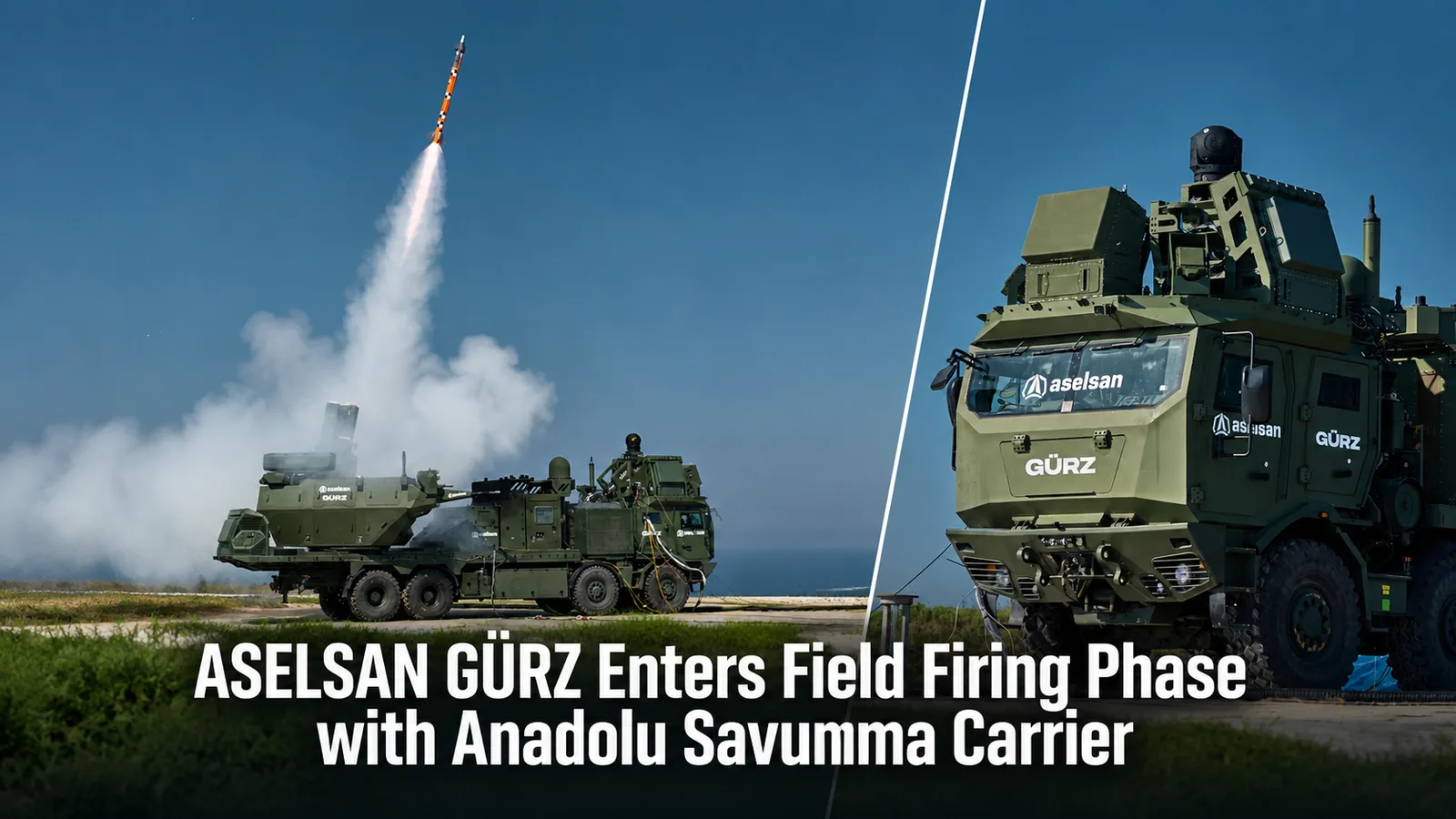
ASELSAN’s GÜRZ air-defence system reached a new development milestone on 5 September 2026 with a successful live-fire field activity. Designed to provide layered short-range air defence against different aerial threats from a single mobile platform, GÜRZ combines AESA radar coverage, electro-optical tracking, command-and-control functions, gun-based effectors and missile interceptors in one architecture.
The activity is important because it exercised more than an individual weapon. Radar and electro-optical detection and tracking, track continuity, range accuracy and the GÖKSUR missile were brought together in the engagement chain, while the dedicated Anadolu Savunma 8×8 carrier provides the mobility, crew environment and structural capacity needed to move the integrated system between firing positions.
Live-fire activity exercised the complete engagement chain
TRT Haber reported on 7 September 2026 that GÜRZ had successfully completed a live-fire field activity two days earlier, on 5 September. The event tested radar and electro-optical detection and tracking, track continuity and range accuracy, while the system’s sensor and communications elements operated as an integrated chain rather than as isolated subsystems.
The GÖKSUR missile used during the activity followed the expected trajectory while conducting demanding manoeuvres. That makes the event a meaningful system-level milestone: GÜRZ is moving from component-level demonstration toward a mobile air-defence node in which detection, tracking, fire control and interception are coordinated on one vehicle.
GÜRZ combines multiple sensors and effectors on a single mobile node
ASELSAN’s official GÜRZ 150 product document describes the system as a fully autonomous multi-effector air and missile defence solution for short and very-short ranges. The published architecture includes AESA radar, IFF, a fire-control radar and electro-optical suite, together with a 35 mm air-defence gun, very-short-range and short-range missiles, a self-defence weapon and a soft-kill electronic countermeasure capability.
The official threat set includes Class 1–3 UAVs, kamikaze and swarm attacks, fixed-wing aircraft, helicopters, supersonic air-to-ground missiles and supersonic cruise missiles. ASELSAN also lists multiple engagement, sequential firing, threat evaluation and weapon assignment, higher-echelon command-and-control connectivity, day/night operation and fire-on-the-move as core characteristics. These functions place GÜRZ in the lower and mobile layers of Türkiye’s wider integrated air-defence architecture rather than in a single-purpose gun or missile category.
Anadolu Savunma developed the dedicated 8×8 carrier for the GÜRZ project
The carrier used for the GÜRZ configuration was developed by Anadolu Savunma specifically for the ASELSAN project. It should therefore not be identified as the company’s legacy vehicle-family designation vehicle family or assigned another commercial designation unless Anadolu Savunma formally announces one. For editorial accuracy, Defence Agenda refers to it as the dedicated Anadolu Savunma-developed GÜRZ carrier.
The distinction matters because the platform is part of the integrated weapon-system architecture. It must support the structural load, power demand, crew workspace, sensors, command-and-control equipment and effectors carried by GÜRZ while also providing the mobility needed for rapid displacement. ASELSAN’s official GÜRZ 150 documentation confirms the use of an 8×8 tactical wheeled carrier and highlights rapid relocation and 'hide-fire-displace' employment as system-level capabilities.
Carrier design supports crew endurance, awareness and cross-country mobility
The dedicated carrier includes an engine-off climate-control capability that allows the crew environment to remain conditioned without continuously operating the main engine. For an air-defence vehicle expected to spend long periods in standby, surveillance or firing-position readiness, this can support crew endurance and reduce unnecessary main-engine operation during static tasks.
The vehicle also incorporates a camera system providing 360° situational awareness around the platform for the driver and crew. A high-load-capacity cabin supports the demanding mission-system installation, while the independent 8×8 axle system is intended to provide mobility, road holding and ride comfort in difficult terrain. Together, these characteristics support a system that may need to change position frequently, follow manoeuvre units and remain operational across dispersed firing sites.
GÜRZ links two domestic engineering capabilities in one air-defence platform
GÜRZ combines ASELSAN’s radar, electro-optics, communications, command-and-control and air-defence effector expertise with Anadolu Savunma’s tactical wheeled-vehicle engineering. The carrier’s development for the GÜRZ programme indicates a vehicle–mission-system integration approach in which mobility and structural capacity are engineered alongside the weapon and sensor package rather than treated as an after-market addition.
This approach is consistent with Türkiye’s wider move toward an integrated system-of-systems model under the Steel Dome architecture. Defence Agenda has previously tracked ASELSAN’s expansion of lower-layer counter-UAS capabilities and the broader GÖKSUR/HİSAR portfolio; GÜRZ adds a highly mobile node capable of combining sensors, kinetic effectors and soft-kill functions at close range.
Implications / Next
The 5 September 2026 firing activity is a development milestone, not evidence that the system has completed operational acceptance or entered full-rate production. The next indicators to watch are broader target sets, electronic-warfare conditions, combined gun-and-missile engagements, reload and resupply cycles, mobility trials and eventual user-acceptance activity.
If those stages are completed successfully, GÜRZ could provide a mobile lower-layer element within Türkiye’s integrated air-defence network. Its operational value will depend not only on interceptor performance but also on sensor fusion, command-and-control connectivity, logistics sustainability and the reliability of the Anadolu Savunma-developed carrier under prolonged field conditions.
Further Reading
Defence Agenda
- ASELSAN Integrated Defence Systems: ZOKA, HİSAR and GÖKSUR
- ASELSAN Steel Dome Adds New C-UAS Layer
- Steel Dome Programme