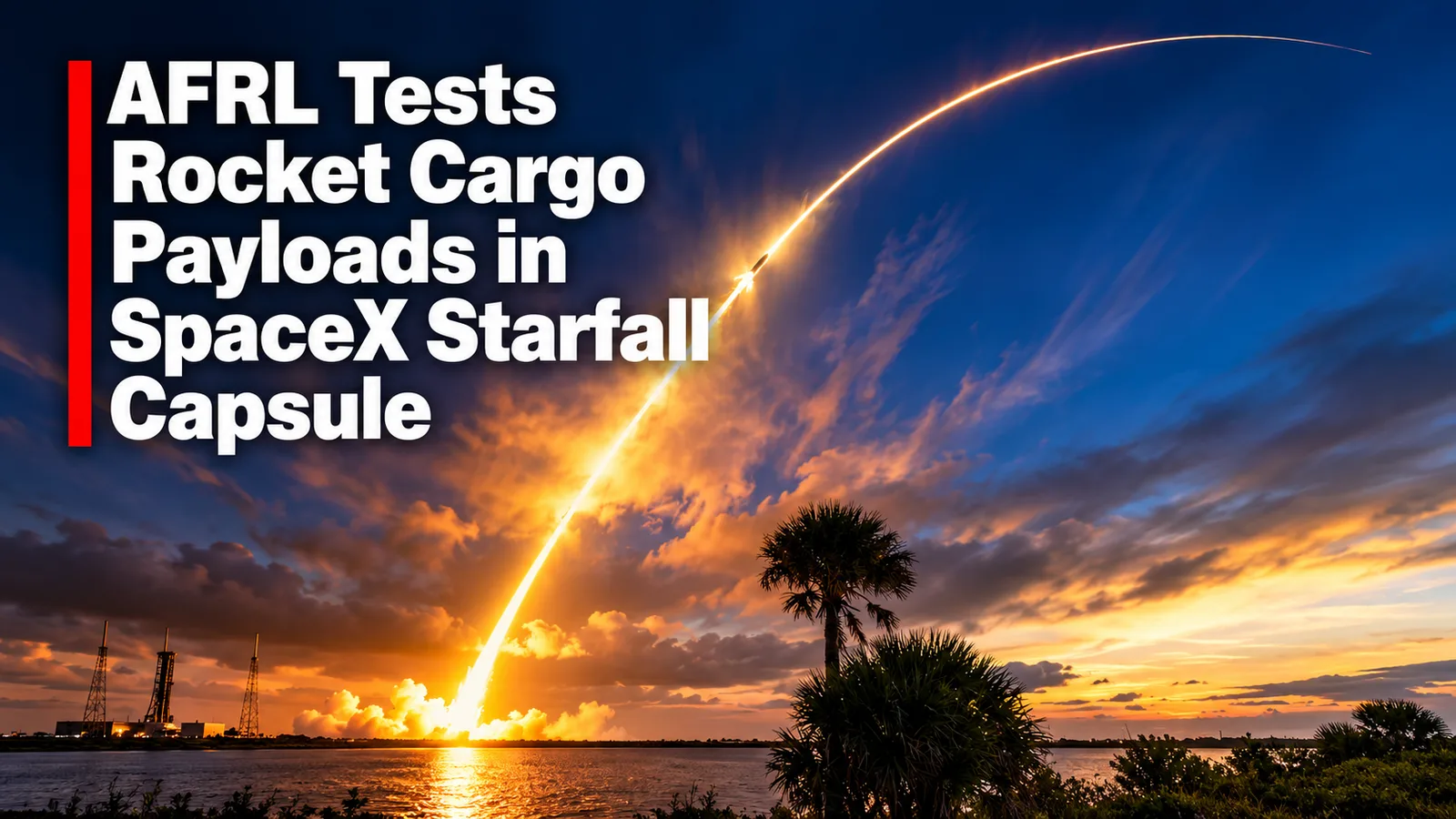
The Air Force Research Laboratory tested representative cargo and environmental sensors aboard a SpaceX Starfall capsule launched on 20 October 2026. The experiment gathered information on whether reusable space transport could eventually support rapid military logistics; it was not an operational delivery mission. Rocket-based delivery promises to change response time and access to austere locations, but re-entry environments, payload integrity and the economics of routine launches remain open engineering questions.
The October 20 experiment and its actual payload
AFRL reported that it used a SpaceX Starfall re-entry capsule aboard a commercial launch on 20 October to evaluate Rocket Cargo point-to-point delivery technologies. The experimental cargo pods incorporated representative mission equipment and environmental sensors measuring temperature, shock and vibration during launch and re-entry. Items highlighted by the laboratory included communications tracking equipment, batteries, a reverse-osmosis desalinator and emergency supplies. Engineers also examined the fit of a life raft as a possible future cargo item. The important distinction is that carrying such items through the test environment is not the same as delivering mission supplies to deployed troops on an operational timetable.
What Rocket Cargo is trying to solve
Aircraft remain the workhorse for military airlift but depend on airfields, overflight permissions, logistics hubs and some degree of freedom from air or missile threats. AFRL’s Rocket Cargo project investigates whether commercial launch systems could move selected materiel on much shorter timelines and reach places difficult for conventional aircraft. The engineering challenge is not just flight speed. Packaging, loading, rocket availability, mission planning, landing or splashdown, recovery and final-mile distribution determine how useful a rapid launch would be to a unit. A capsule that survives launch and re-entry with intact representative payloads supplies engineering data, but does not by itself establish a deployable logistics chain.
Test evidence versus headline delivery promises
AFRL characterised the demonstration as successful research progress, while subsequent reporting highlighted unresolved issues such as capsule recovery and the precise amount of carried equipment. Public descriptions do not establish a military payload delivered to a specific forward operating site, a measured door-to-door time or an operational cost per kilogram. Technical parameters for the Starfall capsule appear in regulatory documentation, but they should not be substituted for a confirmed loaded manifest on this particular flight. Rocket Cargo remains a feasibility programme exploring environmental loads, payload containment and vehicle integration. It is not a government announcement that global one-hour logistics has entered routine service.
Path from re-entry research to repeatable logistics
Next steps include repeated flight and re-entry data, verified cargo recovery, landing-zone safety, field unpacking and an assessment of total mission economics. The project must also demonstrate that military supplies remain usable after the dynamic launch and re-entry environment; surviving the trip is not enough if sensors, medical stores or water-production equipment cannot operate afterwards. Any future military procurement decision will need a credible supply chain and ground-handling concept as well as a flight vehicle. The official 20 October statement is the earliest verified publication about this specific demonstration, which is why the CMS date should be 20 October rather than the 26 October date on the later specialist report.
Industrial and programme assessment
Space-transport concepts create questions unfamiliar to routine airlift procurement. Launch windows, weather, re-entry safety corridors and range operations can be constrained even when a booster and capsule are technically available. The cost and environmental burden of using a rocket for urgent cargo would need to be justified against aircraft, prepositioning and other rapid-response approaches. The experiment is valuable because it measures one important segment of the problem, but an acquisition decision would require end-to-end comparative data that have not been published.
The historical sequence matters to data users. AFRL published its announcement on 20 October, the day of the launch experiment, while specialist publications revisited the milestone six days later. A newsroom that automatically inserts the secondary article date would incorrectly delay the original publication history. The experimental mission itself is stronger evidence than earlier Rocket Cargo concept work, but still falls short of demonstrating routine, point-to-point logistics with ready-to-use cargo received by an operational unit.
Implications / Next
For procurement and industry stakeholders, the critical future evidence will be primary-source confirmation of funded work, validated technical progress and a demonstrable transition to delivered or operational capability. In this case the immediate checkpoint is specific: repeat trials that demonstrate recovery, intact cargo and end-to-end logistics performance. The disclosed milestone should be updated only when those events occur, not assumed from the present announcement.
Further Reading
US launch and re-entry infrastructure
Autonomous military logistics demonstration
Air Force Research Laboratory, 20 October 2026