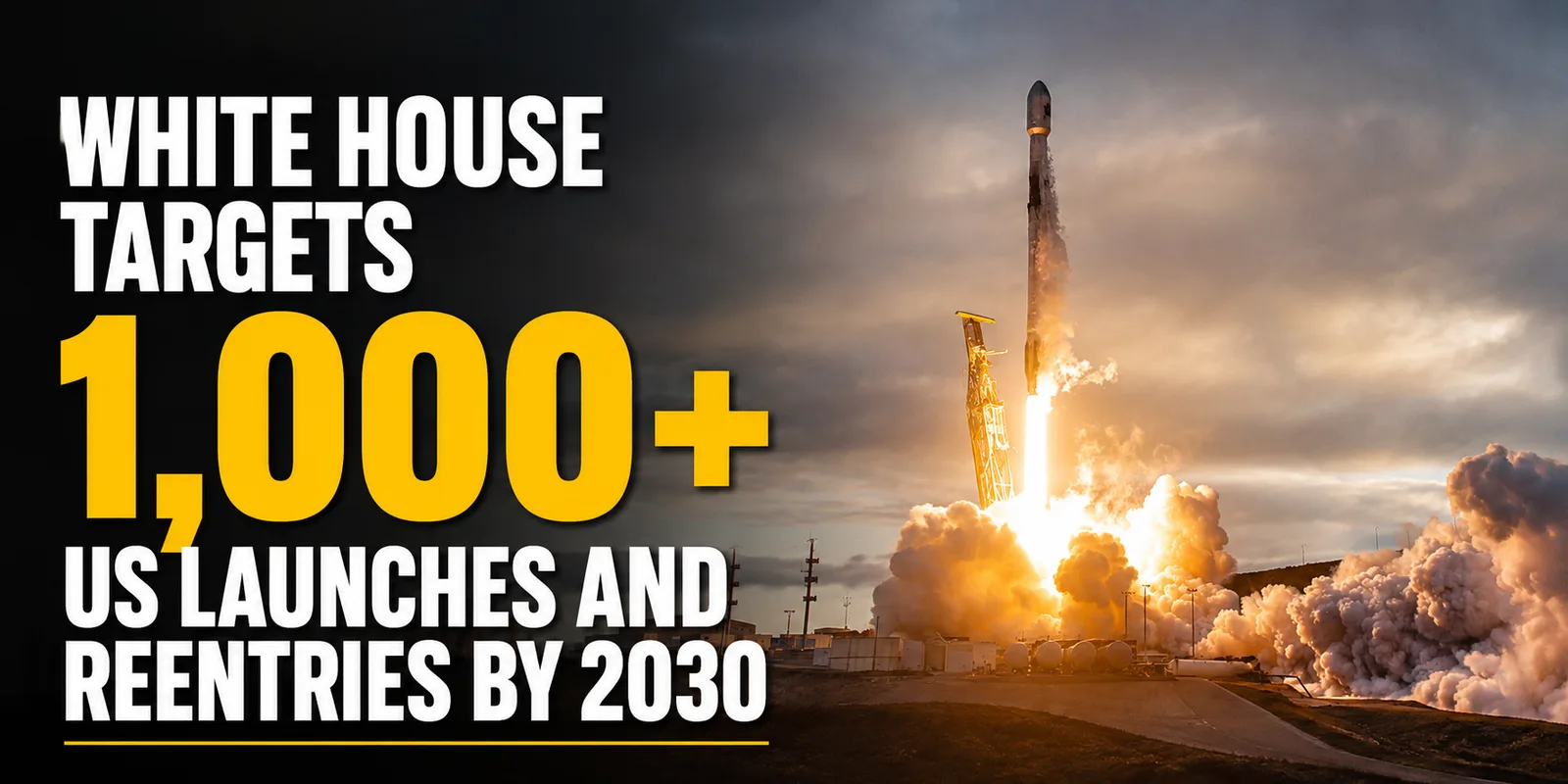
The White House has issued a new National Space Transportation Policy directing the United States to expand launch and reentry infrastructure so national ranges can support more than 1,000 launches and reentries every year by 2030, while reducing bottlenecks at federal spaceports and increasing the use of commercial infrastructure.
National Security Presidential Memorandum 17, signed on 20 August 2026, replaces the 2013 National Space Transportation Policy and assigns a series of 90- to 240-day actions across the Department of War, NASA, the Department of Transportation, the Department of Commerce, the Department of the Interior and other agencies. The policy does not itself fund 1,000 annual missions; it establishes a capacity objective and directs the government to identify new sites, modernise existing ranges, change scheduling and cost-recovery practices, integrate launch activity into air-traffic management and examine barriers to responsive launch.
Key Facts
- Policy: National Space Transportation Policy / NSPM-17
- Signed: 20 August 2026
- 2030 objective: U.S. ranges able to support more than 1,000 launches and reentries annually
- Core federal ranges: Cape Canaveral Space Force Station and Vandenberg Space Force Base
- 2025 Space Force range baseline: Roughly 110 launches at Cape Canaveral and 65 at Vandenberg in the Objective Force planning document
- 2036 demand projection: Approximately 1,200 annual launch activities at Cape Canaveral and 1,800 at Vandenberg in the Space Force Objective Force
- Federal scheduling deadline: 180 days
- Responsive-access study: Barriers to launch within 48 hours of need must be evaluated within 180 days
What the New Policy Actually Does
The central policy objective is broader than the headline launch-rate target. NSPM-17 treats access to, from and within space as a national and economic security requirement and directs federal agencies to build a more scalable transportation architecture spanning launch, reentry, on-orbit logistics and future transportation systems.
For launch infrastructure, the memorandum directs the Department of War and NASA to operate federal ranges transparently for government and non-government users. Agencies are instructed to incentivise commercial co-development of infrastructure through leases, private investment and public-private partnerships, facilitate commercial access to federal sites and establish fair and transparent cost-recovery policies for shared services and infrastructure.
Within 180 days, the Department of War must coordinate federal range-scheduling criteria designed to maximise efficient use of range resources while preserving government priority. The government must also publish range schedules more regularly, reducing uncertainty for commercial providers competing for infrastructure and launch windows.
The Department of Transportation has a separate 180-day task to identify potential locations for additional launch facilities or targeted infrastructure development, integrate launch and reentry activity into airspace and traffic-control modernisation and designate priority airspace for critical launch corridors.
The 1,000 Figure Is a Capacity Goal, Not a Forecast of Government Launches
The White House states that U.S. space transportation ranges must grow to support more than 1,000 launches and reentries annually by 2030. That should not be interpreted as a commitment for the U.S. government itself to conduct 1,000 launches, nor as a guarantee that 1,000 orbital launches will occur.
The metric includes both launch and reentry operations and covers government and commercial demand. It is therefore best understood as a national infrastructure-capacity target intended to prevent federal ranges, airspace, permitting and support services from becoming constraints on industry growth.
The White House fact sheet frames the policy around commercial-first space transportation, infrastructure co-development, permitting reform, transparent scheduling and a more resilient industrial base. It also continues the regulatory direction established by Executive Order 14335 in August 2025, which ordered agencies to streamline launch and reentry licensing and accelerate reviews for next-generation spaceport infrastructure.
Space Force Forecasts Show a Much Larger Long-Term Demand Signal
The Space Force’s 2026 Objective Force provides the clearest public illustration of why infrastructure has become a strategic issue. Its Spacelift and Launch Range Control chapter says the service has accommodated exponential growth in launch cadence using physical infrastructure originally built decades ago.
The document projects annual launch activity at Cape Canaveral Space Force Station rising from roughly 110 launches in 2025 to approximately 1,200 by 2036. At Vandenberg Space Force Base, the projection rises from 65 launches in 2025 to approximately 1,800 by 2036.
Those figures are planning projections rather than committed manifests. The Objective Force explicitly presents itself as long-term conceptual guidance, and the charts include forecast scenarios rather than guaranteed launch demand. Nevertheless, they demonstrate the scale of the mismatch the Space Force is planning against: the two principal federal ranges may need to support activity measured in the thousands rather than the hundreds.
The same document identifies three structural problems. The current launch enterprise is not sized for future volume and tempo; national capacity remains concentrated at a limited number of fixed nodes; and legacy government-controlled range-service models limit the ability to scale with commercial demand.
Cape Canaveral and Vandenberg Are the Current Bottlenecks
Cape Canaveral and Vandenberg remain the two core Space Force launch nodes for national-security missions and a large share of U.S. commercial launch activity. The concentration provides mature range safety, payload processing, security and mission-assurance infrastructure, but it also creates physical and operational bottlenecks.
The Space Force says future demand requires scaling launch pads, range services, secure payload-processing facilities, mission-assurance processes, utilities and the workforce supporting them. Physical expansion is only part of the problem: roads, bridges, power, commodities, propellant infrastructure, communications, blast and flight-hazard areas, payload integration space and range instrumentation all constrain throughput.
Vandenberg has already launched a major Spaceport of the Future recapitalisation effort. A July 2026 industry day focused on power-grid expansion, roads, utilities, environmental planning, logistics, launch support facilities and new models for public-private infrastructure investment.
The service also reactivated the 4th Space Launch Squadron at Vandenberg in July 2026 with responsibility tied directly to range management and Spaceport of the Future initiatives, illustrating that the capacity problem is organisational as well as physical.
Spaceport of the Future Is the Space Force’s Structural Answer
The Objective Force calls for a distributed, resilient and commercially integrated national space-access enterprise under the Spaceport of the Future concept. Cape Canaveral and Vandenberg remain primary federal nodes, but commercial, partner and eventually allied sites are intended to provide additional capacity and geographic diversity.
The envisioned architecture shifts away from treating each launch complex as an isolated facility. Instead, launch sites and providers would become interoperable nodes in a broader network, allowing missions to be reallocated if weather, infrastructure failure, attack, congestion or another disruption affects a primary site.
The Space Force also plans to move toward a landlord-port model in which commercial providers assume more routine operations and maintenance functions while the government retains inherently governmental responsibilities such as mission assurance, public safety, security and national-security prioritisation.
The FY2027 Department of the Air Force budget request identifies $2.2 billion for Space Force Spaceport of the Future and other strategic space infrastructure. That is a budget request rather than a guarantee of final appropriations, but it demonstrates the scale of infrastructure investment the service says is required.
Cost Recovery Is Part of the Capacity Problem
Infrastructure is not the only bottleneck. The Government Accountability Office has previously found that statutory reimbursement rules limited the Department of Defense’s ability to recover indirect costs from high-cadence commercial launch providers using federal ranges.
GAO found that a $5 million reimbursement cap could allow high-frequency providers to continue receiving range support after reaching the statutory ceiling, leaving the government unable to recover the full indirect cost of the activity. The problem matters because launch cadence can grow faster than appropriated range funding.
NSPM-17 directly addresses this issue by requiring fair and transparent cost-recovery policies for common services, commodities and infrastructure. If implemented effectively, that change could link commercial utilisation more directly to capacity investment instead of forcing range expansion to rely almost entirely on appropriations.
Responsive Launch Adds a National-Security Requirement
The policy does not treat launch capacity only as an economic issue. Within 180 days, the Department of War must evaluate regulatory, programmatic, operational and technological barriers to prompt, resilient access to space, including the ability to support accelerated timelines within 48 hours of need and expeditionary locations.
This requirement builds on the Space Force’s Tactically Responsive Space work. During the VICTUS HAZE mission in June 2026, Rocket Lab launched an Electron carrying a Pioneer spacecraft after receiving a Notice-to-Launch requiring the company to posture for a previously unknown orbit within a 24-hour window. Rocket Lab reported an actual notice-to-launch interval of 16 hours and 42 minutes.
The operational distinction is important. A range optimised only for a predictable commercial manifest may not be able to insert an urgent national-security mission without disrupting other users. Responsive launch therefore creates a requirement for both excess capacity and scheduling agility.
Airspace, Spectrum and Reentry Become Infrastructure Issues
Higher launch cadence also creates constraints outside the launch pad. Every launch and reentry interacts with national airspace, spectrum allocation, maritime safety and environmental review processes.
NSPM-17 directs the Department of Transportation to integrate launch and reentry management into airspace and traffic-control modernisation and to identify priority airspace for critical space-launch corridors. The Department of Commerce and Federal Communications Commission must also develop an approach for reliable spectrum access supporting launch, reentry, recovery and on-orbit operations.
The memorandum separately directs the Department of the Interior to identify federal land for an additional designated reentry site within 90 days. Transportation must then evaluate safety criteria, followed by a Commerce Department development plan within 240 days.
This reflects a broader change in the launch market. Reusable vehicles turn reentry into a recurring transportation activity rather than an exceptional event, making landing zones, reentry corridors, airspace closures and recovery infrastructure part of the same capacity equation as launch pads.
Industrial and Commercial Impact
The policy favours commercial space transportation services for government needs and requires development of a space transportation industrial-base strategy within 180 days. That creates opportunities beyond launch-vehicle manufacturers.
The infrastructure buildout will require civil engineering, power systems, cryogenic propellant handling, communications, range instrumentation, autonomous flight-safety systems, payload processing, cybersecurity, logistics, environmental services and airspace-management technology.
The public-private partnership language is also significant. Rather than requiring the government to fund every pad, processing building or utility upgrade itself, the policy seeks structures in which companies invest capital in federal property under leases or other access agreements.
The strategic risk is that commercially financed infrastructure will naturally follow the highest-volume customers. Federal policy will therefore have to balance commercial efficiency with redundancy, national-security access, geographic diversification and the need to preserve capacity for lower-frequency government missions.
Limitations and Counterpoint
The 1,000-plus target is ambitious, but NSPM-17 does not itself provide the appropriations, land, workforce or construction schedule needed to reach it. Many of the most consequential actions are studies, criteria, reports and development plans due within the next 90 to 240 days.
Space Force projections of 1,200 annual activities at Cape Canaveral and 1,800 at Vandenberg by 2036 should also not be treated as fixed manifests. They are long-range planning assumptions intended to stress-test future force design.
Infrastructure expansion can also create conflicts with environmental protection, local communities, airspace users and neighbouring launch providers. Faster permitting may reduce administrative delay, but it does not eliminate physical safety constraints such as blast zones, launch azimuths, weather, propellant handling and vehicle-specific pad requirements.
Finally, a third or additional launch site does not automatically solve heavy and super-heavy launch constraints. Vehicle size, acoustic and blast effects, propellant systems, payload-security requirements and orbital inclination can make a site suitable for one launch class but not another.
Implications / Next
The first policy milestones will arrive quickly. Within 90 days, the government is due to identify federal land for an additional reentry site. Within 180 days, agencies must deliver federal range-scheduling criteria, candidate launch-infrastructure locations, responsive-launch barrier assessments, infrastructure-security recommendations, spectrum planning and an industrial-base strategy.
The more consequential test will be whether those studies convert into funded construction, lease agreements, new launch complexes and measurable increases in throughput at Cape Canaveral and Vandenberg.
For the Space Force, the key indicators are the FY2027 Spaceport of the Future funding outcome, additional commercial outgrants, payload-processing expansion, progress on range automation and whether the service can maintain national-security responsiveness without constraining commercial cadence.
Conclusion
The new National Space Transportation Policy formally recognises that U.S. launch infrastructure is becoming a strategic bottleneck. The White House’s 1,000-plus annual launch-and-reentry objective is less a forecast than a direction to redesign the national space transportation system before demand overwhelms existing federal ranges.
The underlying problem is larger than launch pads. Range scheduling, cost recovery, airspace, spectrum, environmental approval, utilities, payload processing, workforce and geographic concentration all determine how many missions the United States can actually support.
If NSPM-17 is implemented alongside the Space Force’s Spaceport of the Future architecture, the long-term result could be a distributed national launch network in which federal, commercial and partner spaceports operate as interoperable nodes. Whether that architecture emerges will depend on appropriations, commercial investment and the government’s ability to turn short-deadline policy studies into physical capacity.