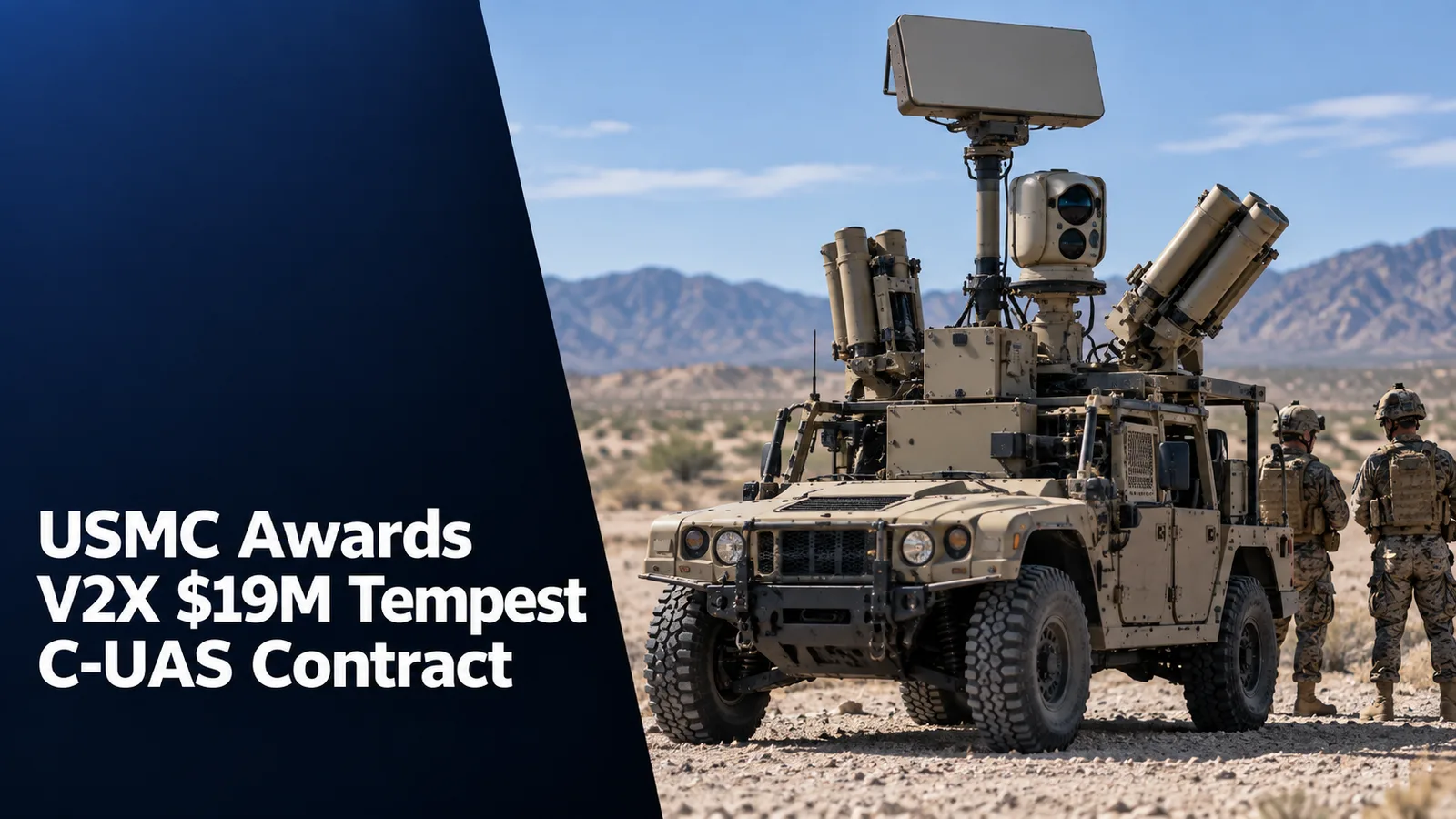
V2X announced on 8 September 2026 that it has received a $19 million indefinite-delivery/indefinite-quantity contract from the U.S. Marine Corps for Tempest counter-UAS vehicles. The scope extends beyond vehicle hardware to maintenance support, software management, spares, ancillary components, training and engineering services. That breadth indicates the Marine Corps is buying an operational support package rather than simply procuring a small number of bare vehicles.
The Marine Corps Is Buying a Mobile Counter-UAS Package
Because the award is an IDIQ contract, the $19 million figure should be treated as the announced contract value or ceiling structure rather than automatically equated with delivered hardware on day one. Public material reviewed for this package does not identify a firm vehicle quantity. Actual procurement will depend on task or delivery orders issued under the contract.
Tempest Prioritises Mobility for Manoeuvre Force Protection
V2X describes Tempest as a commercially based mobile combat vehicle designed to detect, engage and defeat Class 2–3 unmanned aircraft while remaining able to reposition quickly. The company introduced the platform publicly in 2025 as a mobile fires and counter-UAS solution with dual launchers. The underlying concept addresses a growing requirement to protect manoeuvre formations without tying counter-drone systems to fixed sites.
Mobility matters because a counter-UAS system that remains static can become vulnerable to reconnaissance, artillery or drone attack. A vehicle that can displace after an engagement may be easier to keep alive alongside forward units. The trade-off is integration complexity: sensors, weapons, command links and power systems must function reliably on a vehicle that is exposed to vibration, weather and rapid movement.
Support and Software Are Central to Counter-Drone Effectiveness
Counter-UAS performance changes as threat drones change. New frequencies, flight profiles, autonomy and tactics can reduce the effectiveness of a system that is not updated. The inclusion of software management and engineering services in the Marine Corps contract is therefore operationally important, because it creates a mechanism for adapting the system after fielding rather than treating it as a static piece of hardware.
Training and spares are similarly important. Counter-drone crews must identify threats, manage engagement authority and keep sensors and effectors ready under high operational tempo. A platform can have strong advertised performance but still provide limited protection if units lack trained operators or if critical components are unavailable. The contract's support elements suggest the Marine Corps is addressing that sustainment problem at the acquisition stage.
Vehicle Quantity and Delivery Orders Remain the Key Unknowns
The public announcement confirms the customer, $19 million value and broad scope, but it does not disclose how many Tempest vehicles will be delivered or when the first Marine Corps unit will receive them. Those details are essential for assessing the scale of fielding. An IDIQ framework can support rapid follow-on orders, but it does not guarantee that the full ceiling will be obligated immediately.
The next milestones will be delivery orders, first-unit receipt, training activity and operational evaluation. Evidence of deployment with Marine manoeuvre formations would mark a different maturity stage from the current contract award. Until those events are confirmed, Tempest should be described as a funded Marine Corps counter-UAS procurement pathway with quantity still undisclosed.
Implications / Next
The next publication-grade milestone will be the first independently verifiable event that changes the programme status described above, such as a delivery, acceptance event, production start, exercised option, operational test or formal fielding decision. Defence Agenda will continue to separate these maturity stages and will not treat an announcement, contract or first test as proof that the full capability has already entered operational service.