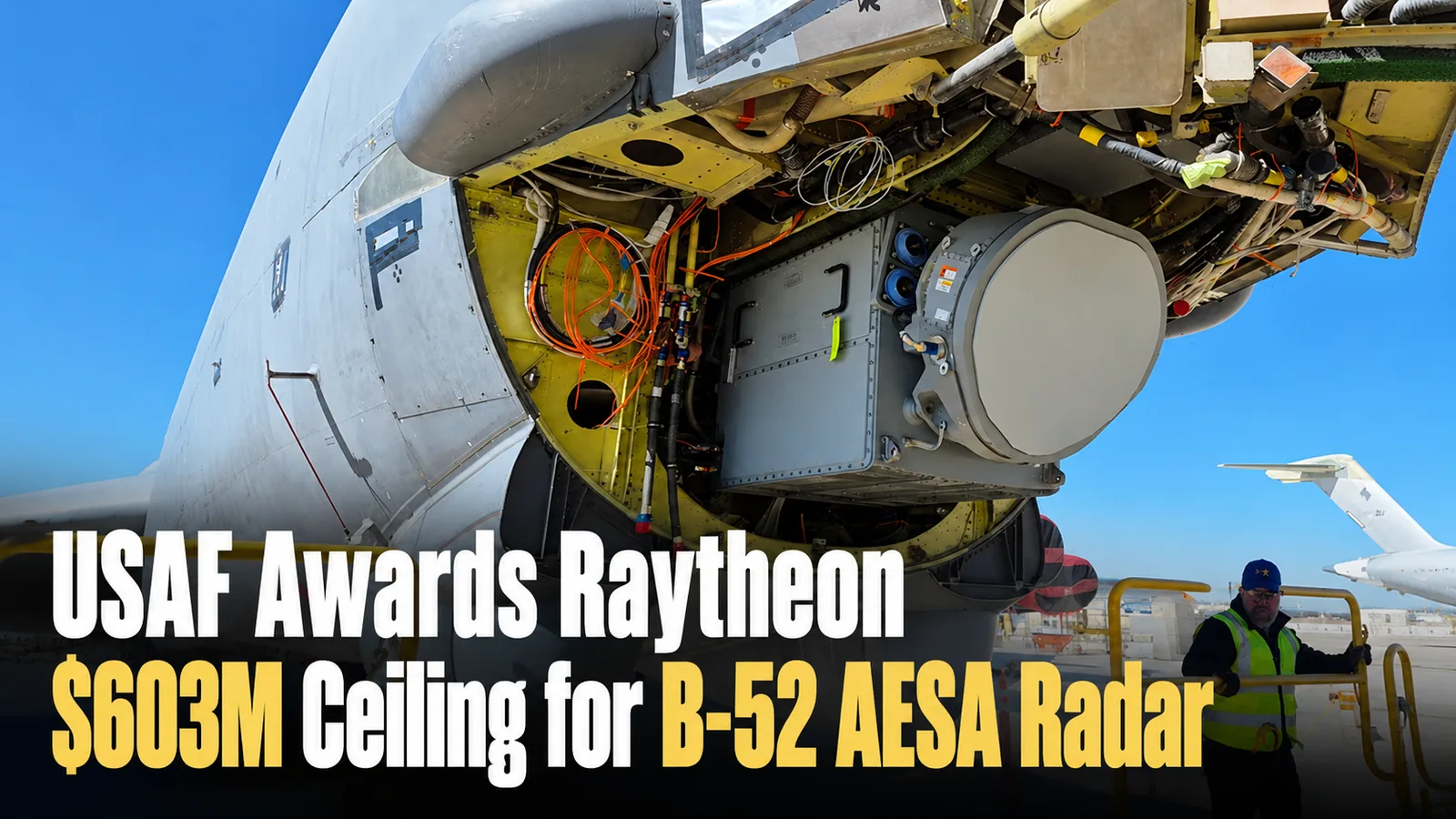
The U.S. Air Force has awarded Raytheon a $603 million ceiling indefinite-delivery/indefinite-quantity contract for production and sustainment of the AN/APQ-188 Bomber Modernized Radar System for the B-52 fleet, moving the long-running Radar Modernization Program into a new procurement phase after years of integration, schedule and cost pressure.
The contract, FA8628-26-D-B001, was awarded on 21 August 2026 and publicly announced by the Department of War on 25 August. The full $603 million is a contract ceiling rather than an amount obligated at award. The Air Force committed $46.008 million in fiscal 2026 aircraft-procurement funding with the initial delivery order. Work is expected to continue through 20 August 2031.
Key Facts
- Contractor: Raytheon, an RTX business
- System: AN/APQ-188 Bomber Modernized Radar System
- Contract type: Indefinite-delivery/indefinite-quantity
- Contract ceiling: $603 million
- Initial obligation: $46,008,396 in FY2026 aircraft-procurement funds
- Contract number: FA8628-26-D-B001
- Award date: 21 August 2026
- Expected completion: 20 August 2031
What the New Contract Actually Covers
The Department of War describes the award as a production and sustainment contract for the B-52 radar modernisation effort. The contract equips B-52 aircraft with the AN/APQ-188, replacing the ageing AN/APQ-166 mechanically scanned radar that has become increasingly difficult to sustain.
The $603 million figure is the maximum ceiling of the IDIQ vehicle. It should not be reported as $603 million already spent or obligated. At award, the Air Force obligated $46,008,396 through the initial delivery order. Future orders can be placed against the IDIQ ceiling as production and sustainment requirements mature.
The acquisition was sole-source. The Air Force Life Cycle Management Center at Wright-Patterson Air Force Base is the contracting activity. The contract notice lists work in Mississippi, El Segundo and McKinney, as well as Warner Robins, Georgia, with performance scheduled through August 2031.
AN/APQ-188 Replaces the B-52’s Legacy Radar
The AN/APQ-188 is an active electronically scanned array radar developed by Raytheon for the B-52 Radar Modernization Program. The Department of Defense’s Director, Operational Test and Evaluation identifies the system as the Bomber Modernized Radar System and says it is intended to replace the AN/APQ-166.
The new radar is expected to improve reliability while reducing the sustainment burden associated with the legacy system. DOT&E also identifies new high-resolution ground-mapping capability, improved target-location accuracy and the ability to track moving surface and air targets as major operational improvements.
Air Force public material describes the radar as supporting all-weather navigation and targeting and notes that the design draws on radar technology already fielded on the F-15 and F/A-18. Raytheon supplies the radar, while Boeing is responsible for integration into the B-52 aircraft as the bomber’s original equipment manufacturer and prime integrator.
Why the Contract Is Strategically Important
The radar upgrade is one of the major elements required to keep the B-52 viable into the 2050s. The bomber is expected to remain a nuclear and conventional long-range strike platform alongside the B-21 Raider, making sensor modernisation as important as the aircraft’s propulsion and weapons upgrades.
A modern AESA changes more than radar reliability. High-resolution mapping, improved moving-target tracking, better situational awareness and software-upgrade potential can support long-range conventional strike, maritime targeting, navigation and nuclear mission requirements while reducing dependence on an analogue radar architecture designed decades earlier.
The upgrade also supports the broader B-52J transformation. The radar programme runs in parallel with the Commercial Engine Replacement Program, which will replace the TF33 engines with Rolls-Royce F130s, as well as avionics, communications, weapons and cockpit changes intended to extend the bomber’s operational relevance.
Programme Restructuring After Cost Growth
The new Raytheon production contract arrives after a difficult development period. The Government Accountability Office reported that the B-52 Radar Modernization Program’s estimated acquisition cost increased from approximately $2.343 billion in the June 2021 baseline to $2.580 billion by August 2023. The programme subsequently experienced further technical and integration pressure.
In spring 2025, the Air Force notified Congress of a significant Nunn-McCurdy cost breach. DOT&E attributed the cost growth to continuing technical challenges associated with integrating the radar onto the B-52.
The Air Force responded by restructuring the programme around a Minimum Viable Product approach. Under the revised plan, the first increment will deliver a reduced capability set sufficient to meet core requirements while deferring some functions to later upgrades.
One notable deferral is the new wideband nose radome. DOT&E says the MVP will initially use the legacy radome, requiring the Air Force to characterise AN/APQ-188 performance within that existing structure. The decision reduces near-term integration scope but means the first operational configuration will not represent every capability originally planned for the programme.
Testing, Production and the June 2026 Crash
The first B-52 fitted with the modernised radar arrived at Edwards Air Force Base in December 2025 after modification at Boeing’s San Antonio facility. The Air Force planned ground and flight testing throughout 2026 to support a production decision.
On 15 June 2026, a B-52 carrying eight people crashed shortly after take-off from Edwards during a routine test mission. Air Force Global Strike Command later confirmed that the aircraft was supporting the Radar Modernization Program. All eight people aboard were killed. The cause remains under investigation and no public finding has linked the accident to the radar system.
The Air Force has stated that the radar modernisation effort will continue. Programme officials said a second RMP test aircraft was already part of the acquisition strategy and was being modified for later testing. The safety investigation and programme test schedule therefore remain separate issues unless investigators determine otherwise.
This distinction is critical: the existence of a crash during an RMP-supported mission does not establish that the AN/APQ-188 or its integration caused the accident.
Milestone C and Full-Rate Production
DOT&E’s FY2025 assessment scheduled developmental and integrated flight testing for FY2026, with a Milestone C decision planned for the fourth quarter of FY2026. Initial operational test and evaluation is expected later, with a full-rate production decision for the remaining aircraft following IOT&E in FY2028.
The newly awarded Raytheon IDIQ is therefore best understood as the contractual mechanism that can support production and sustainment as the programme moves through those decision points. The ceiling allows the Air Force to place orders without representing an unconditional commitment to spend the entire amount immediately.
The FY2027 Air Force procurement budget also shows radar-modernisation procurement funding extending across the remainder of the decade, consistent with a multi-year production and installation effort rather than a single large batch.
A Separate Boeing Award Supports the Same Programme
The Department of War’s 25 August contract release also announced a separate B-52 award to Boeing. Boeing received a delivery order with a maximum value of $162,966,689 for manufacturing, production, kitting and delivery of B-52 Bomb Rack Modernization System kits in support of the B-52 Radar Modernization Program.
The Boeing order, FA8628-26-F-B002, was placed under an existing IDIQ contract and carries an expected completion date of 20 December 2028. The Air Force obligated $34,952,225 in FY2026 aircraft-procurement funding at award.
This amount is separate from Raytheon’s $603 million ceiling and should not be added to the Raytheon contract as if it were part of the same award. The two actions demonstrate that the production phase requires both radar hardware and aircraft-level modification, integration and support work.
Industrial Impact
The direct Raytheon award is also notable because the Air Force had previously examined ways to reduce programme cost by contracting more directly with the radar supplier. A 2025 Selected Acquisition Report said the service was exploring direct contracting with Raytheon for low-rate and full-rate production radars, bulk ordering and other efficiencies following the programme’s cost breach.
The August 2026 IDIQ therefore appears consistent with that cost-control direction. It gives the Air Force a direct production and sustainment vehicle with the radar manufacturer while Boeing continues to perform aircraft integration and related B-52 modification work.
The programme supports work across multiple U.S. sites and links the B-52 modernisation effort to a broader industrial base already producing and sustaining advanced AESA radar technologies for tactical aircraft. That common technological lineage can offer sustainment and supplier-base benefits, although the B-52 installation remains a distinct integration challenge.
Limitations and Counterpoint
The contract announcement does not state how many production radars will be ordered under the $603 million ceiling, how many spares are included, or the unit price of an AN/APQ-188 production set. It also does not confirm that all remaining B-52 aircraft will receive radars under this single contract vehicle.
The frequently cited $2.58 billion programme estimate is a GAO estimate from August 2023, not a new 2026 total. Since then, the programme has experienced a significant Nunn-McCurdy breach and restructuring. It should therefore be used as historical cost context rather than presented as the definitive current programme cost.
The B-52 RMP also remains in test and acquisition transition. Technical integration work, the legacy-radome MVP configuration, software performance, the investigation into the June 2026 accident and later operational testing can still affect schedule and configuration.
Implications / Next
The immediate acquisition milestone is the FY2026 Milestone C decision. That decision will indicate whether the Air Force has sufficient evidence to proceed with the planned production configuration after the programme restructuring.
The next indicators to watch are the return to flight testing with the second modified B-52, the size and value of follow-on delivery orders issued under Raytheon’s IDIQ, and the number of radars committed in the first low-rate production lots.
Further clarity will also be needed on the wideband radome, deferred capabilities and the transition from the Minimum Viable Product configuration to later increments. These decisions will determine whether the initial AN/APQ-188 installation is mainly a reliability and core targeting upgrade or the first step toward the broader sensor capability originally envisioned.
Conclusion
The $603 million Raytheon award is a significant contractual milestone for the B-52 Radar Modernization Program, but the ceiling value should not be confused with immediate expenditure. The Air Force has obligated about $46 million with the initial order while establishing a production and sustainment vehicle that can run through August 2031.
More importantly, the award comes as the RMP transitions from a troubled development phase toward production under a reduced initial capability strategy. The AN/APQ-188 remains central to keeping the B-52 relevant into the 2050s, but its operational value will depend on successful testing, integration with the legacy radome, later capability increments and disciplined control of programme cost and schedule.