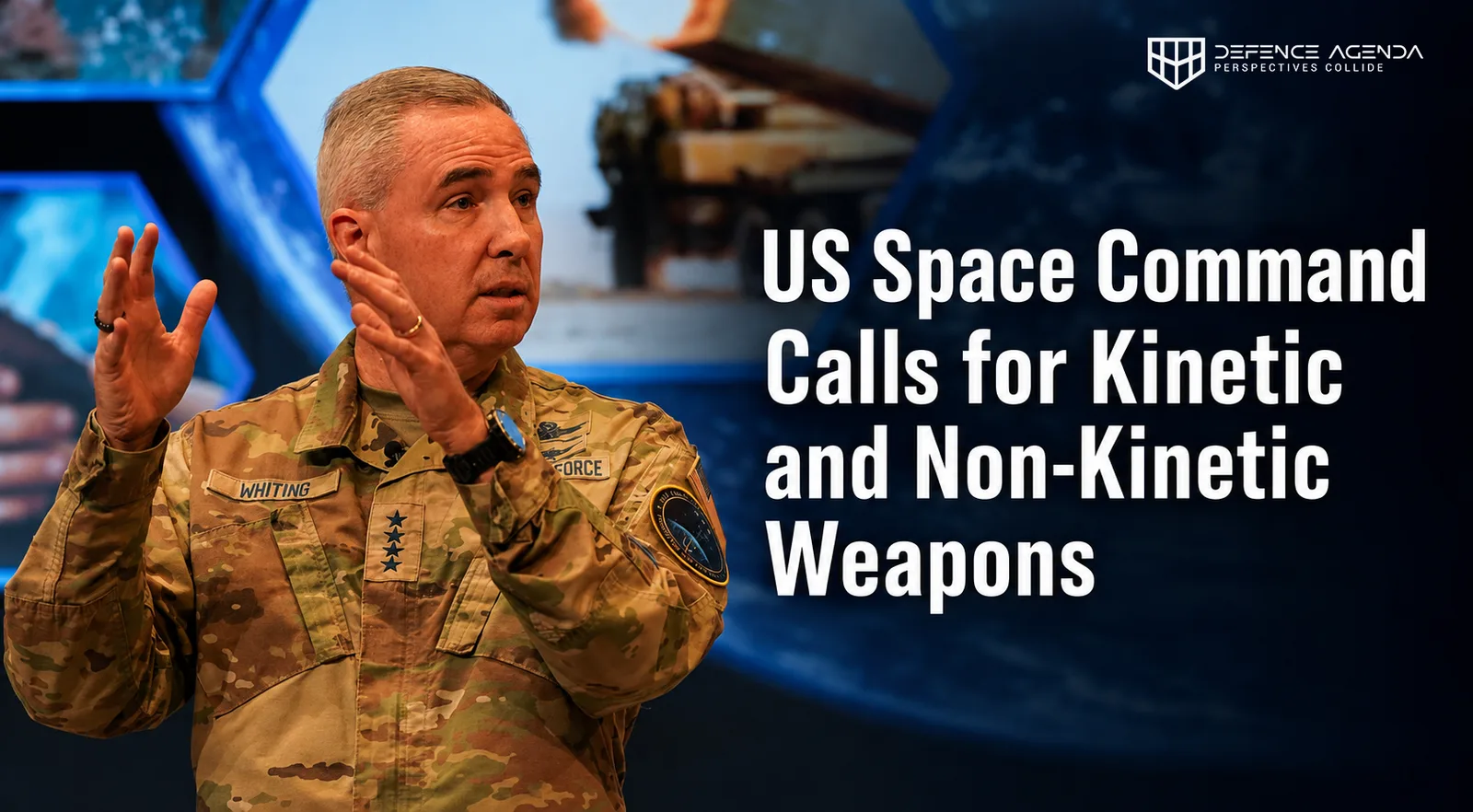
US Space Command space weapons requirements are moving further into mainstream Joint Force planning as Gen. Stephen Whiting argues that future space warfare will require both kinetic and non-kinetic capabilities rather than relying on defensive satellite resilience alone.
Breaking Defense reported on 12 August 2026 that Whiting, commander of U.S. Space Command, is continuing to press the Joint Force to prepare for a conflict in which military effects in space could include multiple classes of weapons and counterspace capabilities.
The significance is larger than a debate over whether the United States should place weapons in orbit. The Pentagon is increasingly treating space control as an operational requirement for forces fighting on land, at sea and in the air because communications, navigation, missile warning, intelligence and precision targeting all depend heavily on space systems.
Key Facts
- Commander: Gen. Stephen Whiting, commander of U.S. Space Command.
- Requirement: Whiting argues that credible space warfighting requires both kinetic and non-kinetic capabilities.
- Joint Force context: Space effects increasingly support — and can constrain — operations across air, land, maritime, cyber and missile-defence missions.
- Space Force doctrine: The service defines counterspace operations across orbital warfare, electromagnetic warfare and cyberspace warfare.
- Operational objective: The central military concept is space superiority — preserving U.S. and allied freedom of action while limiting an adversary’s ability to use space against the Joint Force.
- 2040 framework: USSPACECOM’s Space Warfighting Environment 2040 treats contested space as a baseline condition for future military operations.
- Allied dimension: The United States and six close space partners are developing a multinational concept for protecting orbital assets through Operation Olympic Defender.
US Space Command Space Weapons Move Into Joint Planning
Whiting’s latest comments are part of a broader institutional shift inside the U.S. military.
Space was once discussed primarily as an enabling domain. Satellites provided GPS, communications, weather, intelligence and missile warning to forces operating elsewhere, while military planning generally focused on protecting those services.
That model is changing.
The Space Force and U.S. Space Command now openly describe space as a domain in which military forces may need to contest adversary capabilities, defend friendly systems and establish temporary or local superiority during conflict.
This moves military space operations conceptually closer to air or maritime warfare, where commanders assume that control of the domain may have to be actively contested rather than simply preserved through passive defence.
Whiting Has Been Increasingly Explicit About Space Weapons
The current position did not emerge suddenly.
During the Space Symposium in Colorado Springs on 8 April 2025, Whiting publicly argued that U.S. military planners should be willing to describe certain capabilities as weapons and said Space Command needed space fires and orbital interceptors to support credible deterrence.
U.S. Space Command’s official account described the requirement as including acknowledged kinetic and non-kinetic capabilities, fires and weapons.
The emphasis on “acknowledged” capability is important. Military deterrence depends partly on an adversary believing that a force has both the means and willingness to respond. A capability that is entirely hidden may have operational value but limited signalling value before a conflict begins.
Kinetic and Non-Kinetic Effects Solve Different Problems
Kinetic and non-kinetic counterspace capabilities should not be treated as interchangeable.
At the broadest level, kinetic effects physically damage or destroy an object or supporting infrastructure. Non-kinetic effects can instead interfere with communications, navigation, sensors, data or command systems without necessarily physically destroying the target.
The operational effects can also differ in duration and reversibility.
Some electromagnetic interference can be stopped when the military objective has been achieved. Cyber effects may be temporary or persistent depending on the circumstances. Physical destruction, by contrast, is normally irreversible and can introduce additional escalation and debris concerns when it occurs in orbit.
This gives commanders a wider escalation ladder than a strategy based exclusively on destructive interception.
The Space Force Has Already Put the Concept Into Doctrine
The doctrinal foundation is increasingly explicit.
On 17 April 2025, the U.S. Space Force released its first Space Warfighting framework, establishing space superiority and space control as central concepts for military planning.
The framework divides counterspace activity into three broad mission areas: orbital warfare, electromagnetic warfare and cyberspace warfare.
It also identifies offensive and defensive forms of counterspace action, including orbital strike, terrestrial strike, space-link interdiction and active or passive defence.
The document therefore formalised something that senior leaders had increasingly been saying publicly: protecting satellites is only one side of the space-control problem.
Space Superiority Is Becoming a Joint Force Requirement
Space superiority matters because modern U.S. military forces are deeply dependent on orbital services.
Navigation supports precision weapons and manoeuvre. Satellite communications connect dispersed forces. Missile-warning satellites detect launches. Intelligence and surveillance constellations contribute to targeting and battlespace awareness.
Degrading those services could therefore have consequences far beyond the Space Force.
Whiting told Congress in March 2026 that the Joint Force’s ability to fight as currently designed would be materially affected if an adversary were able to degrade or destroy key U.S. space capabilities.
This explains why Space Command increasingly frames orbital warfighting as a Joint Force issue rather than a specialist Space Force mission.
China Is the Central Counterspace Reference
The shift is heavily influenced by China’s growing military-space architecture.
U.S. officials have repeatedly highlighted China’s development of counterspace capabilities together with an increasingly sophisticated space-enabled targeting architecture.
The strategic problem is dual-sided.
U.S. forces need to defend their own satellite networks while also being able to disrupt an adversary’s use of space for targeting, communications, navigation or command-and-control if required during a conflict.
That is why the U.S. military discussion has moved from satellite protection toward the wider concept of space control.
Russia Adds a Different Set of Space Threats
Russia remains another major part of the threat calculation.
U.S. officials have publicly identified Russian capabilities ranging from electronic interference and cyber operations to direct-ascent and co-orbital anti-satellite systems.
Whiting has also repeatedly highlighted U.S. concerns regarding reports that Russia has explored a nuclear anti-satellite capability for deployment in space.
That possibility would present a fundamentally different risk because the effects of a nuclear detonation in orbit could extend well beyond a single military satellite and affect commercial and third-country spacecraft.
The widening threat spectrum strengthens the argument for having multiple defensive and offensive options rather than relying on one counterspace technology.
Non-Kinetic Space Warfare Is Already More Visible
Non-kinetic space effects are generally more visible in the public domain than destructive U.S. counterspace weapons.
Electronic warfare systems can target satellite communications or navigation links. Cyber capabilities can target data, networks or ground infrastructure. Directed-energy technologies can potentially interfere with optical sensors without creating orbital debris.
These effects can offer military planners different combinations of duration, attribution, reversibility and escalation risk.
Recent exercises have also moved toward integrating non-kinetic operations more directly into Joint Force planning rather than treating them as specialised supporting actions.
Arcane Thunder 26, for example, integrated cyber, space, electronic warfare and conventional capabilities across U.S. and allied forces as part of a wider multi-domain construct.
Kinetic Capabilities Carry a Debris Problem
Destructive orbital warfare carries a major complication: debris.
A kinetic engagement against a satellite can create fragments that remain in orbit and threaten unrelated military, commercial and civilian spacecraft.
Russia’s November 2021 direct-ascent anti-satellite test demonstrated the problem when destruction of the Cosmos 1408 satellite generated a large debris cloud.
This helps explain why military planners have strong incentives to develop non-destructive options alongside any kinetic capability.
It does not mean kinetic systems have disappeared from strategic planning. Instead, the trade space includes military effectiveness, escalation risk, orbital sustainability and the duration of the desired effect.
Orbital Interceptors Add Another Strategic Dimension
Whiting’s references to orbital interceptors have become particularly important because space-based interceptors now appear in two overlapping U.S. strategic discussions.
The first concerns space control and the protection of military assets in orbit.
The second concerns homeland missile defence through the Golden Dome architecture.
These are not identical missions and should not be treated as one programme. Counterspace systems are designed around controlling access to and use of the space domain, while Golden Dome’s proposed space-based interceptor layer is primarily associated with defeating missile threats to the United States.
However, both areas increase the military importance of orbital interceptors, command-and-control networks, space-domain awareness and satellite manoeuvre.
Golden Dome Could Accelerate Military Activity in Orbit
Golden Dome could become one of the most consequential drivers of U.S. military-space investment.
Defence Agenda has previously examined the U.S. Golden Dome missile-defence procurement effort and the emerging role of space-based sensors, command systems and interceptors in the architecture.
Another Defence Agenda analysis explored how space-based interceptor constellations could reshape missile defence, including the challenge of constellation size, orbital geometry, sensor-to-shooter latency and affordability.
These developments are reinforcing the shift from satellites as primarily passive support infrastructure toward spacecraft that may manoeuvre, intercept, defend, escort or otherwise participate more directly in combat operations.
Space Warfighting Environment 2040 Makes Contested Space the Baseline
The long-term direction became clearer on 27 July 2026 when U.S. Space Command released its Space Warfighting Environment 2040.
The framework assumes that by 2040 space will be more crowded, more contested and even more central to Joint Force operations.
It highlights several structural changes, including proliferated dual-use constellations, more capable orbital servicing and manoeuvre, increased vulnerability of terrestrial infrastructure and emerging quantum technologies.
The command’s central message is that contested space must become a baseline training and design assumption rather than an exceptional scenario.
Satellite Manoeuvre Is Becoming Part of Space Combat
Weapons are only one part of that future environment.
Whiting has also pushed strongly for sustained manoeuvre in orbit, including technologies associated with refuelling, servicing, responsive launch and logistics.
The military logic is similar to manoeuvre in other domains: a predictable force is easier to target, while a force capable of repositioning can create uncertainty and gain tactical advantage.
Historically, many military satellites have been designed around highly predictable orbital operations and limited propellant reserves.
A more manoeuvrable future architecture could change the relationship between sensors, weapons, escorts and defended assets.
Space Domain Awareness Becomes the Sensor Layer
Before a commander can employ any counterspace capability, the Joint Force must understand what is happening in orbit.
This makes space domain awareness the equivalent of the sensor layer in a wider kill chain.
Operators need to detect, track and characterise spacecraft, distinguish routine manoeuvres from potentially hostile activity and maintain custody of objects across different orbital regimes.
Whiting has repeatedly connected space fires with better battlespace awareness and faster command-and-control.
The operational challenge therefore resembles other integrated defence architectures: sensors must identify the problem, command systems must determine the response, and an appropriate effector must be available.
Space Command Is Building Kill Chains
U.S. Space Command has already described work to connect sensors and effectors more directly.
In 2025, Whiting said the command had identified four kill chains requiring integrated command-and-control networks and was working with the Space Force, Missile Defense Agency, Department of the Air Force and National Reconnaissance Office to improve integration.
The objective was to increase operational agility and shorten the time between detection, decision and effect.
This is significant because a sophisticated weapon has limited military utility if information moves too slowly through the command architecture to employ it on an operationally relevant timeline.
Allies Are Moving Into Orbital Warfare Planning
The U.S. approach is also becoming increasingly multinational.
In May 2026, Whiting said the seven members of Multinational Force Operation Olympic Defender were developing a combined concept of operations for protecting orbital assets.
The participating countries are the United States, Australia, Canada, France, Germany, New Zealand and the United Kingdom.
The group is intended to move allied military-space cooperation beyond information sharing toward more integrated operational activity.
Breaking Defense reported that the multinational plan is expected to address how national capabilities can be deconflicted, integrated and synchronised during orbital operations.
Combined On-Orbit Operations Are Already Expanding
That cooperation is no longer entirely conceptual.
The United States has conducted rendezvous and proximity operations with allied spacecraft, including bilateral activity with France and the United Kingdom.
Operation Selene subsequently brought the seven Olympic Defender nations together around the tracking of a high-interest object in orbit.
Whiting said in May 2026 that the operation had been successful enough for the activity to become permanent.
This is an important step toward multinational space warfare because effective coalition operations require shared situational awareness before they can progress to synchronised defensive or offensive effects.
Commercial Space Is Part of the Military Architecture
The U.S. approach also depends heavily on commercial companies.
Commercial satellite communications, remote sensing, launch, tracking and data services already contribute directly to U.S. military operations.
USSPACECOM has been expanding its Commercial Integration Cell and running the Apollo Insight series of classified tabletop exercises with commercial operators.
The first 2026 exercise examined the implications of a notional weapon-of-mass-destruction event in space. Subsequent exercises are intended to examine dynamic space operations, sustained manoeuvre, proliferated constellations and missile warning.
This raises an increasingly important question for future space conflict: where the boundary lies between commercial infrastructure supporting military operations and dedicated military space systems.
Resilience Remains as Important as Offensive Capability
The growing focus on weapons should not obscure the defensive half of the strategy.
Space Command’s 2040 framework calls for architectures that can survive attack, regenerate capability and continue operating under pressure.
Proliferated constellations are one part of that model. Instead of concentrating a mission in a small number of highly valuable satellites, a distributed constellation can make the overall capability harder to eliminate.
Responsive launch and replacement spacecraft can contribute to reconstitution. Manoeuvrability can help satellites respond to threats. Cyber defence protects terrestrial and orbital networks.
The most credible future architecture will therefore combine resilience with the ability to impose costs on an attacker.
Space Weapons Create an Escalation Challenge
More explicit space-warfighting doctrine also creates strategic risks.
Military and civilian functions often share the same orbital infrastructure. A satellite may support military communications while also providing commercial or civilian services.
Attacks on ground stations, communication links or satellites could therefore produce effects outside the immediate military target set.
Attribution can also be difficult in cyber and electronic warfare, while orbital manoeuvres may be ambiguous before intentions become clear.
These characteristics create escalation-management problems that differ from conventional air or maritime engagements.
Non-Kinetic Options May Provide More Escalation Control
This is one reason a mixed kinetic and non-kinetic portfolio could be operationally valuable.
A commander may need an effect that is temporary rather than permanent, local rather than global, or reversible rather than destructive.
Electronic and cyber capabilities can potentially offer these options in situations where destruction would create disproportionate strategic or physical consequences.
Kinetic capabilities may still be required against threats that cannot be neutralised reliably through other means.
The portfolio approach therefore gives commanders more choices between observation, defence, disruption, degradation and destruction.
The Main Risk Is an Accelerating Space Arms Competition
The strategic downside is that openly fielding more counterspace capability could accelerate competition among major powers.
If one country deploys new defensive satellites, another may interpret them as offensive-capable systems. More manoeuvrable spacecraft can protect friendly assets but can also approach adversary satellites.
Dual-use characteristics therefore complicate signalling and arms-control discussions.
The United States argues that credible capability can strengthen deterrence by reducing an adversary’s confidence that an attack on U.S. satellites would succeed.
Critics of space weaponisation, however, warn that expanding counterspace arsenals could create new incentives for pre-emption and increase the risk of miscalculation during a crisis.
The Main Opportunity Is Integrated Space Deterrence
From USSPACECOM’s perspective, the opportunity is to create a deterrence architecture in which adversaries face uncertainty at every level.
An attack would have to overcome proliferated constellations, manoeuvrable spacecraft, cyber protection, allied capabilities, commercial redundancy and potential U.S. counterspace responses.
The objective is therefore not simply to threaten retaliation.
It is to make an adversary uncertain that an attack could successfully remove the space capabilities on which the Joint Force depends.
That combination of resilience and offensive potential increasingly defines the Pentagon’s concept of space superiority.
Implications / Next
The first area to watch is procurement.
Senior U.S. military leaders have increasingly defined the requirement for space control, but many details about actual offensive capabilities remain classified. Future budget documents and contract awards may provide clearer indicators of how quickly doctrine is translating into fielded systems.
The second area is Golden Dome. Development of space-based missile-defence sensors and interceptors could significantly expand U.S. operational infrastructure in orbit, even though missile defence and counterspace remain distinct missions.
The third is manoeuvre. On-orbit refuelling, servicing and more capable spacecraft could change space operations from largely predictable orbital patterns toward a more dynamic military environment.
The fourth is allied integration. Operation Olympic Defender’s planned orbital-warfare concept could establish how seven allied militaries share information, coordinate manoeuvres and potentially synchronise effects during a future conflict.
Finally, the 2040 framework will matter increasingly as U.S. services convert its assumptions into force-design, training and acquisition requirements.
Conclusion
Whiting’s call for kinetic and non-kinetic space weapons illustrates how far U.S. military thinking has moved from the idea of space as a largely uncontested support domain.
The Joint Force increasingly assumes that future major-power conflict will include attempts to disrupt, degrade or destroy the space capabilities supporting terrestrial operations.
The U.S. response is therefore becoming multidimensional: proliferated constellations for resilience, manoeuvrable satellites for survivability, space-domain awareness for detection, integrated command-and-control for decision speed and kinetic or non-kinetic effectors for space control.
The unresolved issue is not whether space will remain militarily contested. U.S. doctrine already assumes that it will.
The more consequential question is how the United States and its allies build credible warfighting capability without making orbital conflict more likely or creating effects that undermine the space infrastructure on which modern economies and militaries both depend.
For further Defence Agenda coverage, follow our space, defence technology and missile defence sections. Related coverage includes the U.S. Golden Dome missile-defence procurement programme, space-based interceptor constellation concepts and Defence Agenda’s defence and space strategic trends assessment.
Further Reading
- Breaking Defense: Joint Force needs kinetic and non-kinetic weapons for space war, Whiting says
- U.S. Space Command: Space Warfighting Environment 2040
- U.S. Space Command: Whiting calls for space fires and warfighting capabilities
- U.S. Space Force: Space Warfighting framework
- Breaking Defense: U.S. and allies developing joint orbital warfare plan
- Defence Agenda: US Launches Golden Dome Missile Defence Procurement
- Defence Agenda: Space-Based Interceptor Constellations Reshape Missile Defence
- Defence Agenda: Defense & Space Strategic Trends