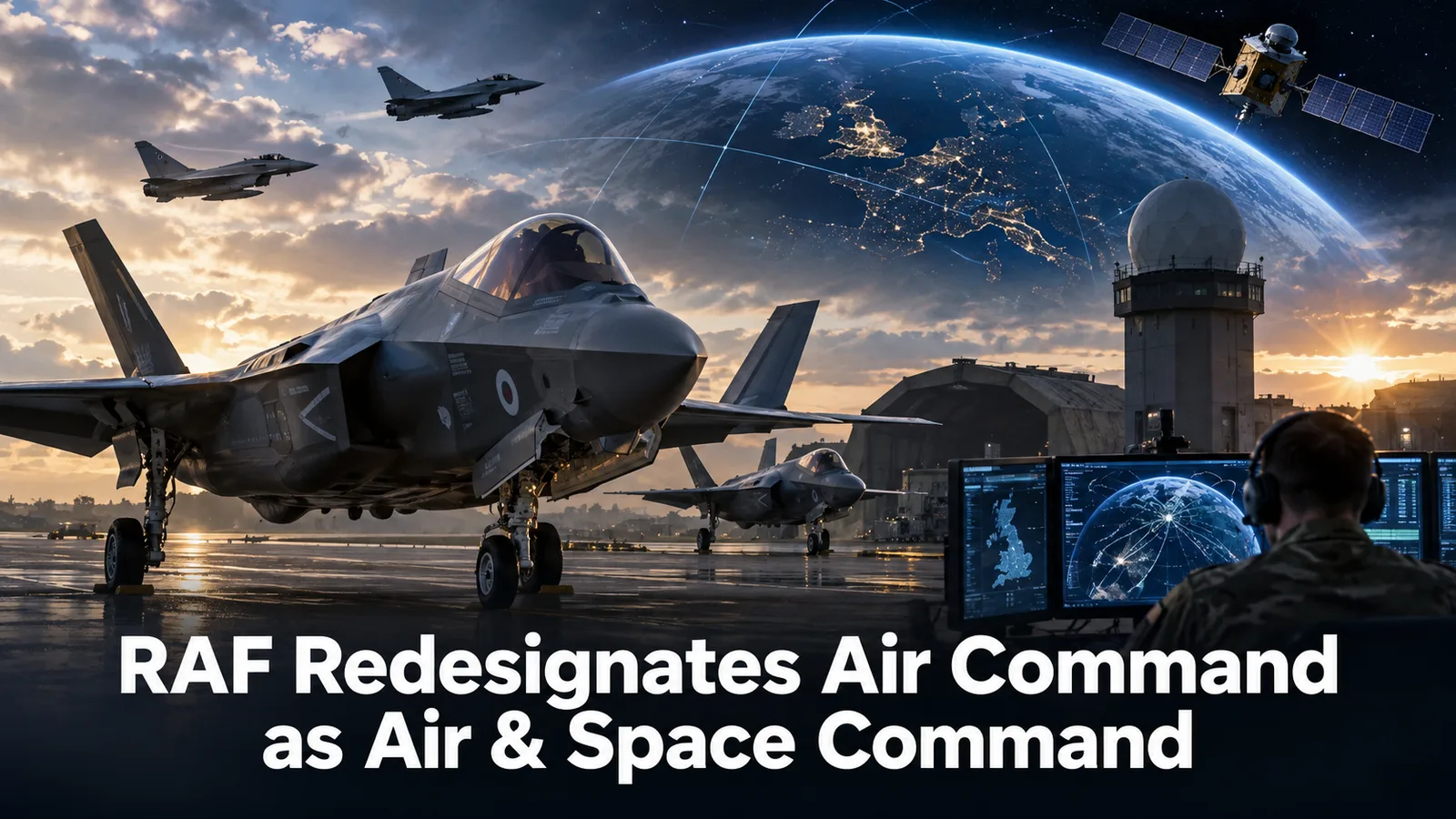
The Royal Air Force has redesignated its headquarters from Air Command to Air & Space Command, effective Sept. 1, formalising the RAF’s role as the lead command for space across UK Defence.
The change does not rename the Royal Air Force itself and does not abolish UK Space Command, which will continue as a joint organisation beneath the new command structure.
Why Air Command Became Air & Space Command
The Royal Air Force has redesignated Air Command as Air & Space Command to make explicit that the headquarters now generates and employs both air and space power. Air Command was created in 2007 when Strike Command merged with Personnel and Training Command, so the new title is the most visible change to the RAF’s top-level command identity in almost two decades. The RAF says space is now inseparable from defence operations, national security and economic activity, making the earlier air-only title increasingly incomplete.
The change applies to the headquarters rather than to the service itself. The Royal Air Force name remains unchanged, unlike several European air forces that have formally added space to their service titles. Air & Space Command also remains under the Chief of the Air Staff and continues to oversee RAF Groups as well as UK Space Command.
UK Space Command and Existing Space Responsibilities
UK Space Command was established under Air Command in 2021 and will continue within Air & Space Command as a joint organisation staffed by the RAF, Royal Navy, British Army and Civil Service. The redesignation therefore does not dissolve or replace UK Space Command; instead, it places the RAF headquarters title more clearly in line with the domain responsibilities already inside its structure. The separate Air and Space Commander role remains the senior RAF warfighter responsible for generating and employing air power across operations.
The RAF also had substantial space-related responsibilities before the rename, including support to ballistic-missile warning through RAF Fylingdales and the wider UK military satellite-communications architecture associated with Skynet. Those functions now sit alongside growing emphasis on space-domain awareness, command-and-control, satellite protection and the National Space Operations Centre. The title change therefore formalises an operational reality rather than creating space capability from scratch.
Strategic Meaning
The redesignation is organisational rather than acquisition-driven, but it signals that space is being normalised as a routine operational domain instead of treated as a specialist adjunct to air power. It can also support doctrine, training and workforce development by making space responsibilities more visible inside the RAF’s command structure. The practical effect will depend on budgets, force structure, programme decisions and the relationship between Air & Space Command and the joint UK Space Command rather than on the new name alone.
Limitations and Counterpoint
No new satellite, sensor, weapon or procurement programme follows automatically from the redesignation. Existing capability plans still depend on separate UK defence decisions, and the organisational boundary between RAF headquarters responsibilities and UK Space Command remains important. The rename is therefore a strategic and institutional signal, not evidence by itself of additional funding or immediate force expansion.
Implications / Next
The next developments to watch are changes in RAF doctrine, space training, personnel specialisations and command relationships. Activity at the National Space Operations Centre and future Skynet, surveillance or protection programmes will show whether the institutional emphasis is matched by capability investment. Any adjustment to the relationship between Air & Space Command and UK Space Command would be especially significant because it would indicate a structural change beyond terminology.