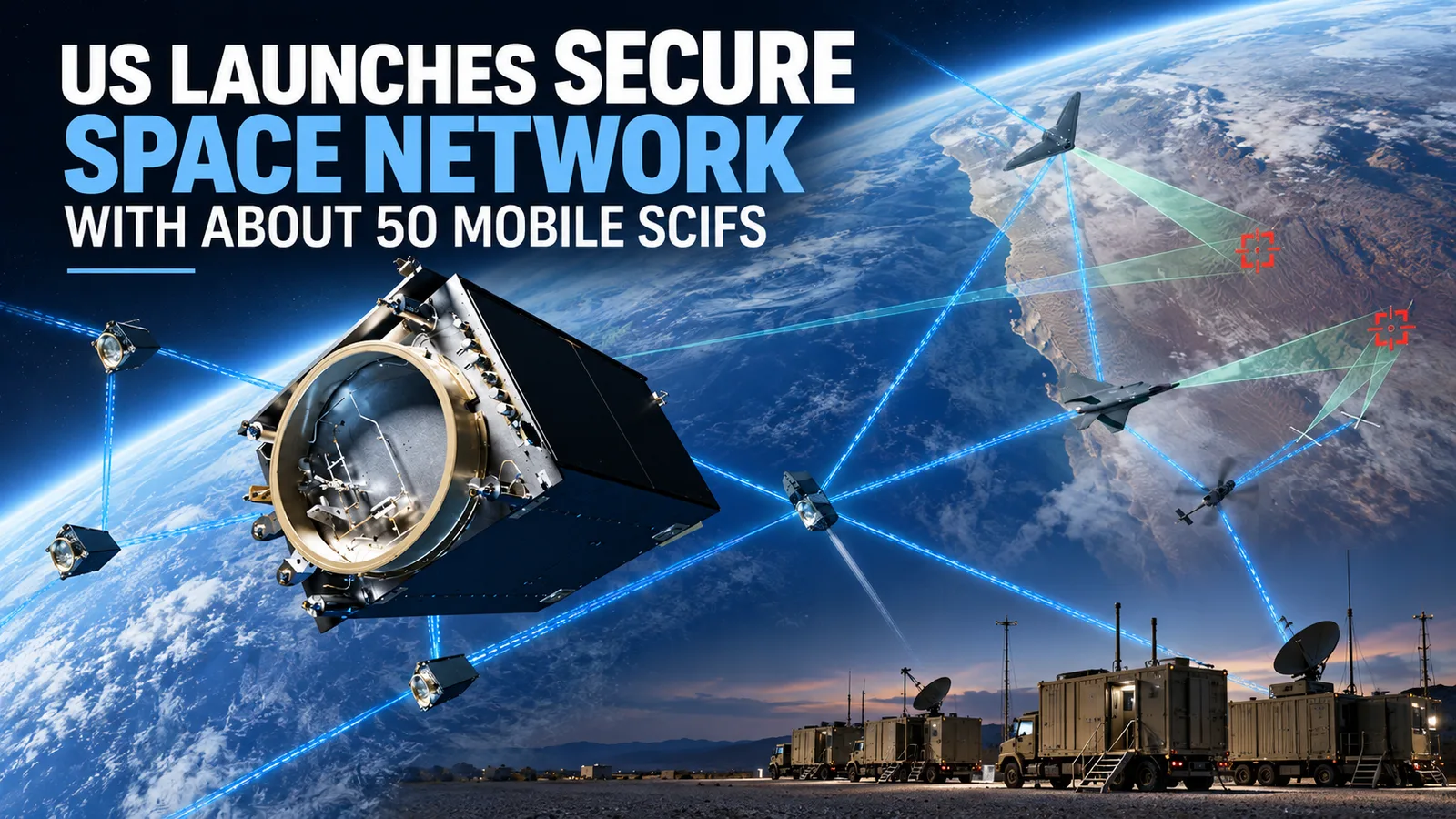
The U.S. Department of War has launched a Secure Space Network designed to expand access to classified defence work by producing and deploying approximately 50 mobile Sensitive Compartmented Information Facilities, or SCIFs, together with related information systems across the United States.
The 3 September 2026 initiative is intended to lower a persistent barrier for smaller and non-traditional suppliers that have technologies relevant to national security but lack accredited facilities in which classified information can be discussed, developed and integrated. The network will place rapidly deployable secure workspaces at military installations, industry-facing locations such as APEX Accelerators and other mission-relevant sites, while also establishing scalable production capacity for additional units.
Key Facts
- Programme: Secure Space Network
- Lead office: Office of Industrial Base Growth under the Under Secretary for Acquisition and Sustainment
- Initial scale: Approximately 50 mobile SCIFs
- Geography: United States
- Potential locations: Military installations, APEX Accelerators and other mission-relevant sites
- Primary purpose: Expand supplier access to accredited classified workspaces
- Target users: Government teams and authorised defence-industry partners
- Acquisition partner: Space Development Agency
- Programme value: Not publicly disclosed
- Deployment schedule: Not publicly disclosed
The New Capability Targets an Industrial-Base Bottleneck
The Secure Space Network is not a communications satellite programme despite its name.
Its purpose is to create a distributed network of secure physical facilities and associated information systems that allow authorised companies to perform classified work without first building their own permanent SCIF infrastructure.
The Department says industry has identified access to classified environments as a major barrier to participation in defence programmes. For a company entering a sensitive programme, the cost, time and accreditation requirements associated with a fixed secure facility can become a gating item before meaningful engineering collaboration can even begin.
The new network is intended to reduce that barrier by making accredited space available regionally.
About 50 Mobile SCIFs Form the Initial Production Effort
The Department says the first phase will design, produce and deploy approximately 50 mobile SCIFs and related information systems across the United States.
That number should be treated as the current programme target rather than a completed deployment count.
The 3 September release does not identify how many units have already been produced, how many are under contract, which companies will manufacture them or when all 50 are expected to be operational.
No public contract value was included in the announcement.
Mobile Facilities Change the Cost Structure of Classified Collaboration
Traditional classified infrastructure is normally fixed to a specific location and built around physical, technical and procedural security requirements.
That model works for established prime contractors and large programme offices with stable classified workloads, but it can be inefficient for newer suppliers whose need for secure access is intermittent or programme-specific.
A mobile SCIF provides another option. Instead of requiring every supplier to make a permanent capital investment before accessing classified work, the government can place secure capacity closer to suppliers or mission locations as needed.
The Department says fixed facilities will remain part of the wider model, providing enduring capacity where long-term demand justifies it.
APEX Accelerators Could Become Regional Access Points
The Department explicitly identifies APEX Accelerators as one category of industry-facing location where Secure Space Network facilities could be positioned.
APEX Accelerators already function as a nationwide entry point for companies seeking to compete for U.S. government contracts. The Office of Industrial Base Growth says the network has more than 90 accelerators and serves companies with registration, market research, proposal support and procurement readiness.
During the April 2024 to March 2025 reporting period, APEX Accelerators served 26,232 new business clients and supported clients associated with $64.9 billion in contracts and subcontracts.
Positioning classified collaboration infrastructure near that network would connect procurement-readiness support with a physical path into sensitive programme work.
The Goal Is to Move Suppliers From Unclassified Engagement Into Classified Development
The Department’s stated objective is not merely to provide meeting rooms.
It wants to expand the number of firms able to move from unclassified business-development activity into classified development, integration and production.
This is particularly relevant to commercial technology companies whose products may have defence applications but whose existing facilities and workforce were not originally built around national-security classification requirements.
Secure access alone will not qualify those companies for classified contracts. Personnel eligibility, facility sponsorship, cybersecurity, information handling, foreign ownership considerations and programme-specific requirements remain separate gates.
The network removes one barrier, not the entire classified-contracting process.
SCI Access Still Depends on Authorisation and Vetting
Sensitive Compartmented Information is subject to access controls beyond simply possessing a general security clearance.
The Defense Counterintelligence and Security Agency states that its Adjudication and Vetting Services organisation is the authority for determining eligibility for non-Intelligence Community Department personnel requiring access to classified material, including SCI.
The Secure Space Network therefore should not be interpreted as opening classified workspaces to companies or employees without the required clearances and authorisations.
The facilities create accredited infrastructure. They do not replace the personnel-security and need-to-know requirements governing access to sensitive information.
The Department Wants Surge Capacity, Not Only Fixed Capacity
A second important part of the announcement is industrial scalability.
The Department says the initial production effort will establish a repeatable capability to manufacture additional mobile secure units as national and industrial requirements increase.
That introduces a surge-capacity concept into classified infrastructure.
If a new mission, crisis or classified acquisition programme suddenly creates demand in a location without enough secure workspace, additional units could theoretically be produced and deployed faster than conventional permanent construction.
The Department has not disclosed the production rate, inventory objective beyond the initial approximately 50 units or mobilisation timeline for additional capacity.
Space Development Agency Is an Acquisition Partner
The release states that the Secure Space Network will advance the Department’s wider Acquisition Transformation agenda through an agile, iterative approach developed in partnership with the Space Development Agency.
SDA is relevant less because the facilities are specifically for space programmes and more because the agency has become associated with iterative acquisition, proliferated architectures and recurring production tranches.
The Department appears to be applying a similar philosophy to infrastructure: build an initial set, learn from deployment and establish production capacity that can expand as demand changes.
The public release does not identify SDA as the network operator, nor does it state that the 50 facilities are dedicated to SDA programmes.
This Is Industrial Infrastructure, Not a Space-Based Network
The programme name creates an obvious risk of misinterpretation.
“Secure Space Network” refers here to secure physical workspace, not orbital communications or a new military satellite constellation.
The initiative is distinct from the Space Force’s Space Data Network and from SDA’s Proliferated Warfighter Space Architecture.
Those programmes address data transport and communications through military networks and space systems. The Secure Space Network addresses where authorised personnel and companies can physically conduct classified work.
The Programme Supports a Wider Push to Bring in New Suppliers
The Office of Industrial Base Growth describes its mission as increasing competition, building capacity and creating pathways for businesses to enter and succeed in the defence marketplace.
Its APEX Accelerators, Mentor-Protégé Program, Project Spectrum and other initiatives focus on reducing barriers related to procurement knowledge, cybersecurity, supply-chain readiness and supplier maturity.
The Secure Space Network adds classified physical infrastructure to that portfolio.
This matters because the Pentagon’s effort to broaden the industrial base has increasingly targeted the gap between a company having useful technology and being able to function inside the compliance and security environment of a classified defence programme.
Classified Infrastructure Can Be a Competitive Barrier
For established primes, secure facilities are a normal part of the cost base.
For smaller firms, the economics can be different. A company may have a strong AI, autonomy, microelectronics, sensing or software product but lack enough confirmed classified business to justify building a dedicated facility before winning a contract.
That can create a circular problem: the company needs classified access to compete effectively, but may need a programme or sponsor before investing in the infrastructure that enables that access.
A shared or regionally deployable government-backed facility can weaken that cycle by giving selected suppliers access to secure collaboration without requiring every participant to duplicate the same fixed infrastructure.
The Network Could Increase Competition in Classified Acquisitions
The Department explicitly links the programme to greater competition.
If more qualified companies can enter classified development and production, programme offices have a larger pool of potential suppliers and subcontractors.
That could be particularly important in sectors where commercially driven innovation moves faster than traditional defence acquisition, including software, artificial intelligence, autonomy, cyber, advanced manufacturing and certain space technologies.
However, greater physical access does not automatically translate into more contract awards. Technical maturity, security compliance, contracting mechanisms, programme sponsorship and cost competitiveness remain decisive.
The Model Could Also Improve Classified Supply-Chain Collaboration
Classified programmes frequently involve teams spread across primes, sub-tier suppliers, government laboratories and operational organisations.
When a supplier does not have an accredited facility, collaboration can be delayed or restricted to unclassified subsets of the programme.
Regional secure facilities could allow engineering reviews, integration work and sensitive programme discussions to occur closer to suppliers that would otherwise need personnel to travel to major government or prime-contractor sites.
This could reduce some travel and coordination friction, although the Department has not published expected time or cost savings.
Security Governance Will Be as Important as Physical Deployment
Mobile classified infrastructure creates advantages in flexibility, but it also introduces demanding governance requirements.
Each facility will need to maintain accreditation, controlled access, secure information systems, physical security, inspection processes and configuration management as it is positioned or repositioned.
The 3 September release does not describe which organisation will hold accreditation responsibility, who will operate each unit, how scheduling will work or whether suppliers will access the facilities through a central reservation model.
Those administrative details may determine whether the network becomes a widely used industrial tool or a capacity that remains difficult for companies to access in practice.
The Programme Has No Publicly Disclosed Budget Yet
No contract value, appropriation amount or per-unit cost is stated in the launch announcement.
The Department also does not identify the manufacturer of the mobile units or the companies providing the associated information systems.
Defence Agenda found no public award in the reviewed 3 September contract material that can be reliably tied to the programme by name.
The article therefore does not assign a programme value or contractor.
Industrial Impact Extends Beyond SCIF Fabrication
If the network expands beyond its initial approximately 50 units, the supply chain could extend well beyond the physical shelter manufacturer.
Potential industrial requirements include secure communications, access-control systems, electromagnetic shielding, power management, environmental controls, secure networking, cybersecurity, intrusion detection, furniture, transport, sustainment and accreditation support.
Those categories are analytical implications of the capability type, not a disclosed supplier list.
The Department’s own emphasis is on creating repeatable and scalable production capacity for the mobile secure facilities and related systems.
The Initiative Fits a Broader Acquisition-Transformation Agenda
U.S. defence acquisition reform is increasingly focused on reducing the time between identifying a capable supplier and fielding a useful capability.
Defence Agenda has previously examined changes such as the Pentagon’s move away from the Joint Capabilities Integration and Development System and wider attempts to expand participation from non-traditional companies.
The Secure Space Network addresses a different but related constraint: even when procurement pathways are made faster, suppliers can still be blocked if classified programme access depends on infrastructure they do not possess.
Acquisition speed therefore depends on physical and security infrastructure as well as contracting authorities.
Limitations and Counterpoint
The programme remains at an early public stage.
The Department has announced an initial production effort for approximately 50 mobile SCIFs but has not published deployment locations, contractor names, unit cost, programme value, production schedule or operational availability dates.
No evidence has been published showing how much faster a company can enter classified work through the network compared with building or leasing its own accredited space.
The programme also does not remove security-clearance, need-to-know, foreign-ownership, cybersecurity or contracting requirements.
Finally, shared infrastructure may improve access but can create scheduling and capacity constraints if demand for secure space exceeds supply.
Implications / Next
The first indicator to watch is the contract structure for producing the approximately 50 mobile units and associated information systems.
The second is location. Placement at APEX Accelerators or other regional industry hubs will determine which supplier clusters gain practical access first.
The third is accreditation and operating governance, including who controls scheduling, security and lifecycle sustainment.
The fourth is utilisation. The programme’s industrial value will depend on whether new and non-traditional companies actually use the facilities to enter classified development and production.
The fifth is scale. A follow-on order beyond the first approximately 50 units would signal that the Department intends to make distributed secure workspace a permanent part of industrial-base infrastructure.
Conclusion
The Secure Space Network addresses a less visible but consequential constraint in U.S. defence acquisition: access to accredited classified workspaces.
By planning approximately 50 mobile SCIFs and positioning them closer to military installations, APEX Accelerators and other industry locations, the Department is attempting to reduce the infrastructure burden that can keep smaller and non-traditional suppliers out of classified programmes.
The initiative is not a space communications network and it does not bypass personnel-clearance or programme-security requirements. Its value lies in creating a shared, deployable physical layer for classified collaboration.
The main unanswered questions are now commercial and operational: who will build the network, what it will cost, where the first units will go and whether broader access to secure space translates into measurably more competition and faster classified development.