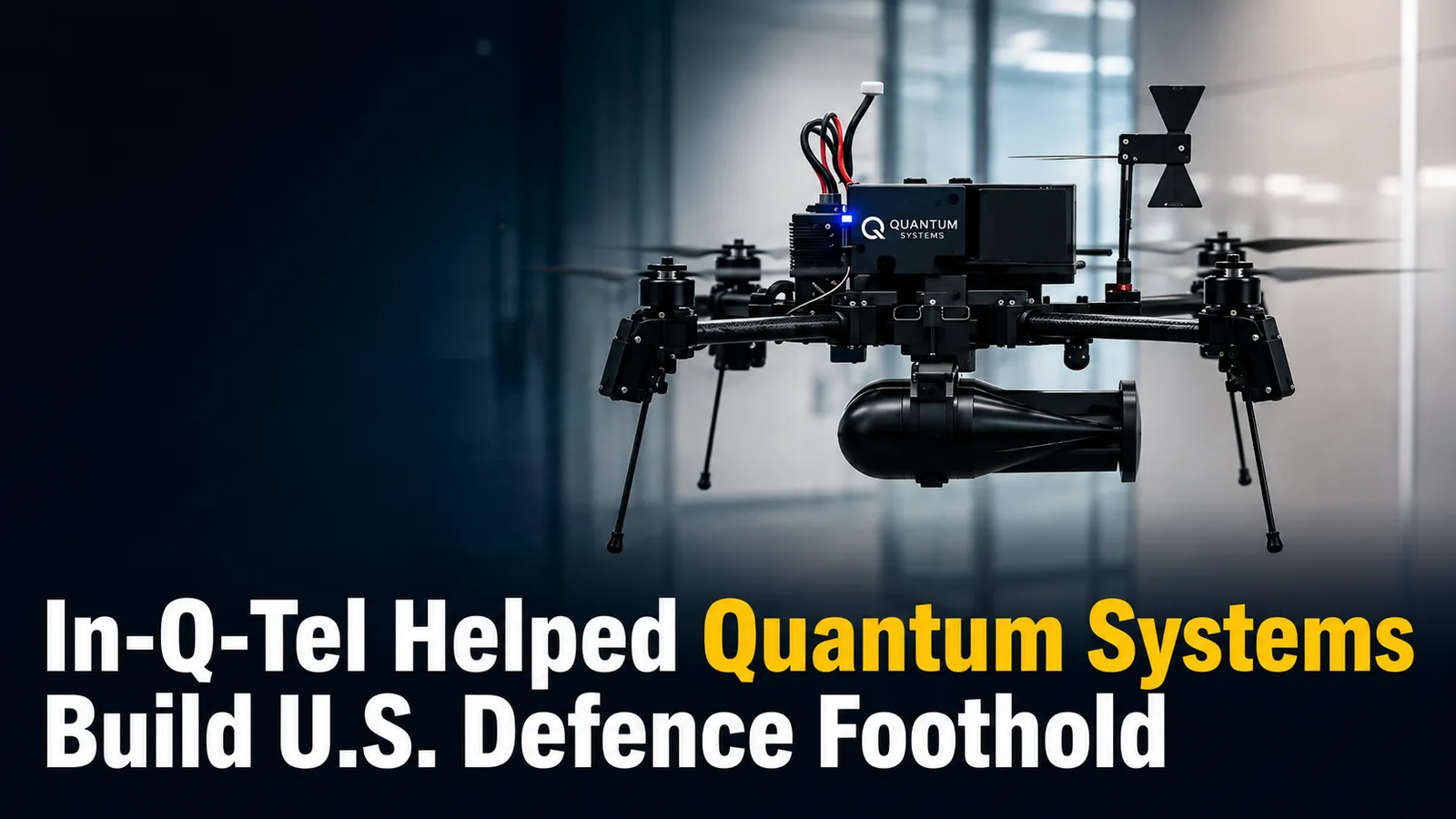
German autonomous-systems company Quantum Systems used the network of U.S. investors including CIA-founded strategic investor In-Q-Tel to open doors in Washington and secure early work with the CIA and FBI, according to co-CEO Sven Kruck.
The disclosure, reported by Reuters on 31 August 2026, provides a rare view of how strategic venture capital can function as more than financing in the defence market. Quantum Systems says the early intelligence-community work was modest in revenue terms but helped establish credibility in the United States. The company has since built a substantial American industrial presence, secured U.S. military contracts and raised $1.2 billion at an approximately $8 billion valuation.
Key Facts
- Company: Quantum Systems
- Headquarters: Munich, Germany
- Strategic investor: In-Q-Tel
- IQT origin: Established by the CIA in 1999 as an independent not-for-profit strategic investor
- Early U.S. customers cited by Quantum Systems: CIA and FBI
- Early intelligence contract value: Not publicly disclosed; described by Quantum as modest in revenue terms
- July 2026 financing: $1.2 billion Series D
- Post-money valuation: Approximately $8 billion
- U.S. production site: 135,000 sq ft facility in Moorpark, California
- New U.S. R&D site: 3,200 sq ft office in Huntsville, Alabama
- 2026 U.S. Army Vector AI contract: $15.3 million
- Earlier U.S. Special Operations APFIT procurement: $20 million announced in 2023
Reuters Links Quantum's U.S. Entry to In-Q-Tel's Network
Reuters reported that Quantum Systems gained an early foothold in the United States with assistance from In-Q-Tel and other American investors. Kruck said those investors helped create lines of communication in Washington and made it easier for the German company to begin working with customers including the CIA and FBI.
The significance is not that In-Q-Tel directly awarded a large procurement contract. Reuters says the reconnaissance work generated relatively little revenue for Quantum Systems. Its value was reputational and institutional: a foreign defence-technology company gained an early U.S. government reference in the world's largest defence and intelligence market.
That distinction is important. The public record reviewed for this package does not disclose the size of In-Q-Tel's investment in Quantum Systems, the exact dates of the CIA and FBI work, the platforms delivered, or the value of those intelligence contracts.
In-Q-Tel Was Created to Bridge Startups and U.S. National Security
In-Q-Tel is not a conventional financial investor.
IQT says it was established by the CIA in 1999 as an independent, not-for-profit strategic investment firm to connect private-sector innovation with the technology requirements of U.S. intelligence and defence organisations.
The organisation now works with more than a dozen U.S. government partners and has expanded internationally, including an office in Munich. Its public portfolio spans artificial intelligence, hardware, cybersecurity, energy, microelectronics and space.
This institutional model explains why even a relatively small investment can have strategic value. Reuters cited a person familiar with IQT's operations saying investments are often below $3 million, while access to national-security customers can be far more valuable than the cheque itself.
The exact amount invested by IQT in Quantum Systems has not been publicly confirmed in the sources reviewed.
Quantum Systems Publicly Lists In-Q-Tel as an Investor
Quantum Systems' own U.S. website lists In-Q-Tel among its strategic partners and investors.
That provides company-level confirmation of the investor relationship, although the page does not disclose ownership percentage, board rights, observation rights, special contractual rights or the investment amount.
Reuters' new reporting adds the missing operational context: Kruck says IQT and other American investors helped the company reach U.S. government customers and establish early credibility.
CIA and FBI Work Was a Door-Opener, Not the Current Scale Story
Quantum Systems' current U.S. position is much larger than the early intelligence work described by Reuters.
In May 2023, the U.S. Department of Defense announced $20 million in APFIT funding for U.S. Special Operations Command to accelerate procurement of a fixed-wing VTOL intelligence, surveillance and reconnaissance small UAS from Quantum-Systems Inc.
The APFIT award was explicitly intended to move a mature technology into fielding faster. The U.S. government identified Quantum-Systems Inc. in California as the supplier.
That contract is independently documented and should be separated from the earlier CIA/FBI reconnaissance work, whose value and detailed scope remain undisclosed.
Vector AI Won a $15.3 Million U.S. Army Requirement in 2026
Quantum Systems' U.S. military position deepened further in April 2026 when the U.S. Army selected Vector AI for the Company-Level sUAS Directed Requirement 2 initiative under a $15.3 million contract.
Quantum Systems says the selection followed a competitive evaluation covering aircraft performance, payload integration and interoperability with emerging Army software architectures.
The company positions Vector AI as a mid-range ISR system with electric vertical take-off and landing, fixed-wing cruise efficiency, AI-enabled mission planning and navigation options designed for degraded or GPS-denied environments.
The Army activity also supports the service's future Medium Range Reconnaissance requirements, giving Quantum a route from an urgent fielding action into a potentially larger programme architecture.
U.S. Localisation Became an Industrial Requirement
Kruck told Reuters that foreign defence suppliers face pressure to establish local U.S. operations. Quantum Systems has responded by building a domestic industrial footprint rather than serving the market only from Germany.
In June 2025, the company opened a 135,000-square-foot production and integration facility in Moorpark, California. Quantum said the site consolidates U.S. manufacturing, engineering, R&D and flight operations and supports systems including Vector AI, Twister and Reliant.
The company expected more than 100 employees in the Moorpark and Ventura County area by the end of 2025.
This localisation is strategically important because it places manufacturing, engineering and customer support inside the United States, shortening supply chains while satisfying procurement expectations for domestic industrial presence.
Huntsville Adds Customer-Proximate Engineering
On 24 August 2026, one week before the Reuters investigation, Quantum Systems opened a 3,200-square-foot engineering and R&D office in Huntsville, Alabama.
The company explicitly linked the move to proximity to defence customers and partners. Huntsville hosts major U.S. Army organisations, aerospace programmes, prime contractors and missile and aviation engineering activity.
The office is intended to place engineering resources closer to users so operational feedback can be incorporated into new unmanned intelligence systems.
This matters because the company's U.S. strategy is no longer limited to selling a German-designed drone. It is building a local product-development loop tied directly to American mission requirements.
The U.S. Market Has Become Part of Quantum's Global Scale-Up
Quantum Systems closed a $1.2 billion Series D financing round on 2 July 2026 at an approximately $8 billion post-money valuation.
The round was co-led by Blackstone, Noteus, Airbus and Advent. Other investors included BOND, Fidelity Management & Research Company, Wellington Management, A.P. Moller Holding and Elephant Lake Ventures, alongside existing shareholders including Balderton and HV Capital.
The company said the capital would be used to expand production, strengthen supply-chain resilience, increase deliveries across allied markets and develop software and AI.
Quantum also said its systems executed more than 19,000 missions in Ukraine during 2025 and that it had established production footprints across Germany, Ukraine, the United States, Australia, Romania, the United Kingdom and the Baltics.
The Financing Story Has Moved Far Beyond IQT
The Reuters article should not be interpreted as saying In-Q-Tel remains Quantum Systems' dominant financial backer.
Quantum's July 2026 financing demonstrates a much broader capital base that now includes major private-equity, institutional and aerospace investors.
IQT's significance is better understood as early strategic access. Its network helped Quantum enter U.S. government channels at a stage when the company was much smaller, while later investment rounds provided the capital required to scale into a multi-billion-dollar defence technology company.
Kruck also told Reuters that IQT had not proactively contacted him by email during the previous two years, indicating that the relationship should not be portrayed as continuous operational management by the investor.
The Intelligence Link Raises European Strategic-Autonomy Questions
The Reuters investigation places Quantum inside a wider European policy debate.
European governments are trying to build a larger sovereign defence-industrial base while reducing excessive dependence on foreign suppliers and external capital. Yet the U.S. offers defence startups not only deeper venture pools but also the largest government defence market in the world.
Marie-Agnes Strack-Zimmermann, chair of the European Parliament's security and defence committee, told Reuters that IQT should be viewed differently from a normal financial investor because it was created to identify and secure technologies relevant to U.S. intelligence requirements.
Germany's defence ministry told Reuters that it takes investor influence in the defence sector seriously and that shareholders should not interfere in operations, technology or research.
These concerns do not establish that IQT controls Quantum Systems. The public sources reviewed do not disclose an IQT ownership percentage or evidence of operational control.
Access to the U.S. Market Can Also Create Export-Control Dependencies
Cross-border defence expansion creates regulatory consequences.
Reuters notes that technology developed in the United States cannot simply be transferred abroad by Quantum without the applicable U.S. approvals.
This is one of the trade-offs of localisation. Establishing U.S. development and production can unlock government procurement, customer proximity and industrial incentives while also bringing products, technical data and components under U.S. export-control rules where applicable.
The article does not identify which Quantum Systems products or subsystems are currently subject to which specific ITAR or EAR classifications, so those details should not be inferred.
Quantum Is Becoming a Multi-Domain Autonomous-Systems Company
The company is also broadening beyond its original small-UAS identity.
Quantum's U.S. portfolio now separates its air systems into short-range ISR Twister, mid-range ISR Vector AI and long-range ISR Reliant. It is also developing land systems, emerging maritime systems, counter-UAS products and the MOSAIC UXS software environment.
MOSAIC UXS is intended to connect autonomous systems across domains, enabling mission control, data fusion and interoperability.
The July 2026 financing was explicitly framed around moving from individual platforms toward an interoperable family of systems across air, land and sea.
This shift is strategically important because future defence-company valuations may depend less on one drone airframe and more on the software, autonomy and command architecture connecting multiple systems.
Airbus Adds a European Strategic Counterweight
The Series D also deepened Quantum Systems' relationship with Airbus Defence and Space.
The companies said they would cooperate on next-generation sovereign European defence capabilities, combining Quantum's unmanned systems, software and AI with Airbus' larger defence architecture and integration experience.
This complicates a simple narrative of U.S. influence replacing European sovereignty.
Quantum's capital structure and industrial relationships now span both sides of the Atlantic. Its U.S. investor and customer network helped establish early market credibility, while Airbus and other European stakeholders are part of the company's current scale-up.
Europe Still Lacks a Direct Equivalent to In-Q-Tel
Reuters highlights a structural gap in Europe's defence-innovation system: there is no single European institution with the same combination of strategic venture investment, intelligence-community mission alignment and government-market access as IQT.
Europe has expanded instruments such as the NATO Innovation Fund, the European Defence Fund, national venture initiatives and defence-focused investment vehicles. These can provide capital, but they do not necessarily replicate IQT's model of pairing investment with direct pathways into classified or mission-specific government customers.
Quantum Systems illustrates why that matters. An early government reference can validate technology, attract later investment and reduce the credibility barrier facing a startup entering a conservative procurement market.
Early Intelligence Work Should Not Be Confused With Intelligence Ownership
The Reuters investigation may attract attention because it combines the CIA, venture capital and European defence technology.
The available evidence supports a narrower conclusion than some headlines may imply.
IQT is a CIA-founded strategic investor. Quantum publicly lists IQT among its investors. Kruck says IQT and other U.S. investors helped the company build Washington connections and secure work with the CIA and FBI.
The public record reviewed here does not establish that the CIA owns Quantum Systems, that IQT controls its management, that intelligence agencies direct its product roadmap, or that the company's current $8 billion valuation is primarily attributable to intelligence contracts.
The early intelligence work was described as modest in commercial value but important for credibility.
Limitations and Counterpoint
The value and date of IQT's original investment in Quantum Systems remain undisclosed in the sources reviewed.
The CIA declined Reuters' request for comment.
The exact CIA and FBI contract values, procurement mechanisms, system configurations and delivery dates are also not public.
Reuters' account is based substantially on comments from Quantum co-CEO Sven Kruck about how investor networks supported U.S. market entry. Independent public procurement records confirm later U.S. military business, including the $20 million USSOCOM APFIT activity and the $15.3 million Army Vector AI requirement, but they do not reveal the earlier intelligence contracts.
The strategic-autonomy debate should likewise be separated from evidence of corporate control. German and European officials have raised concerns about foreign strategic influence, but no reviewed source shows that IQT controls Quantum's operations or research.
Implications / Next
The first metric to watch is Quantum Systems' U.S. contract pipeline after the 2026 Army selection and Huntsville expansion.
The second is whether U.S.-developed variants diverge from European configurations as local customer requirements, export controls and supply chains become more distinct.
The third is Quantum's transition from ISR drones into broader autonomous and potentially armed systems. That will determine whether the company becomes a true multi-domain defence prime rather than primarily an ISR-UAS manufacturer.
The fourth is the European policy response. If governments want strategic startups to remain primarily anchored in Europe, they will need mechanisms that provide not only capital but also rapid access to customers, testing, classified requirements and scaled procurement.
The fifth is governance transparency. Any future disclosure of IQT's stake, investor rights or the structure of technology-development agreements would allow a more precise assessment of strategic influence than is possible today.
Conclusion
Quantum Systems' U.S. expansion shows how defence-market access can be as valuable as investment capital.
In-Q-Tel's role was not to finance the company's present scale by itself. According to Quantum's co-CEO, the CIA-founded investor and other U.S. backers helped open early channels to the CIA and FBI, giving a German startup a credibility reference inside the American national-security market.
Quantum subsequently converted that foothold into a much larger U.S. presence: a 135,000-square-foot California production facility, a Huntsville engineering office, a $20 million Special Operations procurement pathway and a $15.3 million Army Vector AI contract.
At the same time, the company has become one of Europe's most valuable defence technology businesses, raising $1.2 billion at an approximately $8 billion valuation in July 2026.
The strategic lesson is broader than Quantum Systems. As Europe tries to build sovereign defence technology champions, the decisive competition is not only over who provides startup capital. It is also over who can connect those companies to government missions, procurement budgets and operational users first.