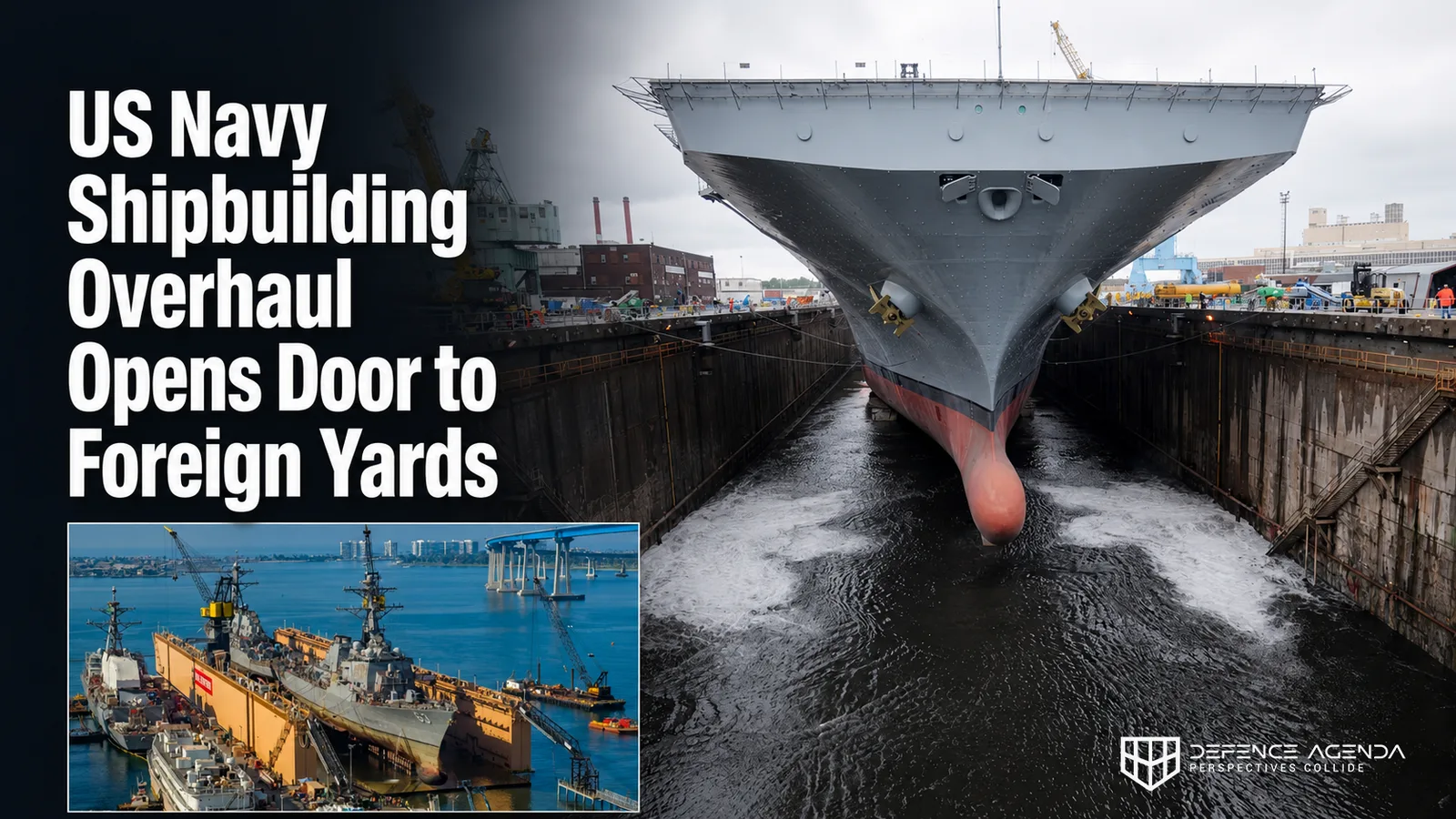
US Navy shipbuilding overhaul is moving into a new policy phase after the White House directed the Department of War to open selected naval programmes to a Finland-model acquisition approach, plan a fifth public Navy shipyard and restructure Naval Sea Systems Command.
The presidential memorandum signed on 13 August 2026 links persistent shipbuilding delays to design complexity, iterative design changes, weak competition and an atrophied industrial base. It also directs the Department of War to examine foreign-parent shipbuilders as a near-term bridge to domestic capacity, provided they make substantial investments in U.S. yards, train American workers, transfer shipbuilding techniques and build a U.S. supply chain.
The decision is important because it moves U.S. naval industrial policy beyond additional funding. Washington is now attempting to change how ships are designed, competed, built, repaired and supported, while accepting limited foreign construction as a tool for rebuilding domestic capacity.
Key Facts
- Date: Presidential memorandum signed 13 August 2026.
- Foreign-yard model: Up to three ship classes may use a Finland-model approach under specified national-security waivers.
- Initial foreign construction: A qualifying foreign supplier may build the first two ships of an eligible class abroad while investing in U.S. shipbuilding capacity; subsequent ships must be built in U.S. yards.
- Surface combatants: A new competitive acquisition plan is due within 90 days for ships able to perform anti-submarine warfare, surface warfare and convoy escort missions.
- Fifth public yard: A plan is due within 120 days for a fifth public Navy shipyard, including Pacific-proximate options and up to three new drydocks.
- Component repair: A separate plan must create a centre able to hold at least one ship set of spare equipment for five submarine classes.
- NAVSEA reform: The Department of War must review NAVSEA within 120 days with delivery speed and results-based accountability as central objectives.
US Navy Shipbuilding Overhaul Targets Design Churn and Capacity
The White House memorandum begins with a blunt diagnosis. It says U.S. Navy shipbuilding has suffered from overly complex designs and iterative design changes that contributed to cost growth, delays and cancellations.
That diagnosis closely matches independent findings from the U.S. Government Accountability Office. In April 2026, GAO reported that Navy and Coast Guard shipbuilding programmes had consistently fallen short of cost and schedule expectations over two decades.
For the Navy, GAO reported that the lead Columbia-class ballistic missile submarine was at least 18 months behind its contracted delivery date. Virginia-class construction was proceeding at roughly one submarine per year as of June 2025, half the Navy’s two-per-year objective, while DDG-51 Flight III destroyer delays ranged from 22 to 58 months as of February 2026.
The White House response is therefore not simply to order more ships. It is attempting to reduce design instability, widen the supplier base and make delivery performance a stronger acquisition metric.
The Finland Model Creates a New Route for Foreign Shipbuilders
The most consequential industrial measure is the proposed use of what the memorandum calls the “Finland Model.”
The approach is based on the U.S.-Finland medium icebreaker arrangement concluded in October 2025. Under the 13 August memorandum, a similar framework can be applied to as many as three eligible ship classes.
A foreign supplier would have to simultaneously build a new U.S. shipyard or acquire ownership or a majority equity position in an existing American yard. It would also have to hire and train a U.S. citizen workforce, license proprietary shipbuilding techniques to the American operation and develop a U.S. supply chain for construction and maintenance.
If those conditions are met, the supplier could build the first two ships at its parent foreign yard. All subsequent ships would be built in the United States.
This is not a general exemption allowing the Navy to outsource shipbuilding indefinitely. It is a tightly conditioned bridge mechanism intended to import capacity, production knowledge and mature designs while creating permanent industrial capability inside the United States.
The Policy Marks a Major Shift in the Foreign-Yard Debate
The memorandum is especially significant because U.S. naval shipbuilding law has traditionally placed strong restrictions on constructing military vessels in foreign yards.
The President delegated authority to the Secretary of War to make national-security determinations under 10 U.S.C. 8679 for qualifying contracts. Congress must be notified, and no contract under the waiver can be made until 30 days after the determination is received.
This creates a more formal path for allied shipbuilders to enter selected U.S. naval programmes without removing Congress from the process.
Defence Agenda previously examined the argument that U.S. Navy shipbuilding should remain domestic, particularly amid proposals from high-capacity allied shipbuilders. The new memorandum does not fully reject that industrial-sovereignty logic. Instead, it attempts to use foreign construction as a transitional mechanism for rebuilding domestic yards rather than a permanent substitute for them.
New Surface Combatant Competition Could Favour Mature Designs
Within 90 days, the Department of War must submit a plan for a new competitive surface-combatant acquisition approach.
The memorandum specifies inherent capability for anti-submarine warfare, surface warfare and convoy escort duties. It also allows proposals based on the international procurement model.
The requirement is notable for what it does not say. The White House does not direct the Navy to begin with an entirely new clean-sheet combatant. The broader memorandum repeatedly emphasises proven, reliable and affordable technology and mature parent designs.
This reflects one of the recurring lessons from recent U.S. shipbuilding problems: attempting extensive modifications to a parent design can erase the schedule and cost advantages that made the original platform attractive.
The memorandum therefore prohibits the Navy from imposing iterative changes on mature parent designs in the programmes developed under the new approach. Any change would require approval from the Secretary of War, in consultation with the Secretary of the Navy, OMB and the National Security Advisor.
Auxiliary Ships Are Part of the Same Industrial Strategy
The international procurement approach is not limited to combatants.
The memorandum directs planning for Consolidated Cargo Replenishment at Sea tankers and, separately, Roll-On, Roll-Off vessels using the same Finland-model logic.
That matters because naval power depends on logistics as much as combatant numbers. Tankers, sealift vessels and other auxiliaries determine how effectively a fleet can sustain dispersed operations over long distances.
They may also be better candidates for commercial or allied shipbuilding practices because their designs can draw more heavily on mature merchant-shipping experience.
For U.S. industrial policy, auxiliary construction could also widen the addressable market beyond the small group of yards focused on highly specialised combatants and nuclear-powered ships.
CVN-81 Faces a Potential Technology Reversal
One of the memorandum’s most unusual provisions concerns CVN-81.
Within 60 days, the Secretary of War, in consultation with the Secretary of the Navy, must provide a plan describing the measures, timetable and resources required to replace the Electromagnetic Aircraft Launch System and Advanced Weapons Elevators with steam and hydraulic systems for construction of CVN-81.
The directive does not itself provide the engineering plan or cost of making that change. Those details are the subject of the required 60-day review.
If implemented, however, the decision would represent a major technology and design reversal within the carrier programme. It also creates an inherent tension with another central theme of the memorandum: avoiding iterative changes after a mature design has been established.
How the Navy reconciles those priorities will be one of the most closely watched elements of implementation.
A Fifth Public Navy Yard Targets Maintenance Capacity
The memorandum also addresses the sustainment side of fleet readiness.
Within 120 days, the Department of War must develop a plan to increase nuclear-powered submarine and aircraft-carrier readiness through private-sector capacity and the establishment of a fifth public Navy yard.
The White House fact sheet describes this as the first new public naval shipyard in more than 80 years.
The plan must examine locations close to the Pacific Fleet, including sites in the continental United States, Alaska, Hawaii and U.S. territories. It must also consider up to three new drydocks capable of accommodating current and projected submarine classes.
The Pacific emphasis reflects a basic geography problem. Future naval competition is increasingly centred on the Indo-Pacific, but the Navy’s maintenance infrastructure cannot be expanded or repositioned quickly.
A new yard would therefore be both an industrial project and a force-posture investment.
Submarine Repair Gets a Dedicated Component Centre
The White House also ordered a plan for a new Component Repair Center within 90 days.
The centre would receive new components and refurbish old ones for the submarine repair industrial base. The memorandum requires it to maintain at least one “ship set” of spare equipment for the Los Angeles, Virginia, Seawolf, Ohio and Columbia classes.
This targets a less visible but important readiness problem.
Ship maintenance delays are not caused only by drydock shortages. Components, repairable assemblies, supplier lead times and replacement-part availability can keep a submarine unavailable even when yard labour and infrastructure exist.
A centralised repair and spare-equipment structure could therefore reduce the time lost waiting for critical components during maintenance periods.
NAVSEA Reform Puts Delivery Speed at the Centre
The memorandum’s organisational component may prove as important as the industrial investment.
Within 120 days, the Department of War must review Naval Sea Systems Command and recommend personnel, organisational and structural reforms.
The stated objectives include results-based accountability for NAVSEA leaders, measured by the speed at which vessels and systems are delivered; reduced bureaucracy; fewer competing internal priorities; and controls against unnecessary redesign of mature parent designs.
This is a direct attempt to change acquisition incentives.
Traditional naval programmes are judged across cost, technical performance, requirements compliance and schedule. The White House is placing much heavier political weight on schedule and throughput.
That could produce faster decision-making, but it also creates a countervailing risk: schedule pressure can become counterproductive if programmes enter construction before designs are mature or technical risks are understood.
GAO Data Shows Why the Administration Is Acting
The scale of the problem is visible in GAO’s latest shipbuilding assessment.
GAO said in April 2026 that none of the seven shipbuilders constructing Navy battle-force ships had been positioned to meet Navy delivery goals when it examined the industrial base, due partly to infrastructure and workforce constraints.
The watchdog also highlighted shortages of welders, pipefitters and machinists, ageing shipyard infrastructure, limited physical space and regional difficulties recruiting and retaining skilled labour.
These problems persist despite billions of dollars already invested in the industrial base.
The issue is therefore not simply insufficient federal spending. It is whether investment is coordinated, designs are stable, suppliers can scale and shipyards have enough skilled workers to turn appropriated money into delivered hulls.
The FY2027 Plan Adds $65.8 Billion to the Industrial Push
The presidential memorandum builds on a much larger naval investment cycle.
On 11 May 2026, the Department of the Navy released its FY2027 Shipbuilding Plan, describing the President’s budget request as a $65.8 billion generational investment in shipbuilding and part of a 30-year strategy to expand fleet and industrial capacity.
The Navy said that plan would combine fleet growth with shipyard expansion, workforce investment and stronger accountability for industry.
The August memorandum adds more prescriptive mechanisms to that strategy.
Rather than relying only on U.S. yards to expand at their existing pace, it opens a controlled path to allied shipbuilders, limits design churn, targets repair bottlenecks and creates deadlines for institutional reforms.
Submarine Production Shows the Scale of the Workforce Challenge
Submarine construction remains one of the hardest parts of the industrial problem.
The Navy’s Submarine Industrial Base Program Office says the required production objective is one Columbia-class ballistic missile submarine and two Virginia-class attack submarines per year while sustaining the existing fleet.
The programme estimates that meeting the broader build-and-maintain mission requires around 140,000 skilled workers: 100,000 for new construction and 40,000 for maintenance and sustainment.
That workforce cannot be created simply through procurement contracts.
Training pipelines, wages, housing costs, retention, supplier investment and modern manufacturing all affect whether the industrial base can translate higher demand into higher output.
The White House’s foreign-investment model attempts to address part of that problem by requiring participating overseas suppliers to train American workers rather than simply deliver finished ships.
The Industrial Opportunity Is Technology Transfer, Not Just Hulls
For allied shipbuilders, the new policy could create a major opportunity.
The most valuable prize may not be the first two ships built overseas. It may be long-term participation in the reconstruction of U.S. shipbuilding capacity.
A qualifying foreign company could gain a U.S. industrial footprint, access to long-duration Navy demand and a position inside a supply chain receiving substantial federal investment.
For Washington, the intended return is production knowledge.
Modern shipbuilding efficiency depends on modular construction, digital design, production sequencing, supplier coordination and stable manufacturing processes. Importing proven practices may offer greater long-term value than simply purchasing a small number of foreign-built hulls.
The Main Risk Is That Foreign Construction Becomes a Substitute for Reform
There is also a clear counterargument.
Allowing the first ships of selected classes to be built abroad could relieve immediate pressure but reduce incentives to correct deeper U.S. shipyard problems if the transition is not managed carefully.
Foreign construction can accelerate deliveries, but it does not automatically solve American workforce shortages, supplier fragility, drydock constraints or acquisition-management problems.
The success of the Finland Model will therefore depend on whether domestic investment, technology transfer and workforce development occur at the same time as the initial foreign builds.
If the foreign yard simply becomes a faster source of hulls, the policy could weaken the domestic capacity it is intended to rebuild.
If the arrangement genuinely transfers production capability into U.S. yards, it could provide a faster pathway to industrial recovery.
Design Stability May Be the Most Important Reform
The memorandum’s repeated focus on mature parent designs deserves particular attention.
Shipbuilding is highly sensitive to late design changes because modifications propagate through structures, electrical systems, piping, combat systems, weight margins and production sequencing.
The United States has repeatedly attempted to increase capability during acquisition, only to find that design changes slow construction and raise costs.
A stricter parent-design model would trade some customisation for speed and predictability.
That approach is common in commercial shipbuilding, where repeated production of stable designs helps yards improve cycle time and labour efficiency.
For the Navy, however, the challenge will be requirements discipline. Operational communities will still seek changes as threats, sensors and weapons evolve.
The new approval structure is intended to make those changes exceptional rather than routine.
Implications / Next
The memorandum creates several near-term deadlines that will show how quickly the policy moves from presidential direction to executable acquisition plans.
By 12 October 2026, the Department of War should provide the 60-day plan for CVN-81’s launch and weapons-elevator systems.
By 11 November 2026, the 90-day plans for the new surface-combatant competition, CONSOL tankers, Roll-On, Roll-Off vessels and the Component Repair Center should be due.
By 11 December 2026, the Department should provide plans for the fifth public Navy yard and NAVSEA reform.
The most consequential issue will be which foreign shipbuilders and parent designs are considered for the Finland Model. The memorandum does not identify specific companies, countries or ship designs.
Congress will also remain important because national-security waivers for qualifying foreign construction require notification before contracts can proceed.
Finally, the industrial test will be whether the policy produces additional American shipyard capacity rather than only additional procurement pathways.
Conclusion
The US Navy shipbuilding overhaul represents one of the most significant attempts in recent years to change the industrial mechanics behind American naval power.
The White House is attacking several problems simultaneously: design churn, limited competition, insufficient yard capacity, maintenance bottlenecks, supplier weakness and acquisition bureaucracy.
The Finland Model is the most disruptive element because it accepts limited foreign construction as a bridge to rebuilding U.S. capacity. The fifth public yard and component repair centre target sustainment. NAVSEA reform targets governance. Restrictions on design changes target programme execution.
None of these measures guarantees faster ship delivery. GAO’s findings show that the underlying workforce and infrastructure problems are deep and have persisted despite major investment.
But the 13 August memorandum changes the policy framework. Washington is no longer treating the shipbuilding crisis primarily as a question of adding money to existing programmes. It is attempting to redesign the industrial and acquisition system itself.
For the U.S. Navy, the measure of success will be straightforward: whether the new approach can convert a historically large shipbuilding budget into more ships and submarines delivered on predictable schedules, while leaving the United States with more domestic industrial capacity than it had when the reform began.
For further Defence Agenda coverage, read our analysis of the long-range U.S. Navy shipbuilding strategy, the counterargument on why U.S. naval construction should remain domestic and our broader assessment of defence industrial-base readiness.
Further Reading
- White House: Rebuilding the United States Navy and America’s Shipbuilding Industrial Base
- White House Fact Sheet: U.S. Navy and Shipbuilding Industrial Base Reform
- U.S. Navy: Fiscal Year 2027 Shipbuilding Plan
- GAO: Navy and Coast Guard Shipbuilding — A Disciplined, Strategy-Driven Approach Is Needed
- White House: Restoring America’s Maritime Dominance
- Defence Agenda: 1937 for 2037 — U.S. Navy Shipbuilding Strategy
- Defence Agenda: Why U.S. Navy Shipbuilding Must Stay Domestic
- Defence Agenda: Rearming the Defence Industrial Base