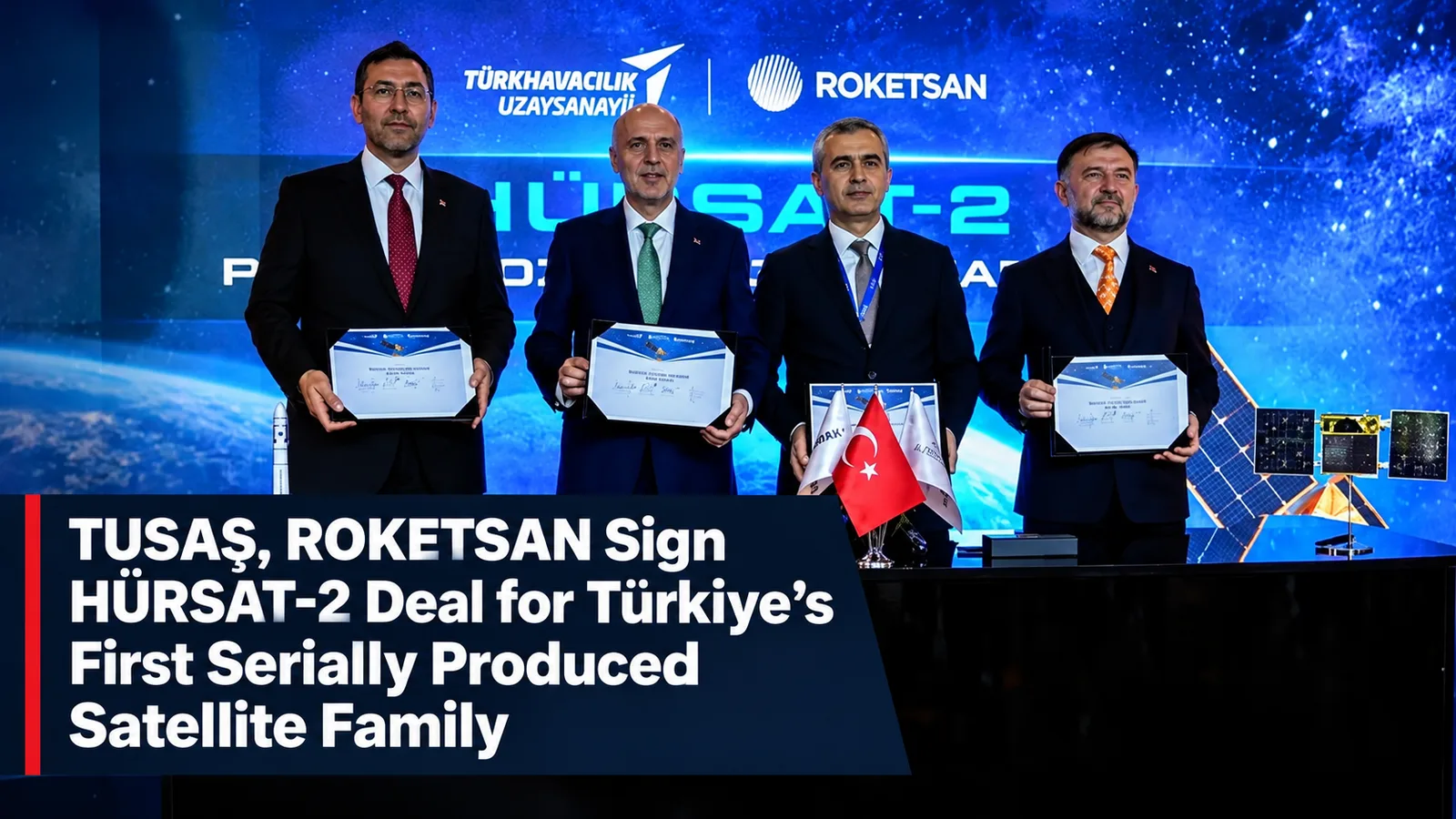
Turkish Aerospace (TUSAŞ) and ROKETSAN have signed the HÜRSAT-2 Project Contract during the 77th International Astronautical Congress in Antalya, advancing what they describe as Türkiye’s first serially produced satellite family. The agreement was signed at the TUSAŞ pavilion in the presence of senior officials from the Secretariat of Defence Industries, Turkish Aerospace and ROKETSAN.
The announcement matters because HÜRSAT is being positioned not as a single spacecraft, but as a configurable satellite family designed for repeat production across different mission profiles. In parallel, the agreement reinforces Ankara’s push to connect domestic spacecraft manufacturing with an eventual nationally controlled launch capability.
HÜRSAT Is Designed as a Reusable Small-Satellite Family
According to Anadolu Agency reporting and event statements, HÜRSAT can be configured for different mission needs across a 200–650 kg mass range. Turkish Aerospace says the family is intended to support multiple use cases rather than requiring a full redesign for every mission, which is why the “serially produced” framing is central to the programme’s value.
The publicly described concept suggests a modular architecture in which a common platform can host different payloads and operational configurations. If executed as intended, that approach could reduce non-recurring engineering costs, shorten delivery timelines and create a more exportable satellite product line than a succession of entirely bespoke national spacecraft.
HÜRSAT-1 Provides the Technology-Demonstration Baseline
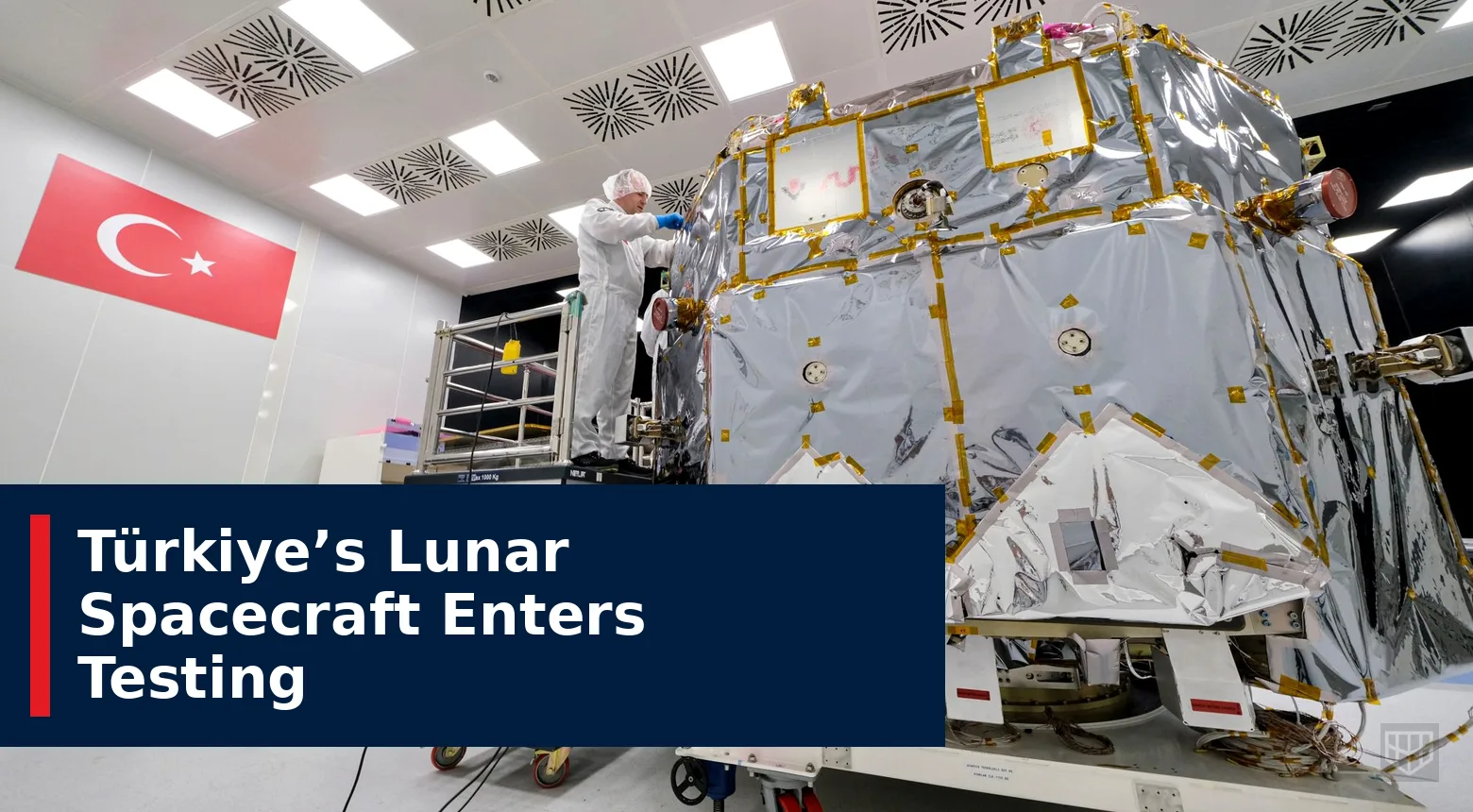
Turkish Aerospace has stated that HÜRSAT-1 is currently undergoing test activity and will be used to validate the family’s core technologies in orbit. Company statements cited by multiple Turkish outlets add that launch-preparation work is continuing at Turkish Aerospace facilities.
That makes HÜRSAT-1 the technical foundation for the wider family rather than simply the first unit in a production sequence. Its value lies in proving the architecture, onboard technologies and software stack that could later be reused across follow-on satellites such as HÜRSAT-2.
HÜRSAT-2 Formalises the Next Step and Brings ROKETSAN into the Architecture
The Antalya signing specifically covers the HÜRSAT-2 project. Anadolu Agency reported that the contract was signed with participation from SSB Deputy Presidents Mustafa Şeker and Hüseyin Avşar, Turkish Aerospace General Manager Mehmet Demiroğlu and ROKETSAN General Manager Murat İkinci.
At the ceremony, officials linked the agreement to Türkiye’s ambition not only to produce satellites but also to launch them with indigenous means. Public reporting around the event indicates that ROKETSAN’s role is tied to the launch side of the future architecture, although the core announcement does not publicly specify a launch vehicle, launch-site concept or detailed division of responsibilities.
The Programme Targets Earth Observation First
Turkish Aerospace General Manager Mehmet Demiroğlu has described the first HÜRSAT configuration as an approximately 200 kg-class Earth-observation satellite. Public remarks around the launch announcement reference sub-metre imaging resolution, wide-area observation and sun-synchronous orbit as intended mission characteristics.
Those features position HÜRSAT first and foremost as a practical operational satellite family rather than a purely symbolic national-space project. They also place the programme in a competitive segment of the global small-satellite market, where mission flexibility, faster production and lower total programme cost can matter as much as raw payload size.
Industrial Logic: From Bespoke Platforms to Productised Spacecraft
The HÜRSAT family reflects a broader transition in space manufacturing from individually engineered national projects to repeatable platform-based production. For Türkiye, this matters because a serially producible satellite family can support not only government users, but also institutional customers and export opportunities if the platform reaches sufficient maturity and cost discipline.
That product logic is also where the Turkish Aerospace–ROKETSAN pairing becomes strategically significant. A reusable domestic satellite bus combined with an eventual indigenous launch option could improve schedule control, reduce foreign-service dependence and strengthen Türkiye’s long-term claim to independent end-to-end space capability.
What Remains Undisclosed
The announcement does not publicly define the project value, delivery milestones, launch date, launch vehicle or target orbit for HÜRSAT-2. It also does not state whether the second spacecraft will be financed entirely through internal resources, public procurement, a specific government programme or a mixed model.
Those omissions matter because they limit near-term assessment of execution risk and schedule realism. The next important disclosures to watch are a formal HÜRSAT-1 launch timeline, clear definition of ROKETSAN’s launch role, and programme-level detail on when HÜRSAT-2 is expected to move from contract signature to manufacturing and launch preparation.