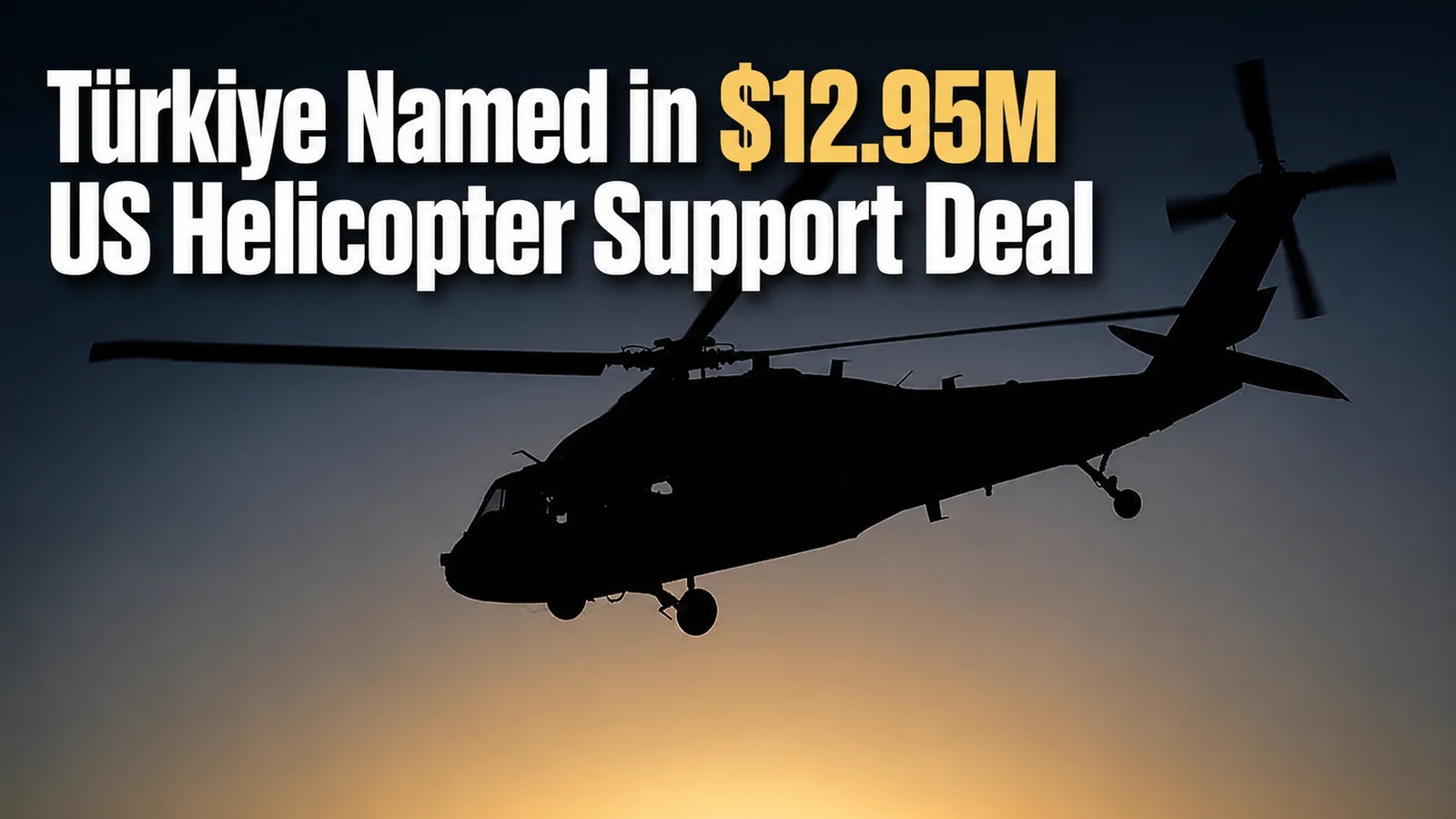
Türkiye US helicopter logistics support remains part of a wider U.S. Army Foreign Military Sales framework after Applied Technologies Group received a $12,948,210 contract modification for logistics support to the Utility Helicopters Project Office.
The U.S. Department of War contract notice dated 19 August 2026 identifies Türkiye among multiple Foreign Military Sales customers supported through the funding structure. The modification raises the cumulative value of the Applied Technologies Group contract to approximately $65.28 million.
The Türkiye reference requires careful interpretation. The notice does not announce a new helicopter purchase for Türkiye, does not identify a Turkish platform or FMS case, and does not disclose how much of the $12.95 million modification is attributable to Türkiye. It is a programme-office logistics support award serving U.S. Army requirements and a wider pool of international customers.
Key Facts
- Contractor: Applied Technologies Group Inc., Huntsville, Alabama.
- Modification value: $12,948,210.
- Programme: U.S. Army Utility Helicopters Project Office logistics support.
- Cumulative contract value: Approximately $65.28 million after the latest modification.
- Türkiye connection: Türkiye is included among multiple Foreign Military Sales customers supported by the funding pool.
- Not disclosed: No country-level financial breakdown, Turkish FMS case number, aircraft quantity or Türkiye-specific work package was published.
- Not a helicopter purchase: The award concerns logistics/programme support rather than acquisition of new aircraft.
Türkiye Appears in a Multi-Customer FMS Support Pool
The most important element of the 19 August contract notice is the distinction between being named as an FMS customer and receiving the entire contract value.
Foreign Military Sales funding frequently supports programme-management, technical, engineering and logistics work shared across several international cases.
When multiple countries are listed against one contract action, the headline modification value should not automatically be assigned to any individual customer.
In this case, the $12.948 million figure represents the value of the Applied Technologies Group contract modification. The public notice does not specify the amount funded on behalf of Türkiye.
It also does not identify the specific Turkish aircraft fleet, FMS case or individual logistics activity associated with the Turkish portion of the programme.
The Award Is Not a New Turkish Helicopter Acquisition
The distinction is especially relevant because U.S. contract announcements that include FMS funding can sometimes be interpreted as new equipment sales.
That is not what the 19 August notice states.
The contract is for logistics support for the Utility Helicopters Project Office. No new helicopters, production lots or aircraft delivery quantities are identified.
The announcement therefore should not be described as a $12.95 million helicopter sale to Türkiye.
Nor should the cumulative $65.28 million contract value be interpreted as the value of support supplied to Türkiye. That cumulative figure covers the wider ATG task order across its period of performance.
What Does the Utility Helicopters Project Office Do?
The Utility Helicopters Project Office sits inside U.S. Army aviation acquisition and sustainment structures and is closely associated with the H-60 Black Hawk portfolio.
U.S. Army FY2026 budget documentation states that UHPO manages development and modernisation activity supporting the H-60 Black Hawk.
The programme-management support portfolio includes development, modernisation, design, Integrated Logistics Support, system readiness, airworthiness and cybersecurity.
That breadth explains why a UHPO support contract cannot automatically be tied to the purchase or delivery of a specific helicopter.
Logistics Support Covers More Than Spare Parts
Military aviation logistics is significantly broader than physical spare-parts supply.
Programme-office logistics work can include lifecycle planning, sustainment documentation, maintenance planning, repair analysis, configuration management, readiness support and preparation for formal programme reviews.
Applied Technologies Group recruitment material for UHPO-linked positions in 2026, for example, describes work involving Lifecycle Sustainment Plans, Depot Maintenance Support Plans, Level of Repair Analysis and transition-to-sustainment documentation.
Those activities are programme-support functions rather than helicopter production.
Türkiye Has Appeared in Earlier UHPO FMS Support Contracts
The Türkiye connection is not unique to the latest modification.
On 23 September 2024, Applied Technologies Group received an $11,041,114 modification under the same contract, W31P4Q-23-F-E001, for Utility Helicopters Project Office logistics support.
That U.S. contract notice explicitly listed Türkiye among a group of FMS customers alongside Albania, Australia, Austria, Bahrain, Croatia, Jordan, Latvia, Lithuania, Mexico, Slovenia, South Korea, Sweden and Thailand.
The recurrence indicates an established international-support component within the UHPO workload.
It still does not establish that each listed customer receives an equal share of the funding or identical services.
The ATG Contract Has Expanded Through Successive Modifications
The current action is part of a multi-year support contract rather than a stand-alone award created in August 2026.
Applied Technologies Group was already receiving UHPO logistics-support modifications under contract W31P4Q-23-F-E001 in 2023 and 2024.
On 3 September 2025, the U.S. Army awarded ATG another $12,308,640 modification, taking the cumulative face value at that stage to $49,371,665.
That 2025 action combined Army procurement, operations-and-maintenance and Foreign Military Sales funding.
The 19 August 2026 modification continues that contractual support line and lifts the cumulative value further.
Separate UHPO Technical Support Also Includes Türkiye
The wider UHPO international-support structure extends beyond Applied Technologies Group.
On 25 February 2026, Iron Mountain Solutions received an $18.99 million modification for technical support to the Utility Helicopters Project Office.
That action included Foreign Military Sales funding covering Türkiye and more than 20 other customers.
The cumulative value of the separate Iron Mountain contract reached $211.24 million.
Taken together, the records show that UHPO uses broad programme-support contracts to service both U.S. Army requirements and an extensive international customer base.
Why the FMS Structure Matters
Foreign Military Sales is not limited to the initial purchase of a platform.
An FMS relationship can extend through training, programme management, sustainment, spares, engineering, modifications and other lifecycle services long after an aircraft enters service.
This recurring support can be strategically important because military helicopters frequently remain operational for several decades.
Customers consequently require access to configuration management, engineering knowledge, maintenance systems and supply chains throughout the life of the fleet.
Defence Agenda has previously examined the broader role of U.S. government-backed FMS structures in Reaper Exports Unlocked by MTCR Rethink, where FMS was identified as both an acquisition mechanism and a route for long-term training and sustainment relationships.
UHPO Is Also Modernising the Black Hawk Fleet
The programme office is simultaneously responsible for a significant U.S. Black Hawk modernisation effort.
In December 2025, the Army announced that UHPO was examining an industrial strategy to keep the UH-60M operational beyond 2050.
The Army said the programme would explore autonomy, artificial intelligence, launched effects and other new capabilities while maintaining a sustainable industrial base for the helicopter.
In June and July 2026, UHPO also demonstrated H-60M air-launched effects during Army flight testing.
Defence Agenda covered this technology track in Black Hawk Drone Launch Capability.
These modernisation programmes provide useful context for UHPO’s scale, but they should not be conflated with the Türkiye-linked logistics modification announced on 19 August.
What the Contract Does Not Tell Us About Türkiye
Several details necessary for a Türkiye-specific procurement assessment remain absent from the public notice.
- It does not state Türkiye’s share of the $12,948,210 obligation.
- It does not identify a Turkish FMS case number.
- It does not identify a specific Turkish helicopter model.
- It does not announce the purchase of additional helicopters.
- It does not provide quantities of spare parts or support items for Türkiye.
- It does not establish whether the Turkish-funded activity relates to maintenance, engineering, programme management, documentation or another logistics-support function.
Any attempt to assign the full contract value to Türkiye or connect the modification to a specific fleet without additional documentation would therefore go beyond the information publicly released by the U.S. government.
The More Important Signal Is Lifecycle Support
The useful Türkiye-related signal is consequently continuity rather than acquisition volume.
Türkiye has appeared repeatedly in U.S. Army UHPO Foreign Military Sales support funding, including earlier ATG and technical-support modifications.
This indicates that U.S.-origin utility-helicopter support requirements remain active within the FMS system.
For procurement analysts, these smaller sustainment awards can be important because they reveal ongoing lifecycle relationships that may not generate the visibility of a new platform sale.
Long-term military aviation readiness depends as much on technical data, engineering support and logistics management as on initial aircraft deliveries.
Türkiye’s Aviation Ecosystem Is Simultaneously Localising
The continuing FMS relationship also exists alongside Türkiye’s broader effort to increase domestic defence and aerospace capability.
Defence Agenda’s analysis of the Türkiye defence industry transformation shows how domestic platform, subsystem and sustainment capacity has expanded substantially over the past two decades.
That does not automatically eliminate legacy foreign-support requirements.
Aircraft fleets often contain equipment acquired through different procurement eras and supply chains, creating a mixed sustainment environment in which domestic capability and international FMS support operate simultaneously.
Implications / Next
The first item to watch is any subsequent U.S. FMS documentation that identifies Türkiye’s specific case or funding allocation under the Utility Helicopters Project Office.
The second is follow-on modification activity under W31P4Q-23-F-E001. Successive awards show that ATG’s UHPO logistics workload has expanded over several years rather than through one isolated transaction.
The third is whether future notices identify specific engineering, sustainment or modernisation activities for international H-60 customers.
Finally, procurement reporting should maintain a clear distinction between FMS lifecycle-support funding and new aircraft acquisition. In the present case, the public evidence supports the former but not the latter.
Conclusion
The U.S. Army’s latest Applied Technologies Group modification provides a measurable but limited signal regarding Türkiye.
The $12.948 million action supports the Utility Helicopters Project Office and raises the cumulative ATG contract value to approximately $65.28 million. Türkiye is among multiple Foreign Military Sales customers connected to the funding structure.
What the notice does not provide is equally important.
There is no new Turkish helicopter purchase, no disclosed aircraft quantity, no identified Türkiye-specific platform and no public breakdown showing how much of the modification belongs to Türkiye.
The correct interpretation is therefore one of continuing U.S. Army programme and logistics support involving Türkiye as part of a wider FMS customer portfolio.
That may be less dramatic than a new aircraft sale, but for long-term fleet availability it is precisely the type of lifecycle contract that keeps military aviation programmes functioning after initial procurement is complete.
Further Reading
- U.S. Department of War: Contracts for 19 August 2026
- U.S. Department of War: Applied Technologies Group UHPO Contract Modification, 3 September 2025
- U.S. Army: Black Hawk Modernization and Sustainment Programme
- Defence Agenda: Black Hawk Drone Launch Capability
- Defence Agenda: U.S. FMS and Defence Export Policy Shift
- Defence Agenda: Türkiye Defence Industry Transformation