Türkiye’s first domestically developed lunar spacecraft has entered environmental testing ahead of a planned early-2027 launch.
The flight model moves into qualification
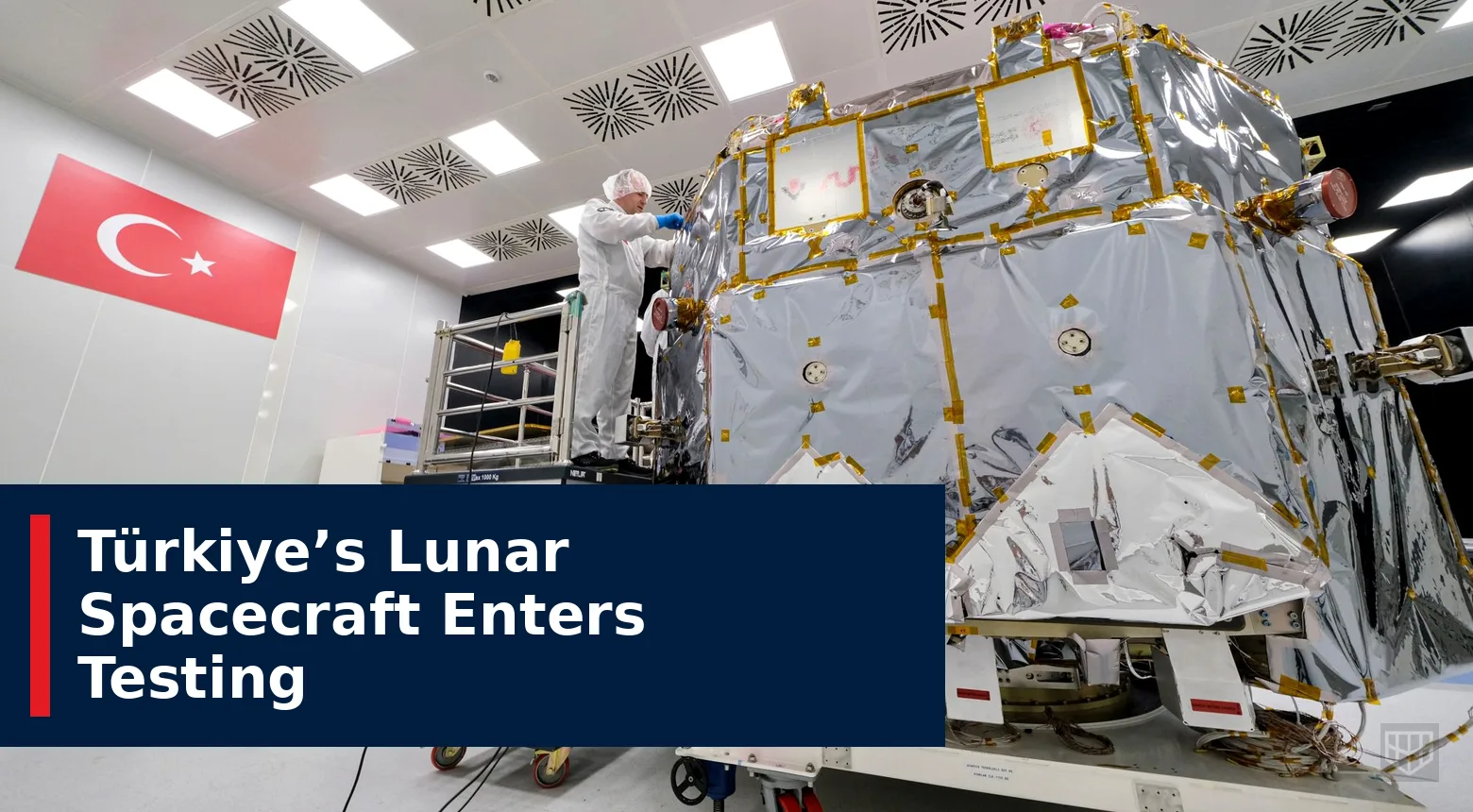
Türkiye has moved the flight model of its first lunar spacecraft into system-level environmental testing after completing production, assembly and integration. Defence Turk reported that the vehicle was transferred to the TUSAŞ Space Systems Integration and Test Centre, known as USET, where it will undergo the campaign needed to verify that the integrated spacecraft can survive launch and operate in space.
Environmental testing is more than a ceremonial handover. A spacecraft at this stage is exposed to combinations of vibration, acoustic, thermal-vacuum and electromagnetic checks defined by the mission’s qualification and acceptance plan. The objective is to identify workmanship, interface or design problems before shipment to the launch site, when corrective action becomes more difficult and costly. The programme has not yet announced completion of this campaign.
Mission profile and payload
The spacecraft is reported to weigh approximately 3.5 tonnes and to carry four scientific payloads. Two are domestic instruments, while China and Sweden are associated with the two international payloads. The declared mission concept calls for launch from Kennedy Space Center in early 2027, followed by a transit of about two months and insertion into a circular polar orbit roughly 100 kilometres above the Moon.
The baseline operational period is at least three months, with the possibility of extending activity to about 18 months if spacecraft performance, consumables and orbital conditions allow. At the end of the mission, the plan is for a controlled descent and hard landing rather than a soft-landing demonstration. That terminology is important: the spacecraft is intended to gather orbital and propulsion experience, not to deliver a survivable lander to the surface.
Domestic content and propulsion
Officials said that 56 of 65 critical items were developed domestically, taking the reported localisation rate above 80 per cent. Such figures are most useful when treated as programme disclosures rather than a complete audit of every component’s origin. Even so, the number indicates that the mission is being used to qualify a broad Turkish supply chain in structures, avionics, software, integration and ground support.
A domestically developed hybrid propulsion system is central to the mission architecture. It is intended to support orbital manoeuvres and the final descent sequence, giving Türkiye an opportunity to validate propulsion performance beyond Earth orbit. The system’s real significance will be established through test evidence and mission execution, particularly ignition reliability, guidance accuracy and the ability to manage thermal and structural loads over the planned transit.
Schedule pressure and next decisions
The path to launch still includes completion of USET testing, resolution of any discrepancies, final configuration control and clean-room preparation at T-STAR before shipment. Launch-provider integration, range scheduling and mission-operations rehearsals are additional dependencies. An early-2027 target leaves limited margin if environmental tests uncover issues that require hardware access or repeat testing.
The next evidence to watch is formal completion of the environmental campaign and confirmation that the flight spacecraft has been accepted for launch processing. A launch date and launch-service statement would then turn the current planning window into a firmer schedule. For now, the transfer to testing is a substantial maturity milestone, but it is not yet proof that the spacecraft is flight-ready.
Mission success will also need to be judged in stages rather than as a single launch outcome. Separation from the launch vehicle, acquisition of communications, trajectory correction, lunar-orbit insertion and sustained payload operation are distinct objectives, each with its own failure modes. The planned final descent would provide a further propulsion and guidance experiment even if the spacecraft completes its minimum orbital mission beforehand. Publishing criteria for those stages would make it easier to evaluate performance objectively and distinguish a partial success from full completion. That discipline is especially valuable for a first national lunar spacecraft, because the engineering knowledge returned by the mission may matter as much as the duration achieved in orbit.