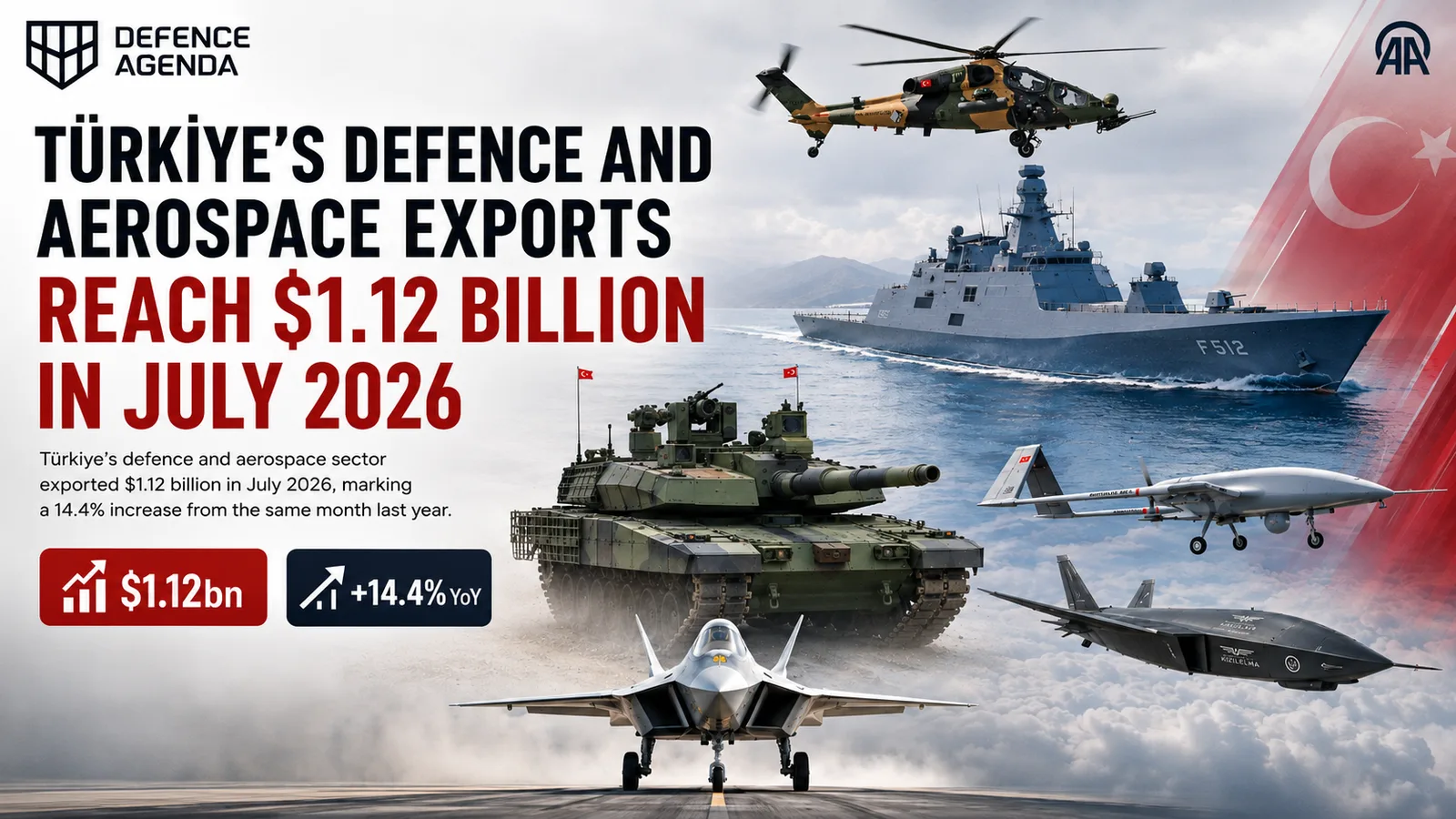
Türkiye defence and aerospace exports reached $1.12 billion in July 2026, rising 14.4% from the same month a year earlier, according to an Anadolu Agency infographic citing the head of Türkiye’s defence procurement authority.
The monthly result extends the sector’s strong export performance during the first half of the year and places the estimated January–July total at approximately $5.79 billion.
The seven-month figure is a Defence Agenda calculation based on the Anadolu Agency July infographic and the agency’s previously reported January–June export total. It was not stated directly on the supplied infographic page.
Key Facts
- July 2026 exports: $1.12 billion.
- July annual growth: 14.4%.
- January–June 2026 exports: $4.6657 billion.
- Estimated January–July 2026 exports: $5.7857 billion.
- Estimated January–July annual growth: Approximately 26.3%.
- June 2026 exports: $802.8 million.
- May 2026 exports: $992 million.
- April 2026 exports: $962 million.
- March 2026 exports: $803 million.
- Source of July data: Anadolu Agency infographic dated 4 August 2026.
- Official cited authority: President of the Secretariat of Defence Industries Haluk Görgün.
How Much Did Türkiye Export in July 2026?
Türkiye’s defence and aerospace sector recorded $1.12 billion in exports during July 2026.
The value was 14.4% higher than the level reported for July 2025. Based on that growth rate, the corresponding July 2025 value was approximately $979 million.
The comparison indicates that the sector added roughly $141 million in monthly exports year on year.
These comparative values are mathematical estimates derived from the published July 2026 total and growth rate. Rounding in the original data may cause small differences.
What Was the Export Total for the First Seven Months?
Anadolu Agency previously reported that defence and aerospace exports totalled $4.6657 billion during January–June 2026.
Adding the $1.12 billion recorded in July produces an estimated seven-month total of $5.7857 billion.
Using the previously reported 29.5% first-half growth rate and the 14.4% July increase, Defence Agenda calculates that the comparable January–July 2025 total was approximately $4.582 billion.
This implies estimated growth of approximately 26.3% for the first seven months of 2026.
The calculation should not be presented as a separately announced official cumulative rate unless confirmed by a subsequent publication from the Secretariat of Defence Industries or the Türkiye Exporters Assembly.
Türkiye’s 2026 Defence Export Progress
| Reporting Period | Monthly Export Value | Cumulative Export Value | Reported Annual Change |
|---|---|---|---|
| March 2026 | $803 million | $1.91 billion for January–March | Cumulative growth of 12.1% |
| April 2026 | $962 million | $2.871 billion for January–April | Cumulative growth of 28% |
| May 2026 | $992 million | $3.863 billion for January–May | Monthly growth of 33.9%; cumulative growth of 29.5% |
| June 2026 | $802.8 million | $4.6657 billion for January–June | Monthly growth of 29.6%; cumulative growth of 29.5% |
| July 2026 | $1.12 billion | Estimated $5.7857 billion for January–July | Monthly growth of 14.4%; estimated cumulative growth of 26.3% |
Why Is the July Figure Significant?
Monthly exports above $1 billion indicate that Türkiye’s defence and aerospace industrial base is increasingly able to convert international contracts into physical deliveries and recognised export revenue.
The performance also follows several consecutive months of high export values, suggesting that growth is not dependent on one isolated reporting period.
Defence exports typically involve long production, testing, licensing and delivery cycles. Monthly figures can therefore fluctuate according to the delivery schedules of aircraft, unmanned systems, naval platforms, armoured vehicles, missiles, electronics, components and maintenance services.
A high monthly value should not automatically be attributed to one contract or one company unless a detailed product and exporter breakdown is published.
What Is Driving Türkiye’s Export Growth?
The official statements accompanying the 2026 export data emphasise several structural factors:
- Expanded industrial production capacity
- A deeper supplier and technology ecosystem
- Systems with demonstrated operational use
- Growing international defence cooperation
- High-value aerospace and defence engineering
- Increasing capacity to provide training, maintenance and lifecycle support
- Exports to NATO members and other international partners
- A broader product portfolio covering air, land, naval, electronic and missile systems
Export growth should nevertheless be evaluated using detailed destination, company and product data when those figures become available.
How Does July Compare With Earlier Months?
July’s $1.12 billion result was higher than the monthly figures publicly reported for March, April, May and June.
May had previously produced $992 million, followed by $802.8 million in June. The July total was approximately 12.9% higher than May and 39.5% higher than June.
This comparison does not necessarily represent a permanent monthly production increase. Defence-export deliveries can be concentrated around customer acceptance dates, shipment schedules and major programme milestones.
What Does the Data Not Reveal?
The supplied Anadolu Agency page does not provide a complete breakdown of the July exports.
- Export value by company
- Export value by product category
- Destination countries
- Share of goods and services
- Value of completed platform deliveries
- Value of components, subsystems and spare parts
- Proportion linked to previously announced contracts
- Currency effects or revisions
Those gaps mean that the monthly total should be used as a sector-level indicator rather than evidence of the performance of a specific exporter or product family.
How Do Export Contracts Differ From Recorded Exports?
A signed defence contract is not recognised as export revenue in full at the time of signature.
Recorded export data generally reflects goods or services delivered during the reporting period. A multiyear aircraft, missile or naval-platform agreement may therefore contribute to monthly export figures over several years.
Contract announcements, order backlogs and monthly customs-based export figures should consequently be treated as separate measures.
| Metric | What It Measures | Main Limitation |
|---|---|---|
| Contract value | Potential value of an agreement over its full duration | May include options, future deliveries and long-term support |
| Order backlog | Contracted work not yet fully delivered | Does not show when revenue or exports will be recognised |
| Monthly exports | Goods and services recorded during a specific month | Can fluctuate sharply with delivery timing |
| Annual exports | Total recorded exports during the calendar year | Does not independently show future demand |
What Should Be Watched During the Rest of 2026?
- Whether monthly exports remain close to or above the 2026 average
- Publication of destination-country and product-category data
- Large platform-delivery milestones
- Conversion of export contracts into recognised shipments
- Changes in exports to NATO and European customers
- Growth in subsystem, engine and electronic-equipment exports
- Maintenance, training and lifecycle-support revenue
- The full-year total and any revisions to earlier monthly data
A simple annualisation of seven-month data would not provide a reliable full-year forecast because defence deliveries are uneven and can be concentrated in particular quarters.
Conclusion
Türkiye’s defence and aerospace sector exported $1.12 billion in July 2026, an increase of 14.4% compared with July 2025.
When combined with the previously reported first-half total, the result lifts estimated exports for January–July to approximately $5.7857 billion.
Defence Agenda calculates that this represents growth of approximately 26.3% from the comparable seven-month period in 2025. The cumulative total and growth rate are derived figures and should not be described as directly announced official statistics.
The July performance provides further evidence of expanding international demand and delivery capacity, but a detailed breakdown will be required to identify the companies, products and destination markets responsible for the increase.