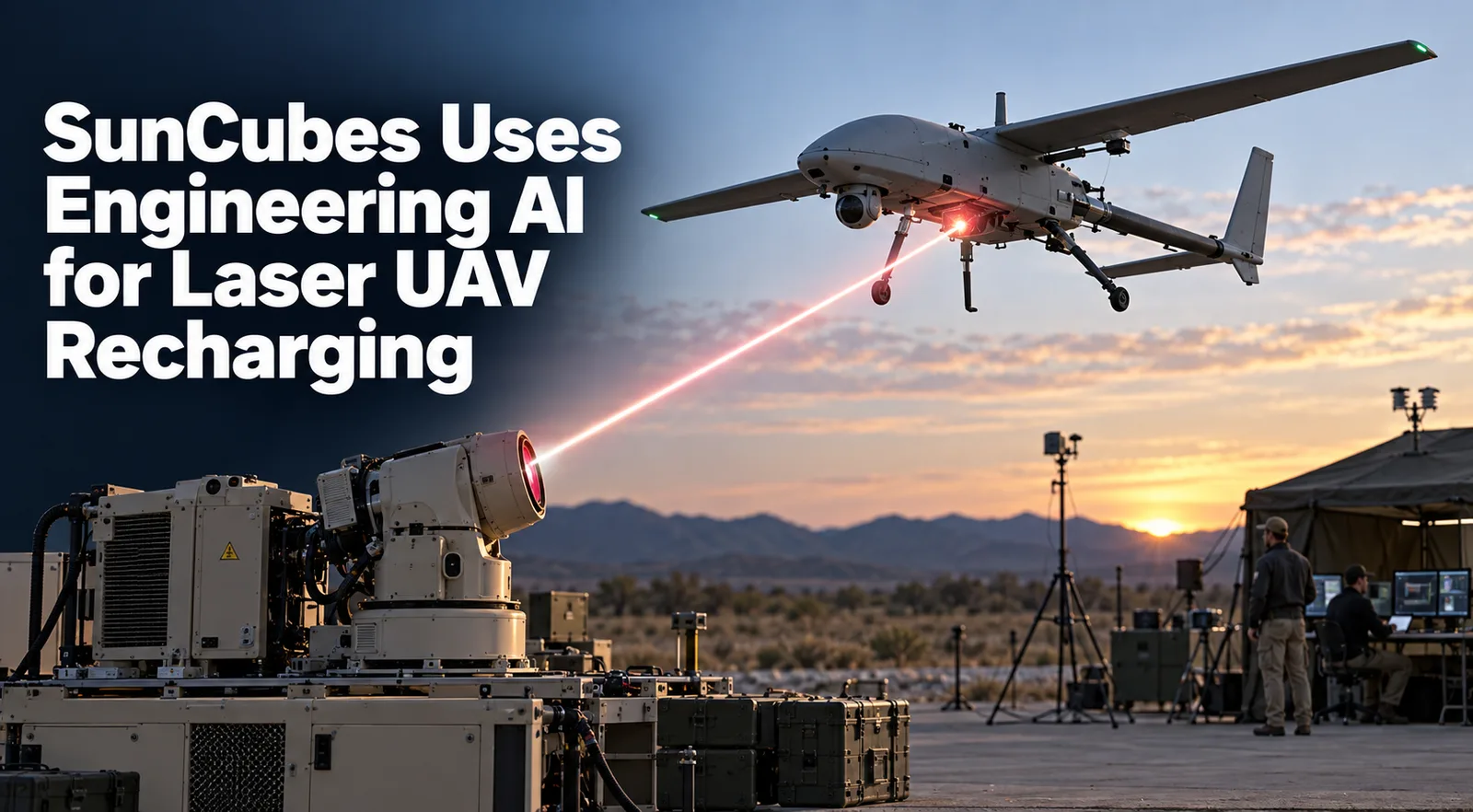
Italian deep-tech company SunCubes is using SimScale’s Engineering AI tools to develop laser-based wireless power systems intended to recharge drones in flight or at remote stations without physical contact. SimScale announced the collaboration on 2 September 2026 and said its cloud tools are being used to evaluate thermal, structural and aerodynamic performance. The objective is to shorten design cycles before committing to physical prototypes.
SunCubes Is Using Simulation AI to Mature Wireless Power Hardware
The project should be treated as technology development rather than an operational charging service. Public sources reviewed for this package do not identify a defence customer, fielding date or deployed laser network. The current milestone is the use of AI-assisted engineering workflows to mature a power-transmission concept aimed at extending UAV endurance.
Battery Endurance Is a Structural Constraint on Electric UAV Missions
Small and medium electric drones are often constrained by battery energy density, especially when they must carry sensors, communications equipment or other payloads. Repeated battery swaps can work at fixed sites but become difficult over pipelines, large farms, offshore infrastructure or military operating areas. A remote power source could theoretically keep aircraft aloft longer without landing.
Laser power transfer approaches the problem by transmitting energy from a ground or remote station to a receiver on the aircraft. That introduces a different set of engineering constraints: beam control, receiver efficiency, heat management, atmospheric losses and safe operation around people, aircraft and sensitive equipment. Extending endurance is therefore not simply a matter of increasing laser power.
Simulation Can Reduce Prototype Iterations but Cannot Replace Flight Validation
SimScale says its AI tools allow SunCubes to examine aerodynamic, thermal and structural interactions in the cloud. That can help engineers explore more design variants and identify weak concepts before manufacturing hardware. For a lightweight UAV receiver, thermal management is particularly important because absorbed energy must be converted efficiently without adding so much cooling mass that the endurance benefit disappears.
However, simulation accuracy depends on models, assumptions and validation data. Outdoor laser transmission must contend with haze, rain, dust, vibration, aircraft motion and changing geometry. Flight testing will be essential to show whether the system can maintain energy transfer reliably and safely under conditions that differ from a controlled laboratory environment.
Defence Relevance Depends on Range, Safety and Survivability
Military users could be interested in persistent unmanned surveillance or communications relay if aircraft can remain airborne for longer periods. At the same time, a high-power energy transmitter can become a detectable and potentially vulnerable asset. Line-of-sight requirements may also limit use in terrain or contested environments where a fixed emitter cannot remain exposed.
The next milestones are hardware demonstration, measured energy-transfer efficiency, flight endurance gains and any operational pilot programme. Until those data are available, SunCubes’ work is best viewed as an enabling technology programme with potential defence applications rather than a fielded solution to UAV endurance.
A further programme-management issue is the relationship between the announced milestone and the supporting infrastructure needed to turn it into repeatable capability. Training, maintenance, software configuration, supply-chain availability and acceptance standards can all become schedule drivers after the public announcement. For that reason, Defence Agenda will track follow-on evidence from the customer, supplier and relevant government authority rather than treating the initial milestone as the end of the acquisition cycle.
Implications / Next
The next Defence Agenda update should be tied to a dated, independently verifiable event that changes programme maturity: a delivery, exercised option, completed test, production milestone, operational acceptance or new contract action. Until that occurs, the current announcement should remain the baseline and should not be extrapolated into undisclosed quantities, performance or fielding status.