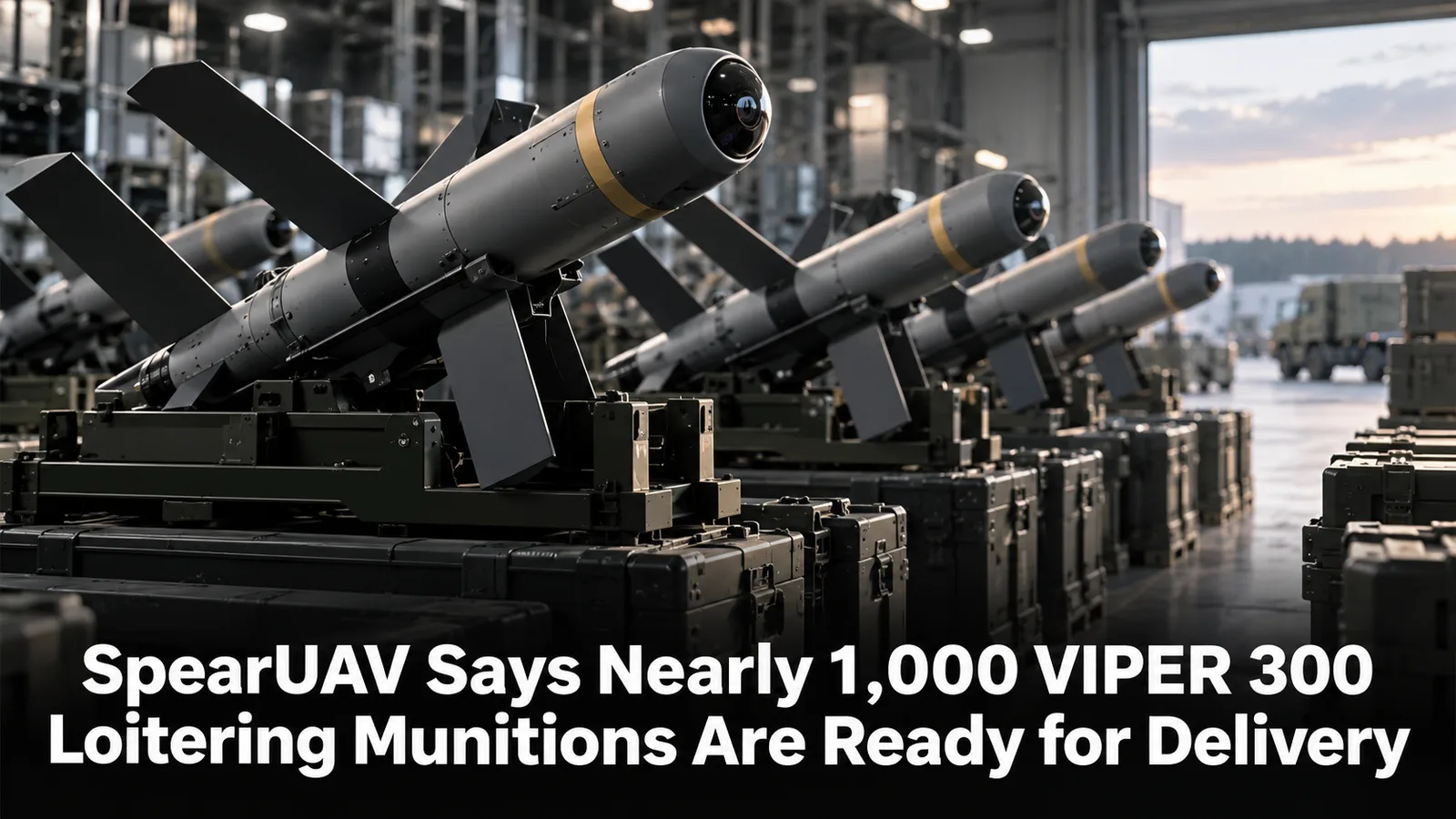
Israeli manufacturer SpearUAV says it has nearly 1,000 VIPER 300 loitering-munition systems ready to deploy to customers worldwide.
The announcement is a production-readiness milestone rather than a new contract disclosure: SpearUAV has not named the countries, units or order allocations associated with the stock.
Production Scale and System Architecture
SpearUAV says it has nearly 1,000 VIPER 300 loitering-munition systems ready for delivery, a milestone that shifts the discussion from prototype capability toward repeatable production and inventory scale. VIPER 300 is a compact quadcopter loitering munition that folds inside a launch capsule and is marketed for dismounted troops and vehicle crews needing organic beyond-line-of-sight reconnaissance and precision attack. Producing close to 1,000 complete systems requires sustained supply of airframes, electronics, warheads, batteries, launch capsules and acceptance testing, making industrial throughput as important as individual-aircraft performance.
SpearUAV lists the system at 2.8 kg including capsule and payload, with a 5 km range, speed of 27 m/s and endurance up to 20 minutes, all of which are manufacturer specifications. The folded capsule enables carriage by soldiers or integration into vehicle-mounted multi-canister launchers, and the VIPER MCL can launch multiple systems sequentially or simultaneously from military platforms. That gives mechanised units a compact ISR/strike layer without relying on a larger fixed-wing UAV detachment for every engagement.
Targeting, Contracts and Customer Context
The company describes onboard AI for target identification and tracking, but public information does not establish an unrestricted autonomous lethal-engagement mode without human authorisation. Defence Agenda therefore treats AI as a targeting and mission-support feature rather than evidence of fully autonomous strike authority. The distinction is important because loitering-munition autonomy can cover navigation, recognition and tracking without transferring the final engagement decision to software.
A December 2024 SpearUAV announcement provides useful order-book context: the company disclosed a $20 million VIPER 300 contract with an undisclosed customer and options that could increase the value to around $60 million, with Janes reporting deliveries expected in 2025. The new nearly-1,000-unit readiness claim should not be mapped directly to that single contract because SpearUAV says it has a growing international customer base and additional orders across the VIPER family. Customer names, allocation by country and inventory ownership remain undisclosed.
Industrial Impact
The production milestone reflects a broader shift in loitering munitions from specialist weapons toward consumable inventories that may need to be manufactured and replenished in hundreds or thousands. In that market, suppliers increasingly compete on production rate, launcher integration, training burden, supply-chain continuity and sustainment as much as on the performance of one air vehicle. If SpearUAV converts the current inventory into recurring follow-on orders, the company will have demonstrated not just technical maturity but the industrial model required for high-consumption precision effects.
Limitations and Counterpoint
No independent production audit has been published, so the nearly-1,000 figure remains a company statement about systems ready for delivery. Exact customer allocations, delivery timelines, contract totals and the extent of operational fielding are not public, while AI and precision claims also remain manufacturer descriptions unless supported by customer data. The milestone is meaningful, but it should be reported as production readiness rather than a confirmed 1,000-unit procurement by one buyer.
Implications / Next
The next indicators are named export customers, follow-on contracts and evidence of multi-canister launchers entering routine vehicle service. Replenishment orders would be especially important because they would show that VIPER 300 is moving into sustained inventory consumption rather than one-time programme buys. Operational reporting may also clarify how users balance AI-enabled target tracking with human engagement control in real missions.