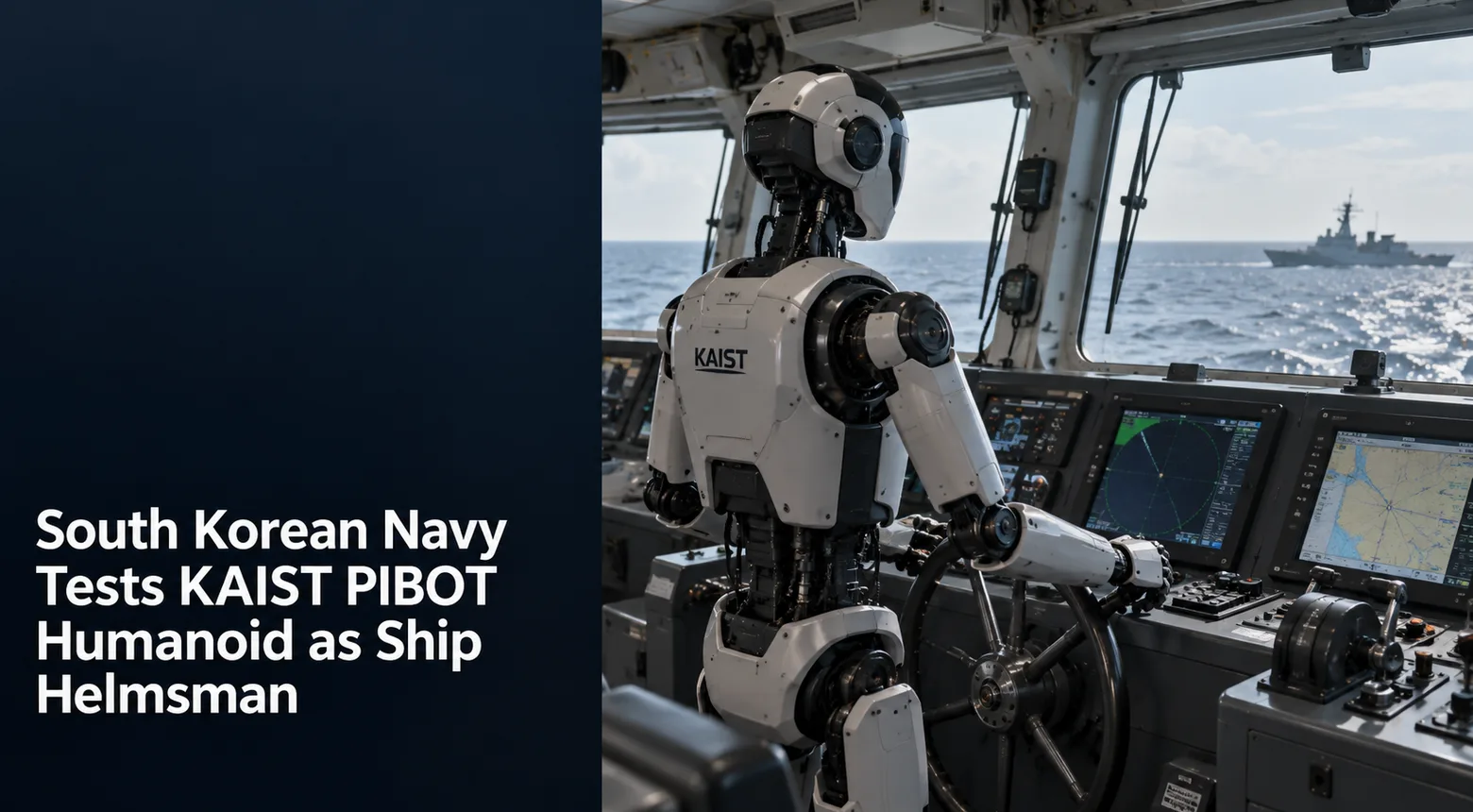
South Korea’s Navy has tested KAIST’s PIBOT humanoid as a ship helmsman, examining whether a general-purpose robot can execute steering orders using controls designed for human sailors. KAIST and Yonhap place the first naval experiment on 23 July 2026 at a Navy training facility in Changwon, where PIBOT was reported to have carried out helm commands in scenarios including narrow waters, adverse weather and night operations.
The engineering choice is important. Rather than redesigning a ship around robotic actuators, PIBOT physically interacts with the bridge controls and receives instructions through an interface that includes natural-language and voice-command processing. KAIST says the approach is intended to allow robotic labour to be introduced into existing platforms with fewer structural modifications, potentially lowering the integration barrier for selected repetitive or hazardous tasks.
Key Facts
- KAIST and Yonhap place the first naval helmsman experiment on 23 July 2026 in Changwon.
- PIBOT manipulated existing ship controls rather than requiring a purpose-built robotic bridge.
- The test included steering orders in narrow waters, adverse weather and night conditions, according to South Korean reporting.
- The project has been developed since 2022 with South Korean defence-agency support.
- Reported development investment is approximately KRW 5.7 billion.
- A later 7 September secondary report gives a different date and location; this package follows the more authoritative contemporaneous KAIST/Yonhap record.
PIBOT demonstrates a robotic helmsman on existing controls
The development is best assessed as a programme milestone rather than a complete operational endpoint. The verified evidence establishes the event described above, while subsequent procurement, integration, readiness or fielding claims require their own confirmation as the programme advances. That distinction is important for comparing announcements across defence programmes, where testing, production, delivery and operational acceptance are separate maturity stages with different evidentiary thresholds.
Automation is aimed at workload, not an autonomous warship
The experiment should not be interpreted as the South Korean Navy handing navigation of an operational warship to an unsupervised humanoid. It is an early combat experiment focused on whether a robot can reproduce a defined human task under controlled conditions. Safe navigation at sea still depends on watchkeeping, situational awareness, rules of the road, command judgement, equipment redundancy and rapid response to abnormal situations that extend far beyond moving the helm.
South Korea’s demographic pressure gives the work an additional operational rationale. With a shrinking pool of military-age personnel, the armed forces are examining automation to reduce manpower demand in jobs that can be standardised without weakening command accountability. A humanoid form factor is attractive where ships, vehicles and facilities have already been built around human reach, posture and control layouts, because the robot can potentially work in spaces that would otherwise need expensive redesign.
Source discrepancy and the next test phases
A later 7 September 2026 secondary report described a test on 23 August at Jinhae, but contemporaneous KAIST and Yonhap reporting identifies the initial naval helmsman experiment as 23 July in Changwon. Defence Agenda therefore uses the July chronology as the stronger record and treats the later date/location as an unresolved reporting discrepancy rather than silently combining the two accounts. This distinction matters because a later event could represent a separate phase, but the available source material does not establish that clearly enough to assert it.
The programme’s next value will come from progression beyond a demonstration bridge. South Korean reporting describes a phased path toward tests on moored vessels and eventually at sea, where vibration, ship motion, communications interruptions and safety certification become more demanding. Success would not eliminate human crews, but it could validate a new class of shipboard automation in which robots take routine physical actions while human watch teams retain navigation authority and mission command.
Implications / Next
The next publication-grade milestone will be the first independently verifiable step that moves the programme beyond the status described here—such as a follow-on test, formal contract action, delivery, operational deployment or completed transaction, depending on the story. Defence Agenda will treat each maturity stage separately and will not infer production, operational capability or procurement completion from an earlier demonstration or announcement. The most useful follow-up evidence will therefore be dated official documentation, customer acceptance, serial-production data or operational activity that can be cross-checked against the current record.