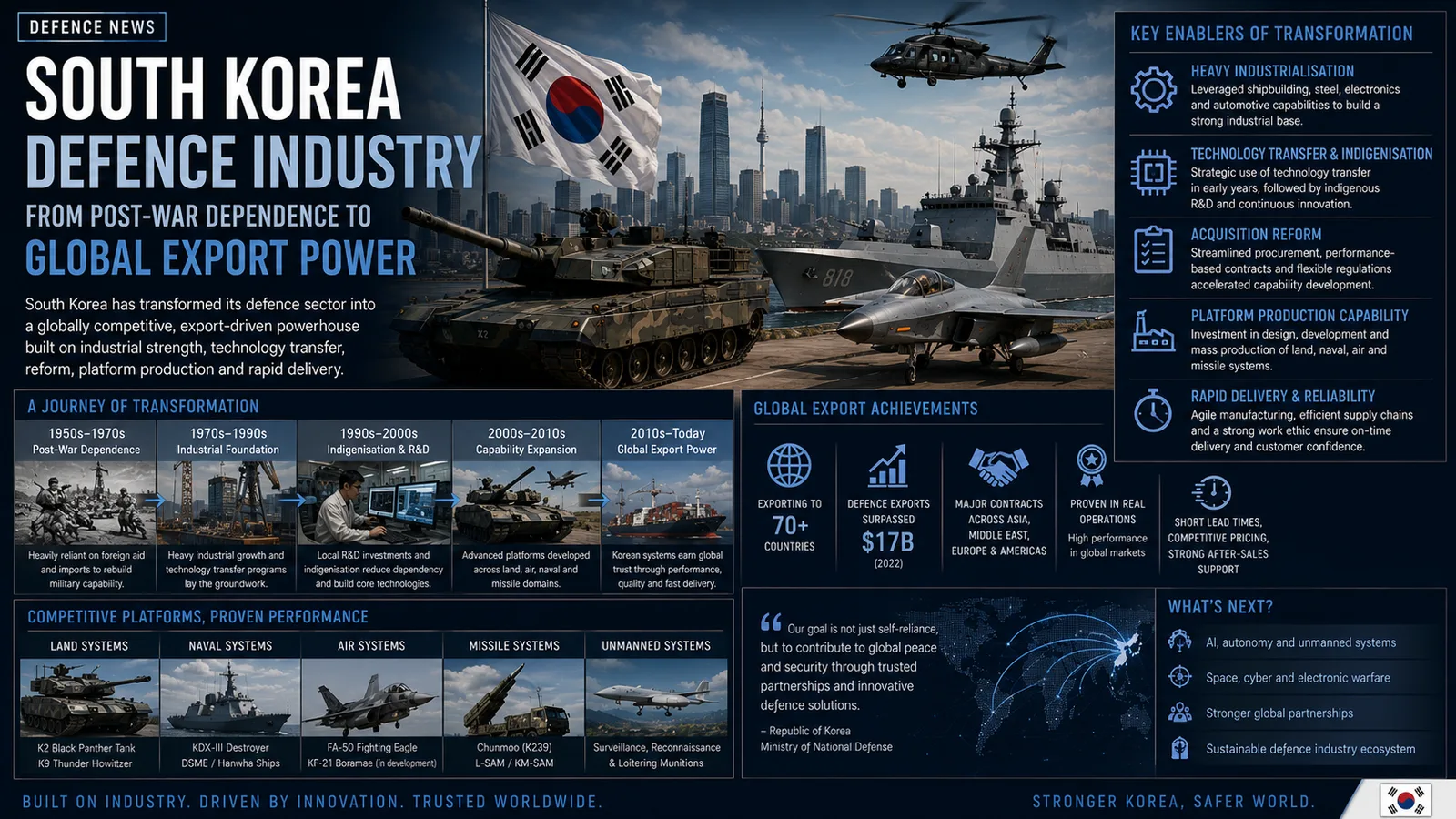
South Korea defence industry has become one of the most important case studies in modern defence industrialisation, moving from post-war dependency to global export relevance through state-led planning, technology transfer, local production and export discipline.
A SAHA Blog analysis traces this transformation from the Korean War to South Korea’s current position as a major supplier of tanks, artillery, aircraft, naval platforms, missiles and defence electronics. The article’s central argument is clear: South Korea did not become a defence exporter by accident. It built defence industry as part of national industrial policy.
This model matters because many countries now want the same outcome. They want to reduce dependence on foreign suppliers, create national production capacity, strengthen military readiness and enter export markets. South Korea shows that this is possible, but only through long-term coordination between government, armed forces, industry, technology policy and foreign partnerships.
South Korea Defence Industry Began With Strategic Vulnerability
The origin of South Korea’s defence-industrial strategy lies in insecurity. The Korean War devastated the country and left South Korea dependent on foreign military aid, especially from the United States.
After the 1953 armistice, South Korea faced a permanent security threat from North Korea while also rebuilding from poverty and industrial weakness. This created a strategic dilemma: the country needed advanced military capability, but it did not yet have the industrial base to produce it independently.
The SAHA Blog article points to the Nixon Doctrine and the withdrawal of part of the U.S. military presence from Korea in the early 1970s as a turning point. Seoul understood that it could not rely indefinitely on external security guarantees alone. It needed a defence industry capable of supporting national survival.
Heavy Industrialisation Created the Defence Base
South Korea’s defence industry was built on the wider foundation of heavy industrialisation. Under Park Chung-hee, the country pursued industrial development, export-led growth and state-directed technology upgrading.
The heavy and chemical industry drive gave South Korea capacity in steel, machinery, shipbuilding, chemicals, electronics and precision manufacturing. These sectors later became essential for tanks, artillery, warships, aircraft structures, missiles and defence electronics.
This is one of the most important lessons of the Korean model. Defence industry cannot be separated from the wider industrial base. A country that wants to build advanced weapons must also build metallurgy, machine tools, electronics, software, testing, logistics, skilled labour and quality systems.
Technology Transfer Was Used as a Learning Tool
South Korea initially relied heavily on technology transfer and licensed production. The SAHA Blog article notes that machine guns, anti-tank rockets, artillery systems and other weapons were produced domestically through technology transfer from the United States.
This was not only procurement. It was industrial learning. Local production allowed South Korean companies and state institutions to absorb manufacturing know-how, quality-control practices, supply-chain management and systems integration experience.
Later, South Korea used similar learning pathways in aircraft, artillery, naval systems, armoured vehicles and missiles. The key was not to remain permanently dependent on licensed production. The key was to use foreign cooperation as a bridge toward indigenous design and exportable platforms.
The 1990s Added Technology Depth
The 1990s marked another stage in the South Korea defence industry model. The country adapted to the wider transformation of military technology after the Cold War, including precision weapons, advanced electronics, information systems and the revolution in military affairs.
The SAHA Blog article also highlights South Korea’s access to Russian technologies after the collapse of the Soviet Union. This gave Seoul another opportunity to study advanced systems and diversify its technology base.
At the same time, the government supported research in advanced materials, microelectronics, biotechnology, fine chemicals, optics and aerospace. These technologies were not only civilian growth areas. They also supported the foundations of a more advanced defence-industrial ecosystem.
DAPA Professionalised Defence Acquisition
A major institutional milestone was the creation of the Defense Acquisition Program Administration, or DAPA, in 2006. The purpose was to centralise and professionalise defence acquisition, procurement, R&D, quality control and industry support.
DAPA says the integration of acquisition-related organisations improved resource distribution across services and weapon systems. It also introduced preliminary research processes and integrated project teams to identify project issues more quickly.
This matters because defence industrialisation depends on institutions. Platforms do not scale if requirements are unclear, procurement is fragmented, quality control is weak or industrial policy changes too often. DAPA gave South Korea a specialised acquisition structure that could connect military demand with industrial execution.
Competition Replaced a Closed Industrial Structure
South Korea also moved to reduce monopoly behaviour inside its defence industrial base. DAPA says the abolition of the specialisation and affiliation system helped transform a monopolistic structure into a more competitive one.
This reform was important because a protected defence industry can become inefficient if it lacks pressure to improve. Competition can sharpen cost discipline, delivery performance, export behaviour and technology upgrading.
The SAHA Blog article also notes the introduction of a multiple-supplier approach to prevent monopolisation. This is a key difference between simply protecting national industry and making national industry globally competitive.
Exports Became a Strategic Policy Objective
The strongest change in the last two decades has been export orientation. South Korea no longer treats defence industry only as a tool for domestic military supply. It treats exports as part of industrial scale, economic growth and strategic influence.
DAPA lists defence exports of USD 9.6 billion in 2024 and sets a target of USD 20 billion by 2030. It also aims to increase South Korea’s global defence-market share from 2.2% in 2024 to 6% in 2030.
This export strategy is not only about selling weapons. It also supports production scale, supplier depth, international partnerships, after-sales services, training packages, maintenance networks and political influence.
K9, K2, Chunmoo and FA-50 Built the Export Brand
The South Korea defence industry export brand is now built around recognisable platforms. K9 Thunder self-propelled howitzers, K2 Black Panther tanks, K239 Chunmoo rocket artillery systems and FA-50 light combat aircraft have become central to the country’s global position.
The U.S. International Trade Administration lists major South Korean defence exports including K9 howitzers to India, Türkiye, Finland, Norway, Poland, Egypt and Australia; K2 tanks and K239 Chunmoo systems to Poland; and FA-50 aircraft to Poland and Malaysia.
The success of these platforms rests on a combination of performance, price, production capacity, delivery speed and industrial cooperation. South Korea has been able to offer systems that are advanced enough for modern forces, but often available faster than many Western alternatives.
Poland Became the Breakthrough Customer
Poland has become the most visible example of South Korea’s export breakthrough. After Russia’s full-scale invasion of Ukraine, European demand for tanks, artillery, rockets and aircraft increased sharply.
South Korea was well positioned because it had active production lines, mature land systems and the political willingness to support large-scale delivery. The SAHA Blog article points to Poland’s interest in K9 howitzers, K2 tanks and combat aircraft as a decisive factor in South Korea’s rise.
The Polish case shows why production capacity is now a strategic advantage. Defence customers are not only asking what a system can do. They are asking how quickly it can be delivered, sustained, upgraded and locally integrated.
Offset Policy Supported Technology Absorption
Offset policy has also shaped the Korean model. The U.S. International Trade Administration notes that South Korea introduced offset programmes in 1982 with the objective of developing the domestic aerospace industry, and that offsets later became a tool to acquire core defence technologies.
Between 2020 and 2024, foreign defence contractors from nine countries participated in 43 offset programmes in South Korea, with secured value of USD 1.026 billion. A major share of those programmes involved exports of Korean-made parts and components for weapon systems.
This shows how offsets can move beyond symbolic industrial participation. When structured well, they can support local suppliers, component exports, technology learning and long-term defence-industrial competitiveness.
Indigenisation Increased the Strategic Value
South Korea’s defence strategy has consistently emphasised indigenisation. According to DAPA data cited by the U.S. International Trade Administration, South Korea’s overall indigenisation rate for weapon systems increased from 75.3% in 2019 to 89.6% in 2023.
This matters because export success depends on control over technology, production and supply chains. A country that only assembles foreign systems has limited freedom to export, upgrade or adapt products for customer needs.
Indigenisation also strengthens national security. Local production can reduce exposure to foreign export controls, supply disruptions and political restrictions during crises.
The U.S. Alliance Remains a Core Foundation
South Korea’s defence industry developed inside the framework of the U.S.–ROK alliance. U.S. standards, equipment, training, interoperability requirements and security guarantees shaped South Korea’s military modernisation for decades.
This alliance foundation gave South Korean industry access to Western operational standards and created a technology reference point. However, South Korea gradually moved from dependence toward selective autonomy.
That balance is one of the model’s defining characteristics. Seoul did not abandon alliance integration. Instead, it used alliance structures, technology transfer and domestic industrial policy to build stronger national capacity.
The Korean Model Is Not Only About Platforms
The South Korea defence industry model is often discussed through famous platforms. However, the deeper story is institutional and industrial. The model combines state planning, export policy, acquisition reform, technology protection, local production, chaebol-scale manufacturing and international partnerships.
Large companies such as Hanwha Aerospace, Hyundai Rotem, Korea Aerospace Industries and LIG Nex1 benefit from South Korea’s wider manufacturing ecosystem. Shipbuilding, automotive, electronics and precision engineering all support defence production.
This industrial depth allows South Korea to scale. It can produce armoured vehicles, artillery, aircraft, missiles and naval systems because these sectors are connected to broader national manufacturing strength.
Rapid Delivery Became a Competitive Advantage
One of South Korea’s strongest advantages is delivery speed. Many Western defence producers face capacity constraints, long lead times and complex multinational supply chains. South Korea has been able to use active production lines and standardised platforms to respond quickly.
This advantage became more important after the war in Ukraine. European states needed to rebuild stocks and replace transferred equipment. Customers began to value speed, reliability and production depth as much as technological sophistication.
South Korea’s export model therefore fits the current defence market. It offers a combination of proven systems, scalable manufacturing, financing options, local production packages and political reliability.
Technology Protection Became More Important as Exports Grew
As South Korea’s defence exports increased, technology protection became more important. DAPA notes that the Defense Industry Technology Protection Act was enacted in 2016 to strengthen protection of national defence-industrial technology.
This is a natural stage in defence-industrial development. Countries that become exporters must protect sensitive know-how, manage cyber risks, control technical data and ensure that international partnerships do not weaken sovereign technology advantage.
The export model therefore requires governance. Industrial growth must be matched by security, intellectual-property protection, export-control discipline, cyber defence and trusted supply chains.
South Korea Now Wants a Top-Tier Global Position
DAPA’s current vision points to a “world’s top four” ambition in defence industry. The agency also targets stronger defence science and technology ranking, higher SME engagement, more jobs, increased exports and expanded global partnerships by 2030.
This shows that South Korea sees defence industry as a national growth engine, not only a military supply function. The goal is to create technology sovereignty, economic value, employment, exports and geopolitical influence.
However, reaching the top tier will be difficult. South Korea must compete with the United States, France, Germany, Israel, Türkiye, Italy, China and other established or rising defence exporters. It must also manage export controls, local-content demands, political risk and technology competition.
The Main Risk Is Overdependence on Export Cycles
South Korea’s export growth is impressive, but it also creates risk. Defence export markets are cyclical, political and highly competitive. Large contracts can transform order books, but delays, financing problems or political shifts can create uncertainty.
Another risk is technology depth. Some South Korean systems are highly competitive in conventional land warfare, but future markets will increasingly demand air defence, AI, unmanned systems, cyber resilience, space support, electronic warfare and software-defined capability.
South Korea’s next challenge is therefore not only selling more platforms. It must move higher in the value chain through sensors, software, autonomy, networked command systems, advanced missiles, space systems and integrated air defence.
Lessons for Emerging Defence Industries
The South Korea defence industry model offers several lessons for emerging defence producers. First, industrial policy matters. Defence capability grows faster when it is linked to national manufacturing, technology policy and export strategy.
Second, technology transfer must be converted into indigenous capability. Licensed production is useful only if it produces lasting design, engineering and supply-chain competence.
Third, acquisition institutions matter. A country needs professional procurement, clear requirements, quality control, R&D funding, test infrastructure and programme discipline.
Fourth, exports require scale. A defence industry that produces only for domestic demand may struggle to sustain advanced production lines. Export customers can create volume, feedback and global credibility.
Fifth, speed is a capability. In today’s market, customers value fast delivery, sustainment support and industrial cooperation as much as headline performance.
What Türkiye Can Learn From South Korea
Türkiye and South Korea have different histories, geographies and alliance positions, but both show how defence industry can become a pillar of national technology policy.
For Türkiye, the Korean case reinforces the importance of supplier depth, export discipline, platform families, production continuity, technology protection and professional acquisition governance. It also shows why defence industry must connect to the wider economy through electronics, materials, software, automotive, shipbuilding, aerospace and machinery sectors.
The strongest lesson is integration. Countries do not become defence exporters only by building individual products. They become exporters by building ecosystems that can design, certify, produce, deliver, sustain and upgrade complete systems over decades.
Conclusion
South Korea defence industry has moved from post-war dependency to global export power through a long process of industrialisation, technology transfer, local production, acquisition reform and export strategy.
The country’s success rests on more than K9 howitzers, K2 tanks, Chunmoo rocket systems or FA-50 aircraft. It rests on institutions, production capacity, state policy, industrial depth, technology protection and a disciplined effort to turn defence procurement into national industrial capability.
The next phase will be harder. South Korea must move from strong platform exports toward integrated systems, software, autonomy, air defence, space, cyber resilience and next-generation military technologies. If it succeeds, K-Defense will become not only an export story, but a full-spectrum defence-industrial model for the 2030s.
For further Defence Agenda coverage, read our defence industry, defence procurement and Asia-Pacific sections. Related analysis includes dual-use defence technologies and innovation, future warfare technologies and military strategy and A2/AD doctrine and layered defence strategy.