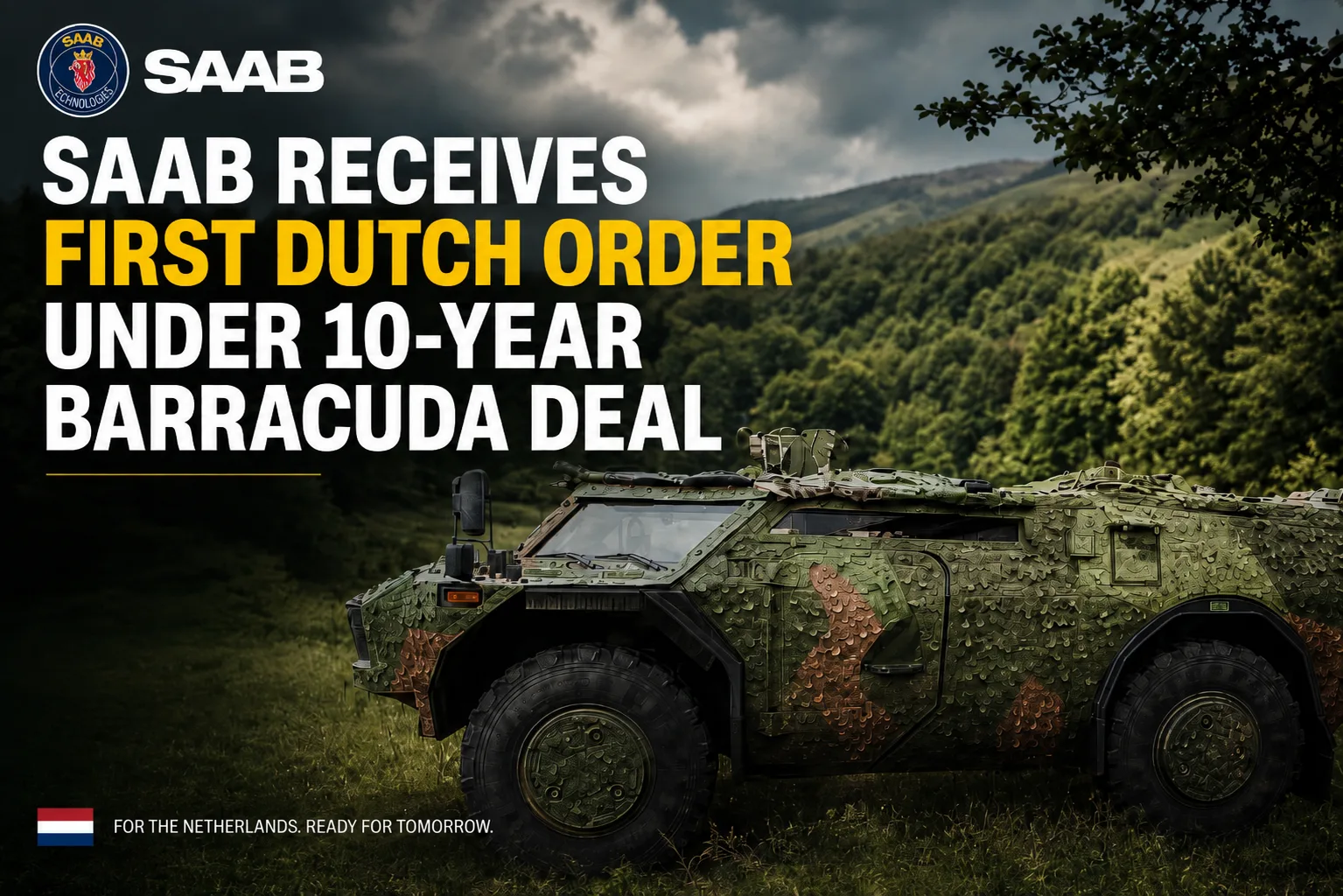
Saab has received the first Dutch order for Barracuda Mobile Camouflage Systems under a 10-year framework agreement designed to equip hundreds of Royal Netherlands Army vehicles with multispectral signature-management protection against visual, infrared, thermal and radar-based detection.
The agreement itself was signed by the Netherlands Ministry of Defence and Saab Barracuda on 10 June 2026 at the Bernhard Barracks in Amersfoort. Saab’s 27 August announcement confirms that the first order has now been placed, initially covering existing Fennek reconnaissance vehicles and Panzerhaubitze 2000NL self-propelled howitzers. The Dutch Ministry of Defence has separately identified CV90 infantry fighting vehicles among the platforms intended to receive the new camouflage systems over the wider framework period.
Key Facts
- Supplier: Saab Barracuda
- Customer: Netherlands Ministry of Defence / Royal Netherlands Army
- Framework signed: 10 June 2026
- Framework duration: 10 years
- First order announced: 27 August 2026
- Initial vehicles: Fennek and Panzerhaubitze 2000NL
- Additional identified platform: CV90 infantry fighting vehicle
- Scale: Hundreds of Mobile Camouflage Systems over the framework period
- Contract value: Not publicly disclosed
The New Development Is the First Order, Not the Framework Signature
Saab’s 27 August release describes a new long-term agreement with the Netherlands, but the Dutch Ministry of Defence had already announced the framework on 10 June. The official Dutch statement says Defence and Saab Barracuda signed a 10-year agreement at the Bernhard Barracks in Amersfoort and that hundreds of mobile camouflage systems would be acquired.
The genuinely new element in Saab’s August announcement is that the company has now received the first order under that framework. Saab identifies Fennek and Panzerhaubitze vehicles as the initial recipients and says deliveries will take place over the coming years.
The chronology matters editorially because the August event should not be framed as a newly signed 10-year contract if the purpose is to describe what changed on 27 August. The new milestone is conversion of the framework into an executable vehicle-level order.
Hundreds of Systems Across Multiple Vehicle Types
The Dutch Ministry of Defence says the programme will acquire hundreds of mobile camouflage systems for Fennek reconnaissance vehicles, Panzerhaubitze 2000NL self-propelled howitzers, CV90 infantry fighting vehicles and additional vehicle types.
Saab’s first-order announcement is narrower. It identifies existing Fennek and Panzerhaubitz vehicles and states that the framework includes options to equip other vehicle types later. It does not identify the number of systems in the first order or the financial value.
The framework approach gives the Netherlands a mechanism to order vehicle-specific camouflage kits over time rather than defining one fixed fleet configuration on day one. This is particularly relevant because Barracuda MCS is tailored around each host vehicle’s geometry, thermal behaviour, apertures, sensors, weapons and maintenance access.
It also allows later orders to follow fleet modernisation, operational experience and changes in the threat environment without requiring a completely new procurement process for every platform.
Why the Netherlands Is Replacing Traditional Camouflage
The Dutch Ministry of Defence says its current camouflage material is primarily suited to static operations and provides insufficient protection against modern sensors operating across the electromagnetic spectrum.
That requirement reflects a wider battlefield shift. Camouflage can no longer be evaluated only by whether a vehicle is difficult to see with the naked eye. Drones, thermal imagers, night-vision devices, airborne electro-optical payloads and radar sensors can detect and classify targets that remain visually concealed.
The Netherlands therefore describes the new systems as vehicle-specific camouflage coverings with improved multispectral properties. The stated threat set includes visible detection, infrared, night-vision and thermal sensors, while Dutch official reporting also says the technology reduces radar detectability.
This turns camouflage into a signature-management problem rather than a paint-and-netting problem.
Barracuda MCS Protects Vehicles While Moving
Saab positions Barracuda Mobile Camouflage System as a vehicle-mounted multispectral signature-management solution that remains fitted during movement and combat. This distinguishes it from static camouflage nets that normally provide their strongest effect when a vehicle is parked or concealed in a prepared position.
Saab says MCS can reduce signatures in the visual and near-infrared, thermal-infrared and radar bands. The system uses vehicle-specific patterns, materials and three-dimensional surface structures intended to reduce contrast with the operating environment and disrupt recognisable vehicle contours.
The company also markets heat-reduction properties intended to lower solar heat loading on the vehicle. That can provide a secondary benefit by reducing internal temperature and cooling demand, although the Dutch procurement release does not publish quantified performance requirements for heat reduction.
Saab states that MCS can be configured for woodland, urban, desert and arctic conditions. The exact Dutch pattern sets, sensor-reduction levels and environment-specific configurations have not been publicly disclosed.
Multispectral Protection Is Increasingly Driven by Drones
The Netherlands explicitly links the procurement to hostile drones and advanced sensors. Small UAVs can now carry thermal cameras and stabilised electro-optical payloads at relatively low cost, allowing reconnaissance units to search larger areas and maintain persistent observation.
A vehicle hidden under conventional visual camouflage may still create a strong thermal contrast, radar return or near-infrared signature. Once detected, that track can be passed to artillery, loitering munitions, FPV drones or other precision fires.
Multispectral camouflage attempts to extend the time required for an opponent to detect, classify and identify the vehicle. It does not make the platform invisible. The operational goal is to reduce detection probability or detection range sufficiently to increase survivability, preserve freedom of manoeuvre and complicate the enemy’s sensor-to-shooter chain.
This is especially relevant for artillery and reconnaissance platforms. A Fennek benefits from lower signature because its mission often depends on observing without being located. A PzH 2000NL benefits because modern counter-battery operations increasingly combine radar, UAV surveillance and thermal detection. CV90 infantry fighting vehicles face similar exposure while manoeuvring near the forward edge.
The Netherlands Tested Multiple Solutions Before Selecting Saab
A Dutch Ministry of Defence publication provides useful acquisition context beyond the Saab press release. COMMIT, the Materiel and IT Command, says multiple suppliers and samples were evaluated before Saab Barracuda was selected.
According to the publication, tests were conducted with the Royal Netherlands Army together with the Netherlands Organisation for Applied Scientific Research, TNO, and the Army’s Camouflage School. Saab Barracuda emerged as the preferred solution from that process.
The first MCS configuration was developed around the Fennek, while the requirement is intended to extend across the wider land force.
This matters because it indicates the procurement was based on comparative testing rather than a direct adoption based only on Saab’s catalogue performance claims. Public reporting does not disclose test scores, detection ranges, competing vendors or detailed evaluation criteria.
Fennek Is the First Vehicle-Specific Configuration
The Fennek reconnaissance vehicle is a logical early platform for multispectral camouflage because reconnaissance depends heavily on low observability and prolonged operation close to adversary sensor coverage.
The Dutch defence publication states that the first MCS implementation was developed for the Fennek. Saab’s August release also uses a Fennek equipped with Barracuda as the principal official image for the new order.
A mobile camouflage solution can provide more persistent protection than a system that must be removed before movement. For reconnaissance crews, this reduces the transition between concealed observation and relocation, when a vehicle may otherwise become more exposed.
Panzerhaubitze 2000NL Adds an Artillery-Survivability Dimension
The inclusion of Panzerhaubitze 2000NL gives the contract a direct artillery-survivability dimension. Self-propelled howitzers increasingly operate under observation from UAVs and other sensor networks, and survivability depends on rapid displacement as well as reduced signature.
Traditional shoot-and-scoot tactics reduce vulnerability after firing but do not eliminate the risk of being tracked during movement or while waiting in firing areas. A fitted MCS can potentially preserve some signature reduction throughout those phases.
The Dutch procurement does not claim that Barracuda defeats counter-battery radar or prevents detection after firing. The system should therefore be treated as one layer of survivability alongside mobility, dispersion, emissions control, deception, air defence and counter-UAS protection.
CV90 Extends the Requirement to the Mechanised Fleet
Although Saab’s first order names Fennek and Panzerhaubitze vehicles, the Dutch Ministry of Defence explicitly lists CV90 infantry fighting vehicles among the platforms to receive the new systems during the wider programme.
That indicates the requirement is not limited to specialist reconnaissance and artillery vehicles. It is intended to extend multispectral protection into the manoeuvre fleet.
The CV90 is particularly relevant because mechanised formations are high-value targets for persistent UAV surveillance. Applying vehicle-fitted signature management across larger armoured formations could reduce the contrast between individual platforms and their operating environment, although effectiveness will depend on terrain, movement, sensor type and tactical discipline.
Passive Protection Complements Counter-UAS
The camouflage procurement should not be viewed as an alternative to active counter-drone systems. The two address different stages of the threat chain.
Counter-UAS systems attempt to detect, track, jam or destroy hostile drones. Signature management attempts to prevent or delay those drones and other sensors from finding a useful target in the first place.
The Netherlands is pursuing both approaches. Defence Agenda has separately tracked European investment in counter-drone interceptors and layered air defence, while the Barracuda procurement addresses passive protection at platform level.
Layering those measures is increasingly important because no single defensive mechanism is sufficient against persistent surveillance. Jammers can reveal their own emissions, interceptors can be saturated and camouflage can be defeated by the wrong background or sensor geometry. Survivability comes from combining signature reduction, deception, mobility, electronic warfare and kinetic defence.
A 10-Year Framework Supports Fleet-Wide Adaptation
The 10-year duration is significant because camouflage requirements are likely to change faster than traditional vehicle service lives.
Sensor technology is evolving rapidly. Thermal cameras are improving, radar payloads are becoming smaller, hyperspectral systems are becoming more accessible and AI-assisted image recognition is reducing the workload required to search large areas.
A long-term framework gives the Netherlands a mechanism to update patterns and fit new vehicle types as those threats evolve. It also gives Saab a recurring integration relationship with the Dutch land fleet rather than a single one-time delivery.
The commercial value of the framework has not been disclosed, so the potential revenue cannot be calculated from the public information available.
Industrial Impact for Saab Barracuda
The Netherlands becomes another significant European user of Saab’s Barracuda signature-management portfolio. The programme reinforces camouflage as a distinct defence-industrial segment alongside armour, electronic warfare and active protection.
For Saab, long-term vehicle-specific integration can also create follow-on demand for replacement kits, new patterns, fleet expansions and additional Barracuda products.
The company has been broadening Barracuda beyond vehicles. In May 2026 it introduced a new poncho designed to reduce individual soldiers’ visual and thermal signatures, reflecting the same sensor-driven battlefield logic at dismounted level.
That broader portfolio gives Saab a layered signature-management proposition covering personnel, moving vehicles and static positions, although the Dutch 10-year vehicle framework concerns Mobile Camouflage System rather than a confirmed procurement of every Barracuda product family.
Limitations and Counterpoint
The Netherlands and Saab have not disclosed the value of the 10-year framework or the first order. The number of systems in the first Fennek/Panzerhaubitze batch is also not public.
The Dutch Ministry of Defence says hundreds of MCS units will be purchased over the wider framework, but it does not publish a platform-by-platform quantity breakdown.
Neither party has disclosed quantified signature-reduction performance for the Dutch configuration. Generic Saab statements about visual, thermal and radar signature management are manufacturer descriptions rather than Dutch acceptance-test data.
Camouflage performance is also inherently context-dependent. A system effective in one background, weather condition, viewing geometry or sensor band may be less effective in another. Multispectral camouflage reduces exposure; it does not make a vehicle undetectable.
Finally, Saab’s 27 August announcement should not be presented as the date the 10-year framework was first signed. The Netherlands Ministry of Defence dates that agreement to 10 June 2026. The August milestone is the first order under the framework.
Implications / Next
The first indicator to watch is the size and delivery timing of the initial Fennek and Panzerhaubitze batches. Even without a disclosed contract value, delivery volume will show how quickly the Netherlands is moving from framework procurement to operational fielding.
The second milestone is CV90 ordering. The Dutch Ministry of Defence has identified the infantry fighting vehicle as part of the wider requirement, but Saab’s initial order does not yet publicly include it.
The third is whether the framework expands to additional combat-support and logistics platforms. A fleet-wide signature-management approach would have greater tactical effect than protecting only a small number of high-value vehicle types.
Finally, the Netherlands’ comparative test process may provide an export reference for Saab. If Dutch operational experience validates the selected configurations against modern UAV and thermal-surveillance threats, the programme could influence other European land forces facing the same sensor-density problem.
Conclusion
Saab’s 27 August announcement marks the first executable order under a Dutch camouflage framework that was signed in June and is intended to run for 10 years.
The programme goes beyond conventional visual camouflage. The Netherlands is purchasing hundreds of vehicle-specific multispectral systems because modern drones, thermal imagers, night-vision devices and radar sensors have made signature management a central element of land-force survivability.
Fennek and Panzerhaubitze 2000NL are the first publicly identified order platforms, with CV90 and other vehicle types expected under the broader framework. The key measure of success will be how quickly the Netherlands turns those framework options into fleet-scale protection and how effectively the systems reduce detection within real operational sensor environments.