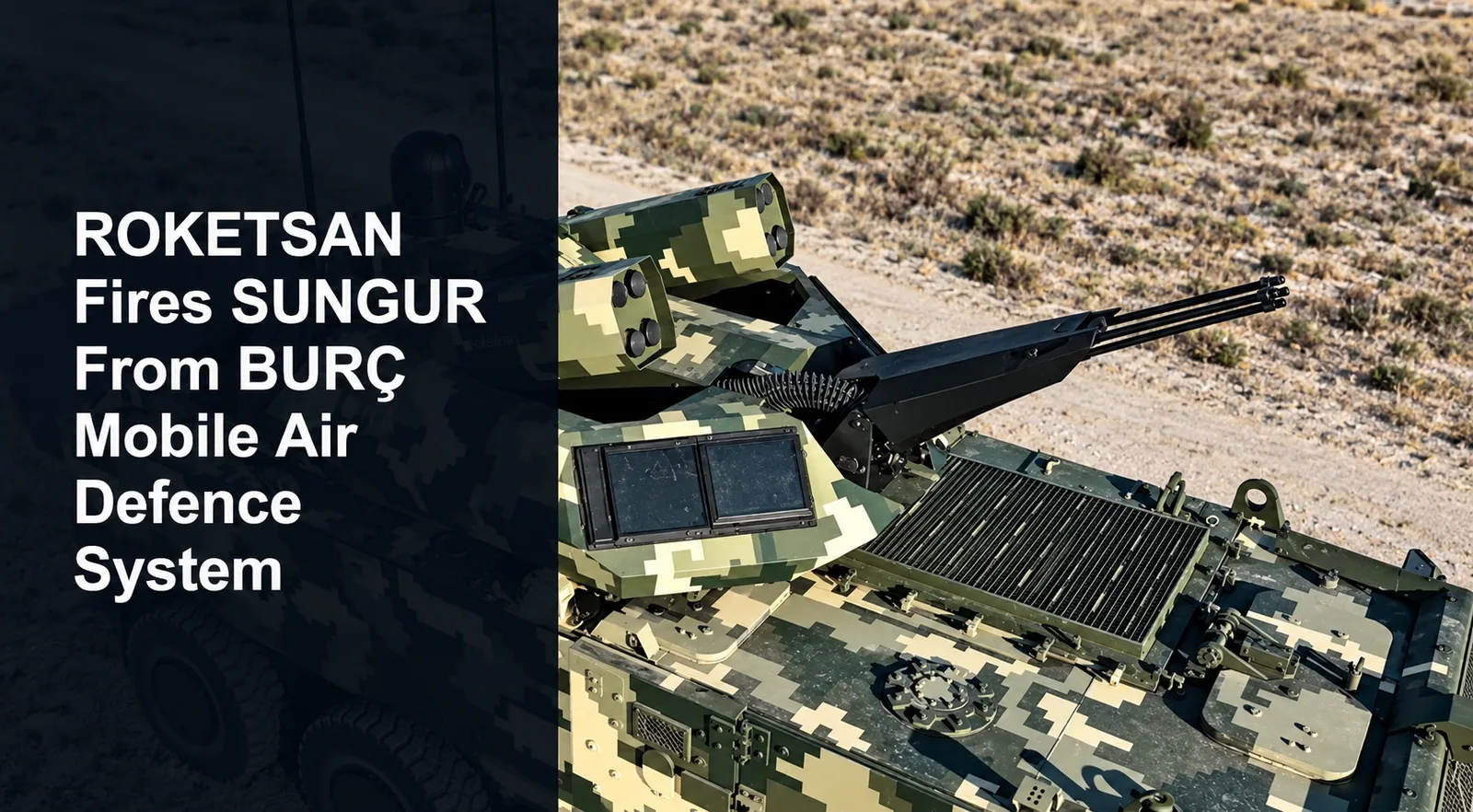
ROKETSAN has conducted a SUNGUR missile firing from the BURÇ mobile air-defence system, advancing integration of the company’s very-short-range missile with a mobile ground-based air-defence platform. The milestone is significant because BURÇ is intended to combine missiles, a cannon, onboard sensors and network connectivity in one manoeuvrable system, but the firing remains a test event and does not by itself establish operational fielding.
SUNGUR firing validates the missile layer
The 14 September 2026 radar item reports that SUNGUR was fired from BURÇ and hit its target on the first firing. ROKETSAN’s own BURÇ technical material identifies eight SUNGUR missiles as the system’s primary armament, alongside a 20 mm or 30 mm cannon as the auxiliary weapon. The company describes BURÇ as a mobile ground-based air-defence system intended to provide 360-degree surveillance, fire-control data and engagement capability against unmanned aircraft, helicopters and fixed-wing aircraft.
ROKETSAN lists SUNGUR as an imaging-infrared, lock-on-before-launch, fire-and-forget missile with an advertised maximum range of 8 km. Those published specifications describe the missile family; they should not be read as confirmation that every BURÇ firing profile has completed qualification. The latest event is best understood as evidence that the launcher, fire-control chain and missile can be exercised together in a live firing sequence.
BURÇ combines guns, missiles and onboard sensors
BURÇ is built around a layered short-range engagement concept rather than a missile-only launcher. ROKETSAN’s product literature describes a 360-degree stabilised turret, active and passive surveillance sensors, an electro-optical/infrared suite, identification friend-or-foe equipment and datalink connectivity. That configuration is intended to give the vehicle both a stand-alone mode and the ability to connect to a wider command-and-control structure.
The architecture is relevant to current counter-UAS and low-altitude defence requirements because a cannon and a guided missile solve different parts of the engagement problem. A gun can provide a lower-cost close-in option against some targets, while SUNGUR extends the engagement envelope against aircraft, helicopters and unmanned systems. The value of the firing is therefore not simply that another SUNGUR was launched, but that the missile function is being demonstrated within a multi-effector mobile system.
Integration milestone, not operational acceptance
The maturity distinction is important. A firing test demonstrates that a defined configuration worked under the test conditions, but it does not establish that the full system has completed qualification, entered serial production, been formally accepted by a service or reached initial operational capability. ROKETSAN has displayed BURÇ publicly for several years and has continued to refine the platform, including unmanned configurations shown at IDEF 2025.
For Türkiye, BURÇ could occupy the manoeuvre-force and point-defence layer beneath longer-range systems such as HİSAR and SİPER. Its relevance to the broader Steel Dome concept is strongest when the vehicle can exchange track and engagement data with other sensors and command nodes, rather than operating as an isolated weapon station. The current firing therefore supports the technical case for integration, while leaving procurement and fielding status to be confirmed by the relevant authorities.
Implications / Next
The next meaningful milestones would be additional firings across different target sets and engagement geometries, formal qualification of the selected configuration, production or procurement announcements, and verified service acceptance. Any disclosed quantity, customer, delivery schedule or operational status should be reported only when confirmed by ROKETSAN, the Presidency of Defence Industries or the Turkish Armed Forces. Until then, the 14 September event is a useful but bounded indicator of programme progress: the missile layer has been exercised from the BURÇ system, while the broader path to fielding remains to be demonstrated.