CBWP Moves From Model to Full-Size Demonstrator
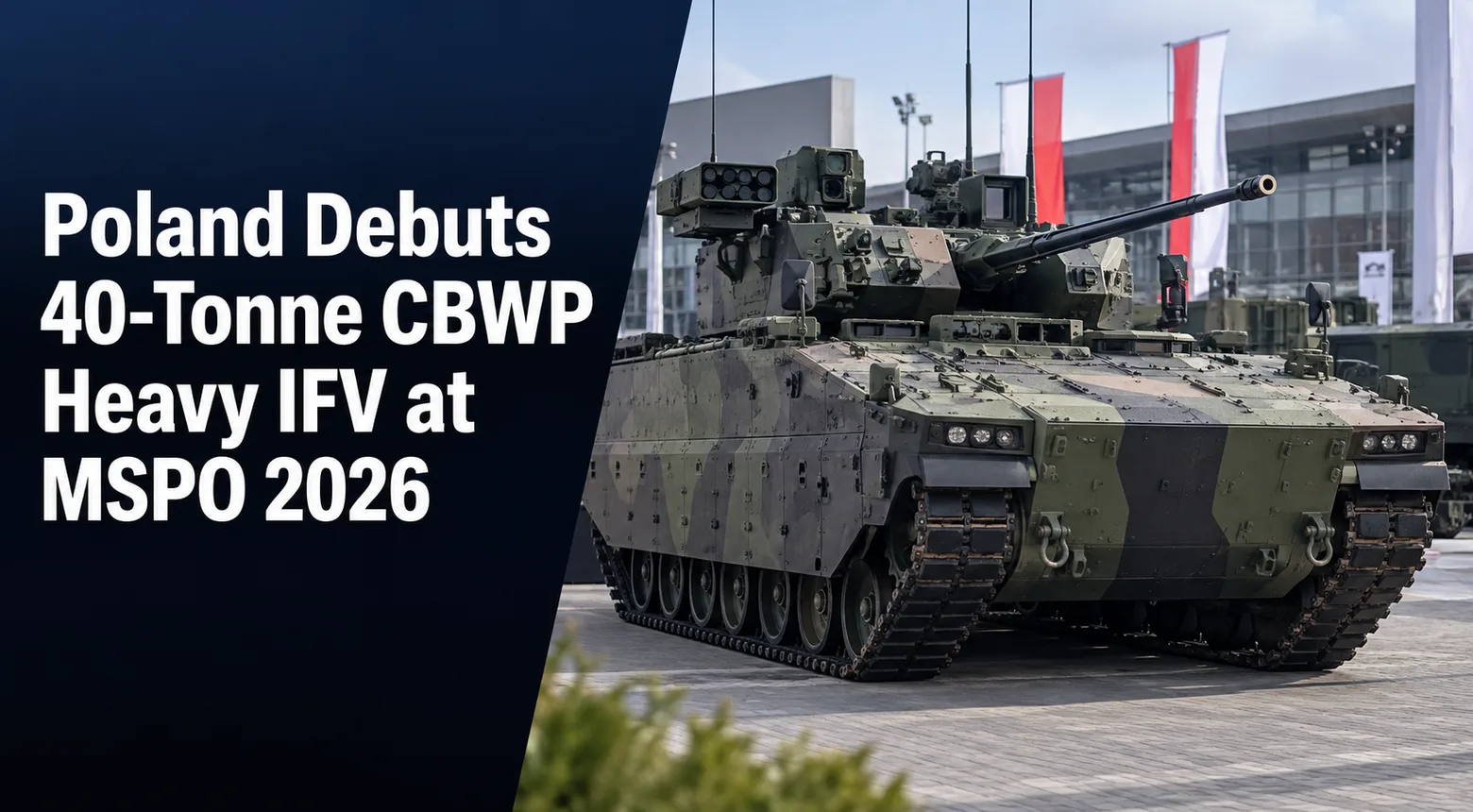
Polska Grupa Zbrojeniowa and Huta Stalowa Wola unveiled a full-size demonstrator of Poland’s new Ciężki Bojowy Wóz Piechoty, or CBWP heavy infantry fighting vehicle, at MSPO 2026 on 8 September. The vehicle represents a clear step beyond the scale model shown during the previous exhibition cycle and gives the Polish programme a physical platform for mobility, protection, turret-integration and crew-layout work. Exhibition material places the vehicle above 40 tonnes and gives it an engine rated at more than 1,000 hp.
The programme is intended to complement rather than simply replace Poland’s lighter amphibious Borsuk IFV. By removing an amphibious requirement and accepting greater vehicle mass, designers can allocate more weight and volume to ballistic protection, mine protection, anti-drone survivability and growth margin. That makes CBWP more suitable for operating closely with main battle tanks in high-intensity combat, where survivability against artillery fragments, mines, top-attack weapons and direct fire can outweigh the mobility advantages of a lighter platform.
ZSSW-30 Gives Poland a Common Firepower Architecture
The demonstrator is fitted with the ZSSW-30 remotely controlled turret, already central to Poland’s modern mechanised-vehicle plans. The turret combines a 30 mm cannon, advanced sights and anti-tank guided-missile integration, giving the heavy platform a firepower architecture that can share training, ammunition and sustainment logic with other Polish vehicles. Commonality is strategically valuable because it reduces the number of unique subsystems that the Army must support across a rapidly expanding armoured fleet.
For the CBWP, however, the integration challenge extends beyond simply mounting an existing turret. A heavier vehicle designed for close cooperation with tanks must manage power generation, electronic architecture, sensors, communications, active-protection growth and thermal-management demand while retaining room for crew and dismounts. The demonstrator phase is therefore important because it allows Poland to validate whether the platform has enough physical and electrical margin for the protection and situational-awareness systems likely to be required before serial production.
Poland Is Building a Two-Tier Mechanised Fleet
The appearance of a heavy IFV alongside Borsuk points toward a differentiated fleet rather than a one-size-fits-all solution. Lighter amphibious vehicles remain valuable for mobility, river crossings and formations that need lower strategic weight, while a heavy IFV can accompany Abrams and K2-class tanks in the most demanding assault and defensive missions. This mirrors a wider NATO trend in which several armies are accepting heavier infantry vehicles to increase protection after combat experience in Ukraine highlighted the vulnerability of lightly protected troop carriers.
The industrial implications are also important. Huta Stalowa Wola is expanding from artillery and Borsuk production into a broader tracked-vehicle portfolio, while PGZ is trying to retain a high share of national design and manufacturing work. If CBWP progresses into a large Polish Army order, it could sustain domestic production across hulls, turrets, electronics and lifecycle support for decades. That would make programme scale and production-rate planning as important as the demonstrator’s technical specifications.
Implications / Next
The next phase is prototype development and formal testing rather than immediate serial production. Polish reporting indicates ambitions to move into prototype and factory-test work before later procurement decisions, with serial production discussed as a possible 2029 objective if negotiations and trials proceed successfully. Those dates should be treated as programme targets, not guaranteed service-entry milestones.
The decisive questions will be protection standard, active-protection integration, troop capacity, mobility under combat load, cost and the number of vehicles Poland ultimately intends to buy. If the programme survives those trade-offs, CBWP could become the protected infantry component of Poland’s heavy brigades and another major pillar of the country’s expanding domestic armoured-vehicle industry.