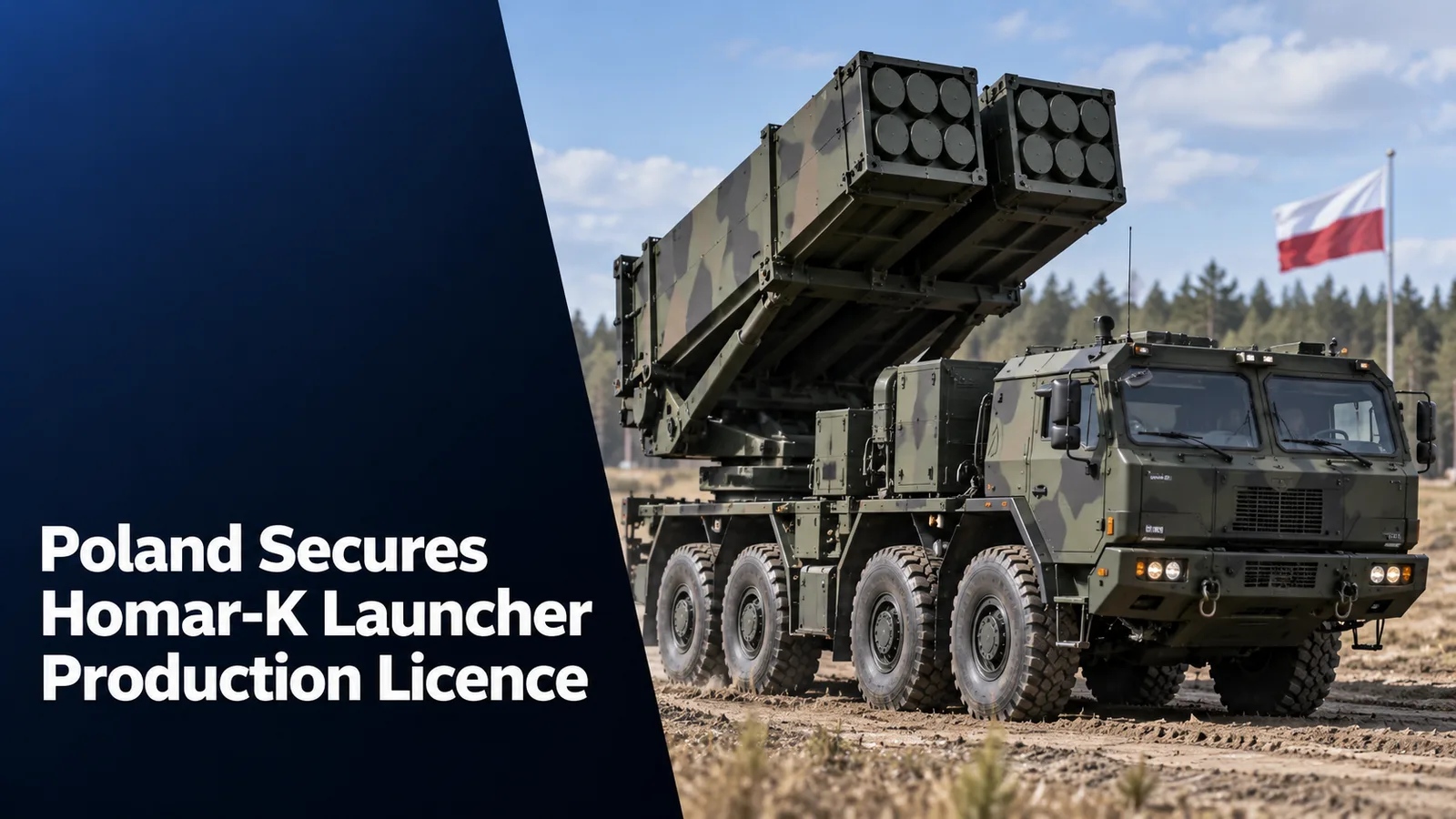
Poland's Armament Agency and Hanwha Aerospace signed a licensing agreement at MSPO on 8 September 2026 covering technical documentation and rights connected with Homar-K multiple rocket launcher modules. Targi Kielce states that the Polish State Treasury will be able to use the documentation to manufacture selected spare parts and conduct final assembly of Homar-K launcher modules. The licence may subsequently be passed to sublicensees in Poland's defence industry.
The New Agreement Transfers Rights Rather Than Additional Launchers
This is an industrial-localisation milestone, not a new launcher-quantity award. Dziennik Zbrojny links the agreement to earlier Homar-K implementation contracts, including the 24 April 2024 deal for 72 launcher modules. No new quantity or contract value was disclosed for the licensing action itself, so it should not be presented as an additional batch of 72 systems.
Local Assembly Extends Poland's Control of the Sustainment Chain
The practical value of technical documentation is that Polish companies can perform a larger share of manufacturing, assembly and future maintenance without relying on a foreign prime for every part or process. Dziennik Zbrojny reports that the localisation framework covers the ability to produce hundreds of selected spare parts and develop transport-launch containers for 122 mm rockets. Those details sit within the broader programme and show how launcher localisation can expand beyond final assembly.
Such rights matter over a long service life because fleet readiness is often constrained by small components, repair data and engineering authority rather than by the availability of complete new launchers. A domestic supply chain can shorten response times and create more options for configuration management, although licensed production still requires qualified facilities, tooling, workforce and quality assurance.
Homar-K Is Becoming an Industrial Ecosystem in Poland
Poland has pursued localisation around the K239 Chunmoo-derived Homar-K system through domestic Jelcz chassis, Polish command-and-control integration and plans for local rocket production. The latest launcher licence adds another layer by bringing documentation and assembly rights into the national industrial base. The result is a programme that is increasingly structured around sustainment and production sovereignty rather than simple import of complete Korean systems.
That strategy can improve resilience and create export opportunities, but it also increases the integration burden across Polish and South Korean partners. Configuration control becomes especially important when launchers, vehicles, ammunition and command systems are produced by several organisations. Industrial autonomy is valuable only if the resulting fleet remains technically coherent and supportable.
The Next Milestone Is Qualified Polish Production
The agreement gives Poland legal and technical rights, but the real production milestone will be the first qualified launcher modules and spare parts manufactured under those rights. Sublicensing to specific Polish companies, completion of tooling and workforce qualification, and acceptance of locally assembled modules will provide stronger evidence of industrial maturity than the signing ceremony alone.
Future reporting should also separate launcher-module localisation from the separate rocket-production joint venture and from procurement of additional Homar-K batteries. These are linked elements of the same ecosystem, but they involve different contracts, companies and maturity stages. The 8 September agreement is best described as a licence and technology-transfer step that enables subsequent domestic production.
The licensing step also changes the economics of long-term support. Local manufacture of selected parts can reduce overseas lead times and create domestic repair options, but it requires demand sufficient to keep tooling, workforce and quality systems active. Poland will therefore need to align future orders and sustainment planning with the industrial capacity created under the licence.
Implications / Next
The next publication-grade milestone will be the first independently verifiable event that changes the programme status described above, such as a delivery, acceptance event, production start, exercised option, operational test or formal fielding decision. Defence Agenda will continue to separate these maturity stages and will not treat an announcement, contract or first test as proof that the full capability has already entered operational service.